
@Walrus 🦭/acc $WAL often referred to simply by its token ticker WAL, is a native cryptocurrency and the economic heart of an ambitious decentralized storage and finance protocol built on the Sui blockchain, designed to reimagine how data is stored, accessed, governed, and monetized in the Web3 era. At its core, Walrus aims to solve some of the most persistent challenges in decentralized technology by blending secure, cost-efficient data storage with programmable smart-contract logic, staking and governance, and incentives that encourage broad participation and network growth.

The philosophy behind Walrus is rooted in the belief that data should not be siloed within centralized silos controlled by a handful of tech giants, but instead should be trustworthy, censorship-resistant, and fully under the control of users and developers. Rather than storing files in one place, or even simply mirroring them across multiple servers, Walrus breaks large files often referred to as “blobs” in decentralized storage terminology into smaller pieces using advanced erasure-coding techniques. These encoded fragments, sometimes called slivers, are then distributed across a global network of independent storage nodes. Thanks to this approach, the system is able to reconstruct original files even if a significant portion of the network goes offline, offering resilience far beyond traditional replication methods while reducing overall storage overhead.
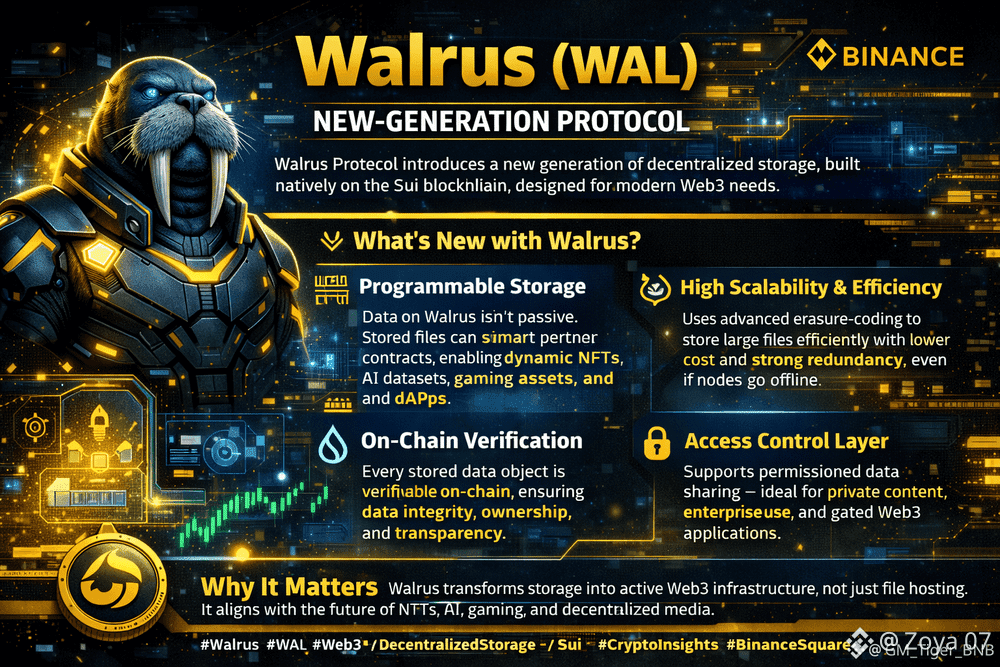
Integration with the Sui blockchain is central to Walrus’s design. Instead of storing blob data directly on-chain, Walrus utilizes Sui to anchor metadata, coordinate storage operations, and manage payments and proofs of availability through smart contracts. The storage space itself is tokenized as Sui objects, allowing developers and users to own, transfer, and program storage resources just like any other digital asset. This deep integration with Sui also means that blobs are bound to addresses on the blockchain, and every storage action from uploading a file to extending its lifetime happens within the secure, decentralized environment that Sui provides.
The WAL token has multiple functions within this ecosystem. It serves as the medium for payments when users upload and store data, it is used to stake and delegate within Walrus’s delegated proof-of-stake (dPoS) consensus mechanism, and it grants holders voting rights in protocol governance. Storage node operators must stake WAL tokens to participate in the network and be eligible to store blobs, and delegators can allocate their tokens to trusted operators in exchange for a share of the rewards. At the end of each epoch an interval over which the network periodically reconfigures nodes, distributes rewards, and evaluates performance tokens are minted and distributed to contributors based on their role and reliability. This incentivization structure aligns economic interests with network health, security, and long-term sustainability.
Walrus’s technological innovation goes beyond simple data distribution. Its proprietary encoding scheme, often referred to as Red Stuff, is engineered to minimize storage redundancy while ensuring rapid data recovery even when much of the network is unavailable. Combined with proofs of availability that storage nodes must periodically produce and verify, the system maintains strong guarantees that data is both present and intact without exposing the contents themselves. Rather than requiring full replication, where every node stores every file, slivered encoding and decentralized verification significantly cut costs and improve scalability.
From the perspective of use cases, Walrus is positioned as a foundational layer for everything from decentralized applications that require robust backend storage, to media distribution platforms that want to host images and videos without centralized dependencies, to enterprise-scale archival systems and even AI datasets that need verifiable, immutable data sources. Because storage resources are programmable, developers can build markets where data is an asset that can be bought, sold, rented, or integrated into complex smart-contract workflows. This makes Walrus particularly attractive for applications where data provenance, availability, and cost efficiency are as important as security and decentralization.
Privacy and security are also integral to Walrus’s vision. While the protocol itself focuses on the availability and verifiability of data, encryption layers can protect the contents of stored files so that even though metadata and proofs are public on Sui, the actual data remains confidential until accessed by authorized parties. In the context of decentralized finance (DeFi), this can extend to confidential DeFi operations, including private swaps, anonymous yield farming, and shielded transactions that protect user identities and strategies while remaining auditable and trustless.
The project’s growth has been bolstered by significant community and institutional interest. During its early development phases, substantial funding reportedly over $140 million in private token sales helped accelerate infrastructure development, tooling, and ecosystem expansion. Strategic backers included major crypto investors, signaling confidence in Walrus’s long-term potential as an infrastructure layer. As the protocol transitioned from testnets to mainnet in 2025, WAL began trading on major exchanges, increasing liquidity, accessibility, and real-world engagement with the token and the network it underpins.
Governance in Walrus is genuinely decentralized: token holders and delegators vote on critical parameters such as reward emission rates, slashing conditions for underperforming nodes, storage pricing, and protocol upgrades. By embedding governance directly into economic participation, the protocol ensures that its evolution reflects the collective interests of those who stake their resources and reputation on its success.

Walrus’s architecture and tokenomics illustrate a fundamental shift in how blockchain infrastructure can be built: decentralized, efficient, and programmable, with economic incentives tightly woven into both storage provision and protocol governance. Its focus on large file storage, resistance to censorship, and interoperability with smart contracts make it a compelling alternative to traditional cloud solutions and existing decentralized storage networks. By treating data as a programmable asset and embedding it within a broader economic framework, Walrus advances the vision of Web3 as a space where users retain control over their data, development communities flourish, and decentralized applications can scale without compromise.


