The US–Iran conflict is sending ripples across global financial markets—and crypto is no exception. Traders and analysts are closely monitoring Bitcoin, Ethereum, and stablecoins as geopolitical tension drives both fear and opportunity.
What nobody discusses is how crypto reacts differently from traditional markets during such conflicts. It’s not just a safe-haven play—flows and positioning tell a more nuanced story.
I’ve been tracking on-chain and exchange data for the last few days. What keeps nagging me is how volatility spikes are paired with selective accumulation, not wholesale panic.
Geopolitical Risk Meets Crypto Liquidity
In theory, international conflict pushes investors into safe-haven assets like gold or the USD.
In practice, crypto behaves both as a risk asset and a hedge.
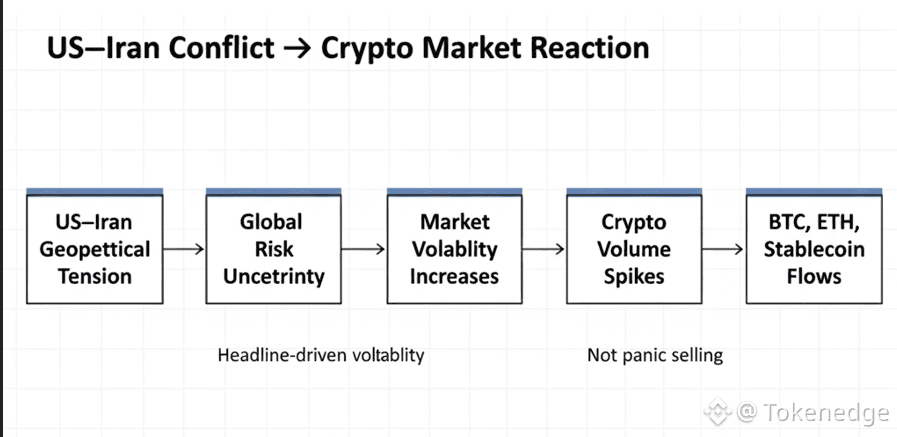
Bitcoin (BTC) has seen sudden volume surges, especially in Middle East and US exchange inflows.
Ethereum (ETH) trading shows similar patterns, but with more short-term sell-offs during initial spikes.
Stablecoins are quietly absorbing liquidity as traders rebalance portfolios, seeking to preserve capital amid uncertainty.
The gap here is crucial: narrative optimism vs. capital positioning. Markets may read headlines bullishly or fearfully—but real flows often tell a different story.
Technical Observations
BTC has held above its 200-day moving average despite a brief dip during news spikes. Support levels around $28,500–$29,000 have been tested twice but held firm.
ETH is trading just above $1,800, facing resistance near $1,900–$1,920. High-volume clusters suggest traders are using these zones for tactical entries and exits.
On-chain activity shows wallets associated with institutions and high-net-worth traders are moving coins to exchanges, hinting at hedging strategies rather than panic selling.
This is a critical nuance: crypto volatility is not always indiscriminate. Understanding flow dynamics is key.
Short-Term Scenarios
Imagine the conflict escalates subtly over the next few weeks.
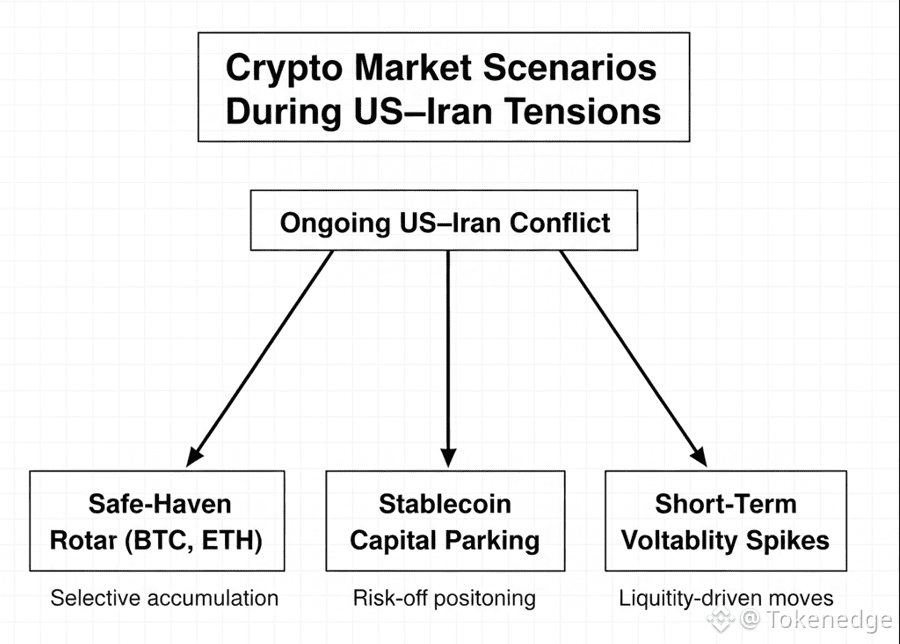
Safe-Haven Rotation: BTC and ETH could see small spikes followed by consolidation. Traders may use dips to acquire positions, causing short-term swings but not sustained drops.
Liquidity Stress: Increased stablecoin demand may slow down leveraged positions, reducing market velocity and suppressing large swings.
Geographic Hotspots: Exchanges in the US, Middle East, and Asia will see concentrated trading, reflecting both fear-driven and opportunistic moves.
The technical setup suggests short-term volatility, but the structural support of major coins remains intact.
Practical Takeaways for Traders
Monitor BTC and ETH support zones closely—these act as anchors amid geopolitical uncertainty.
Track stablecoin flows—they are early indicators of risk-off behavior.
Watch for whale positioning—large transfers to exchanges often precede short-term corrections, not necessarily long-term market collapses.
Avoid trading purely based on headlines; narratives often lag capital flows.
In short, volatility is expected. But disciplined monitoring and understanding of flow, support, and liquidity will separate opportunistic traders from reactive ones.
Bottom Line
The US–Iran conflict is a reminder that crypto markets are sensitive to global events, but not irrational. Price reactions are nuanced, driven by positioning, not panic.
Traders who read flows, on-chain activity, and technical structures alongside geopolitical news will navigate these uncertain times better than those chasing headlines.
Crypto, in this environment, is less about emotion and more about strategy, timing, and capital preservation.