
Most blockchains compete for attention. Plasma competes for invisibility.
While much of crypto focuses on attracting users through incentives, narratives, or speculative upside, Plasma starts from a quieter assumption: money already moves, and crypto should not slow it down. XPL by Plasma isn’t designed to make people feel like they are “using a blockchain.” It’s designed to make value move so smoothly that the underlying system fades into the background.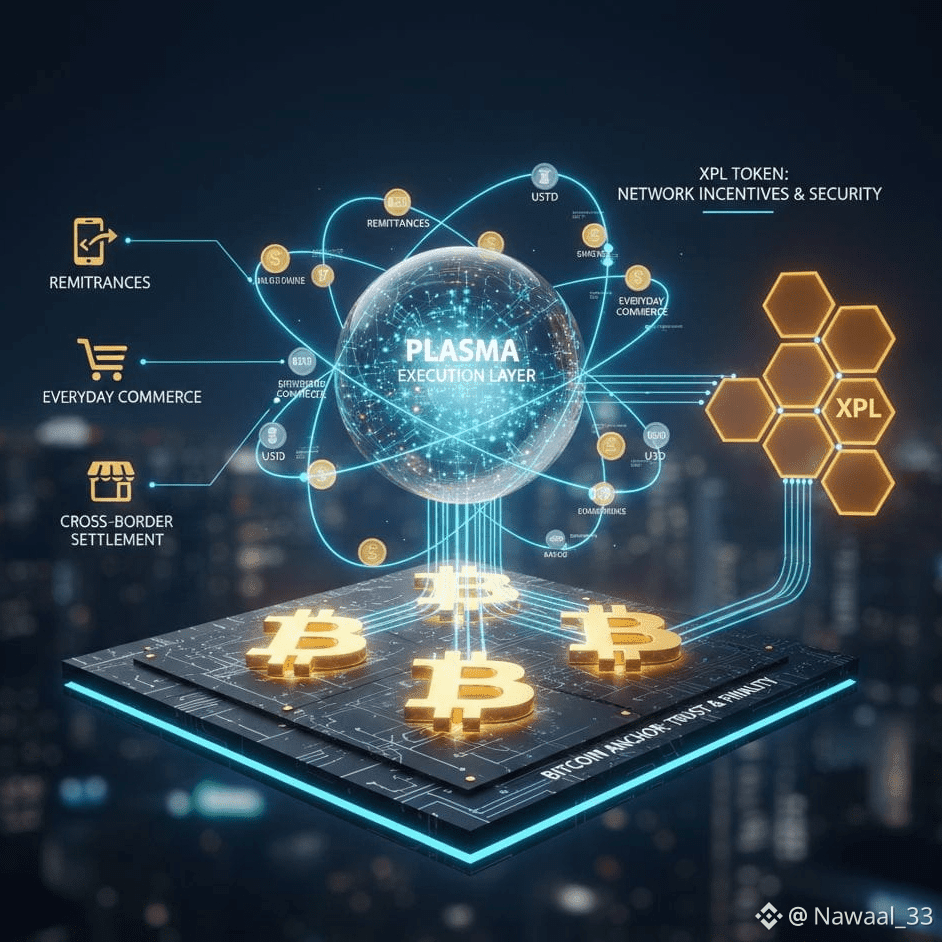
That difference changes everything.
Stablecoins as Core Infrastructure, Not Liquidity Tools
In most ecosystems, stablecoins are secondary. They arrive after the chain launches, once volatility scares away real usage and builders need a unit of account that behaves like money. Plasma reverses this logic. Stablecoins especially USDT are not integrations or add ons. They are the system’s starting point.
This matters because stablecoins are no longer niche crypto assets. They are used for payroll, remittances, treasury management, cross-border settlement, and everyday commerce in regions where traditional banking fails to move fast or cheaply. Plasma doesn’t treat this as an edge case it treats it as the norm.
By designing the network around stable value from day one, Plasma aligns itself with how economic activity already functions, rather than trying to reshape behavior through volatility driven incentives.
Gasless Transfers and the Psychology of Money Movement
Gasless USDT transfers are often described as a UX improvement, but their real impact is behavioral.
When users don’t see fees, calculate costs, or pause before confirming a transaction, the act of sending money becomes instinctive. It stops feeling like a financial operation and starts feeling like communication. That shift changes usage patterns entirely. Payments become frequent, casual, and embedded into daily activity rather than reserved for “important” moments.
This is where Plasma’s design becomes quietly radical. It doesn’t try to educate users about blockchains it removes the need to think about them at all.
And when crypto stops demanding attention, adoption stops being ideological and becomes practical.
Fee Abstraction and the Reallocation of Control
Removing gas fees doesn’t remove economics. It reorganizes them.
On Plasma, transaction costs are sponsored, abstracted, and handled at the infrastructure level. This creates a seamless experience, but it also shifts power away from individual users and toward operators, service providers, and institutions that manage transaction flow.
This mirrors how modern financial systems work. Consumers don’t negotiate settlement fees when using cards or payment apps, yet those hidden costs shape entire industries. Plasma doesn’t pretend to avoid this dynamic. Instead, it embraces it openly.
The result is not pure decentralization, but functional coordination a system optimized for scale, reliability, and predictable behavior rather than ideological purity.
Bitcoin Anchoring: Separating Trust From Speed
Plasma’s Bitcoin anchoring is often discussed as a security layer, but its deeper significance lies in architectural separation.
Bitcoin becomes the layer of finality and trust the place where history is settled and cannot be rewritten. Plasma becomes the execution layer where payments, transfers, and stablecoin activity happen quickly and cheaply.
This division reflects a growing realization in crypto: no single layer can efficiently handle both absolute security and everyday usability. Plasma accepts this trade-off rather than fighting it.
Stablecoins operate as the connective tissue between these layers, inheriting Bitcoin’s credibility while remaining flexible enough for real-world payment flows. It’s a structure that feels less like a blockchain experiment and more like financial infrastructure engineering.
XPL’s Role: Coordination Over Speculation
In this system, XPL does not compete with stablecoins for attention. It doesn’t try to be money. It enables money.
XPL’s purpose is to align incentives, secure the network, and support the infrastructure that allows stablecoins to move efficiently. Its value is tied to usage, settlement volume, and network reliance not hype cycles or speculative narratives.
If Plasma grows, XPL gains relevance through necessity. If Plasma fails to deliver utility, no branding or marketing can compensate. That clarity is uncomfortable—but honest.
What This Means for Crypto as a Whole
Plasma exposes a tension the industry often avoids: most users don’t want decentralization they want reliability.
Gasless environments challenge fee-based DeFi models. Invisible infrastructure challenges wallets built for power users. Stablecoin-first systems challenge token-centric narratives that dominate crypto discourse.
Plasma doesn’t argue against decentralization it simply deprioritizes it where it interferes with outcomes. In doing so, it reframes crypto not as a rebellion against finance, but as an upgrade to how value already moves.
Infrastructure That Wins by Being Unnoticed
Plasma doesn’t feel like it’s trying to change how people think about money. It’s trying to remove itself from the thought process entirely.
By anchoring trust to Bitcoin, centering stablecoins, and abstracting complexity, Plasma is building something closer to financial plumbing than a blockchain community. It may never dominate headlines or trend on social media but systems like this rarely do.
If crypto’s future is less about convincing users to care, and more about quietly supporting economic activity at scale, Plasma’s approach may prove more influential than louder, more visible projects.
Sometimes, the most powerful systems are the ones you forget are even there.

