

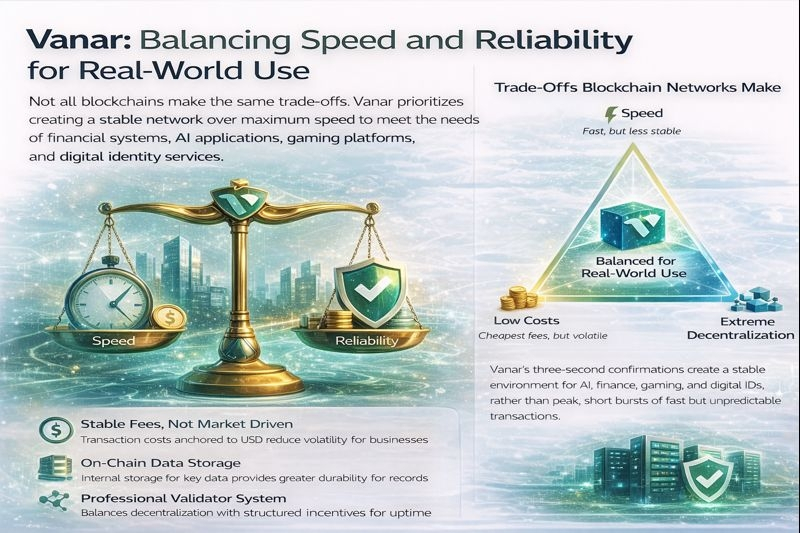
Trade offs are inherent to every blockchain, many times, they are not even obvious to the consumer. Some blockchains pursue only the speed of a transaction, some pursue the lowest cost, while others may pursue extreme decentralisation. The Vanar blockchain has its own approach and intends to produce a stable environment for real world application instead of producing a high speed transaction system for short bursts. This is important because a large portion of the world’s digital infrastructure has graduated from an experimental stage to its current state. Financial systems, gaming platforms, artificial intelligence applications and digital identity systems expect a blockchain to have a constant stream of processing for thousands of automated activities every second. Therefore, when reviewing the features and benefits of a blockchain today, we should consider not only the performance of the blockchain but also the degree of reliability they will show over time.
The architecture of the Vanar blockchain exhibits a conscious balance between speed and reliability. The time from submitting a transaction to receiving confirmation that it has been permanently recorded on the blockchain is about three seconds. This is sufficiently fast for most real time applications; however, the three second confirmation time allows the manufacturer to maintain the stability and reliability of their product. Some blockchains strive for an instantaneous confirmation time, which may result in instability of operations or potentially fragmented agreement among the various players on the system.
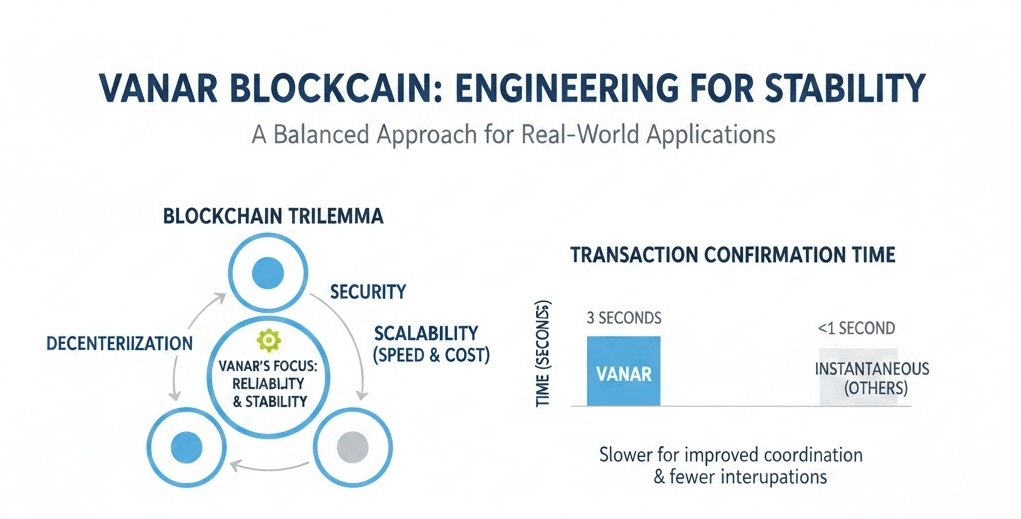
Vanar's decision illustrates a practical mindset, slower response time in exchange for improved coordination and fewer interruptions. Consistency is typically the most important value for institutions that operate payment flows or manage assets, therefore, speed alone is not always so important.
Additional tradeoffs are seen with Vanar's approach to transaction fees. For many networks, transaction fees have market driven fluctuations based on supply and demand, while this generates high level of efficiency in the short run, it creates uncertainty for businesses systems. Vanar, instead of allowing transaction fees to be market driven, anchors transaction fees to US dollars; this reduces instability in costs and allows businesses to create accurate budgets. For some businesses, forecasting projections of expenses is critical; however, if future fees are not predictable, they represent a risk. Stable pricing facilitates compliance planning as well as creates an environment to support long-term contracts; blockchain transforms from being a speculative marketplace to being an operational tool.
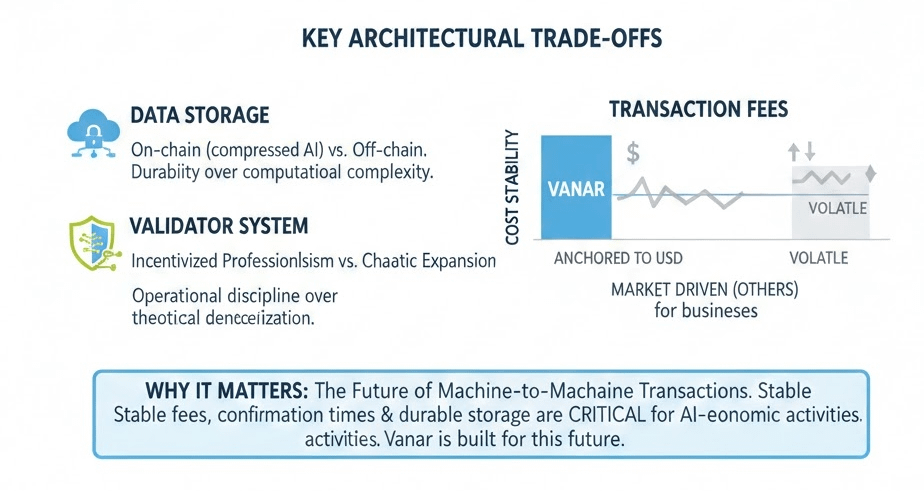
A practical design decision was made when determining how to store data on the blockchain solution. For many blockchain solutions today, most of their ecosystems still utilize off chain data storage. This creates a hidden dependency, if the external system experiences an outage, the blockchain will continue to operate and process successfully, however, there would be no ability to retrieve any of the associated data. Using artificial intelligence and reducing the size of the data by compressing it, Vanar is able to provide a way for the storage of important files within the blockchain itself in a compressed format. This minimizes the possibility of there being any external points of failure. In exchange for greater durability, Vanar's technology has a higher level of computational complexity. Therefore, when managing identity records, legal documents, or digital assets that will remain for a long period of time, that added expense will often be well worth it.
In addition to its use of AI, Vanar’s validator system is designed to balance decentralization with operational discipline. While the validators have a responsibility to confirm transactions and to secure the network, if there are too few validators, then this creates a risk of concentration; however, if there are too many poorly performing validators, then their overall reliability will be weakened. Vanar’s validator system encourages professional level participation through the use of structured incentives that reward both high levels of uptime, as well as long term commitment to the network. As a result, the design is intended to support the establishment of stable infrastructures rather than rapid, chaotic expansion. For many institutions assessing blockchain networks, a predictable system of governance and professional operations will often be more attractive than theoretical decentralization without accountability.
Developments in the marketplace doing more and more to reinforce why we should consider the trade offs associated with these actions. Machine to machine transactions will continue to rise dramatically as we see AI systems begin working directly with each other. Research has released by industry experts that indicate machine driven economic activities in ten years could represent a substantial dollar volume of transactions captured on the blockchain. For machine to machine transactions to work, the machines that carry them must have networks with stable transaction fees and confirmation times, and layers of storage without fragility. Networks suitable for machine to machine activity will have durability to allow their continued operation. Vanar's design decisions closely follow this transition.
So Viewing the above trade offs as positive because they exemplify engineering rigor rather than marketing visions. They demonstrate an emphasis on infrastructure that has to run quietly on a daily basis, rather than a rush to produce headline numbers as a result of marketing techniques. The networks built to support blockchain applications will be the ones that ultimately prevail; not the networks developed to achieve a loud presence.
