

Peak performance numbers are commonly used as benchmarks when discussing modern blockchains. Questions such as What are the maximum number of transactions per second (tps) that this network can perform under stress testing? and How many tps can the network achieve at peak performance, under highly optimised laboratory conditions? are valuable, however they fail to address an underlying user requirement. Users of financial infrastructure do not judge infrastructure by its behaviour for a few short seconds in times of stress, they judge it based on its ability to reliably perform day in and day out, over extended periods of time. This is the long term perspective we have built around the design of Plasma, placing greater emphasis on the reliability of the pipeline than on short term bursts of speed.
Transaction pipelines in traditional finance operate more like public utilities than race cars. Banks, clearing systems, and payment processors need to be able to perform a steady state of business, they cannot count on periodic, unpredictable peaks in performance followed by subsequent instability. Plasma has adopted this same philosophy, instead of designing for extraordinary bursts of performance, the architecture has been designed for the continued delivery of consistent throughput as a result of ongoing demand. As such, there is a reduced operational shock to the network, which eliminates the cycles of congestion and recovery experienced by many of today’s traditional high speed systems following traffic spikes.
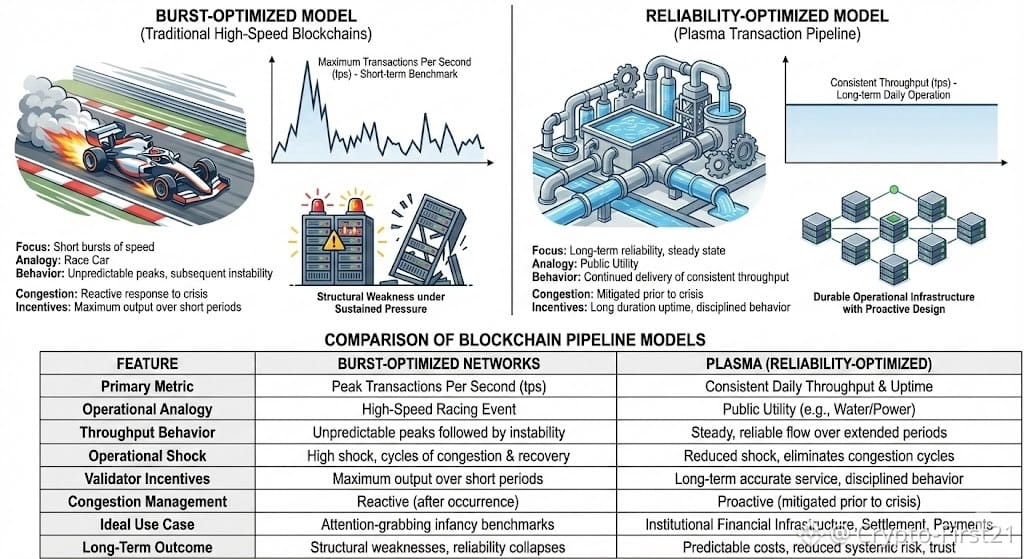
Structural weaknesses are often hidden by burst performance. Although networks may appear to be very fast during short benchmarks, when overload occurs on the validator due to overloaded hardware or failed coordination from high sustained pressure, the network's reliability collapses. Plasma treats transaction execution as an ongoing shared resource that needs careful management throughout time. Validator incentives are aligned with long duration uptime and disciplined behavior. thus, they provide support for continuous participation, smoother coordination, and predictable transaction costs.
When comparing the way pipelines operate, the difference becomes even clearer. The burst optimized model operates like a highway designed for high speed racing events. In this way, bursts are well facilitated during high speed bursts and are poorly equipped to handle traditional commute times. The Plasma pipeline has been designed to facilitate the motion of commuters. Steady flow, efficient scheduling, and minimal resource consumption are a priority within this model. Therefore, congestion is mitigated prior to becoming a crisis instead of having to react to the congestion after its occurrence. This type of proactive design is necessary for organizations that rely on consistent settlement cycles and operational certainties.
Long term reliability of a pipeline from a technical standpoint depends on proper coordination between validators. All nodes need to have access to each other, keep up to date with one another, and respond to requests while under constant use. Plasma directly rewards this ongoing reliability by providing incentives for long term accurate service and resource management rather than just maximum output over short periods of time. As time passes, these factors will reduce systemic risks such as, for example, cascading failures against one another, latency that is not predictable, and fee volatility. The financial industry must be able to operate without surprises, which is why the architecture of the Plasma network was designed with conservativeness as a key consideration.
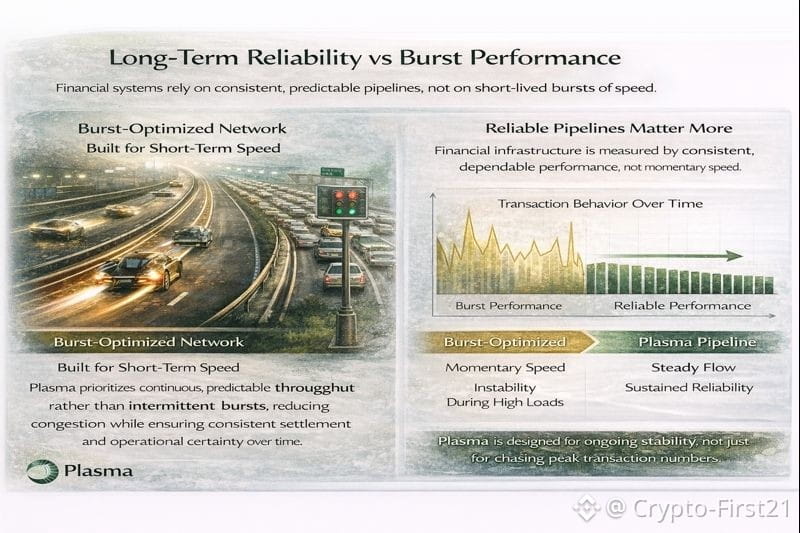
As institutional investment into blockchain becomes more prevalent, market behaviour is reflecting a change in these priorities as well. Institutions will typically choose a particular network based upon how much predictability exists with the amount of time that the network has been up and how stable its operations are when they have access to it. Networks that only have been optimised for speed tend to draw attention in their infancy, will often find it difficult to maintain performance once they start to have real users using them. Plasma has taken a different approach by placing an emphasis on durability during the initial phases of development it is creating a pipeline that institutions can utilise as models against which to conduct audits, and thus utilise in creating long term workflows. Winning benchmarks is of lesser concern than establishing itself as being an infrastructure that is dependable.
The economic side of reliability is also an aspect of consistent reliability. Institutions can plan their operational costs and business decisions simply by having consistently predictable behavior. Reliability is significantly influenced by sudden spikes in volume, congestion, or emergency scaling items. These types of uncertainties translate into financial risk for all financial institutions. Therefore, by operating on a consistent basis through Plasma's pipeline model, institutions can have confidence that their transaction processing and overall business practices are behaving more like a reliable utility, rather than being subjected to speculative activities in a network. This consistent reliability supports real-world applications of financial activities, such as treasury management, cross-border settlements, and industrial or large volume payment processing.
Design philosophies reflect how real financial systems evolve. Many networks have been watching how sustainable results create a more utilitarian experience for the user while creating a much better value proposition for the company running the service. Therefore, after witnessing numerous financial service networks chasing highly speculative speed metrics, it is now clear that durable operational infrastructure has a much higher impact on customer satisfaction than eye catching service speed.
Thus, the Plasma network represents a maturational phase for the network industry. Changing the focus from very experimental fast-paced network metrics to operational reliability opens up new opportunities for financial institutions to utilize these networks on an ongoing basis. Ultimately, by treating financial execution as a continuous network resource and not just a competition of speed metrics, the Plasma network will help develop and build on the reliability necessary for long term sustainable financial institutions throughout the world to rely on daily these types of infrastructures. Moreover, due to the reliability of these types of systems, this, too, may be more transformational than any speed number that has made the headlines due to creating and integrating into, the economic fabric of our planet.

