
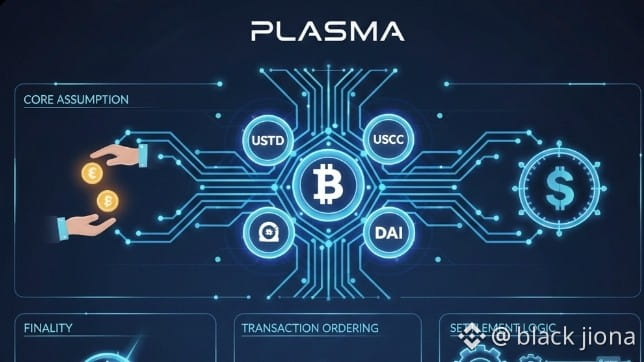
Plasma and the Behavioral Assumptions Behind a Stablecoin-Native Blockchain
When I try to understand a new Layer-1 protocol, I no longer start with throughput charts or benchmark comparisons. I start with a quieter question: what does this system assume people will actually do? Not what they might do in ideal conditions, but how they behave when money is involved when networks stall, when volatility spikes, when compliance matters, and when transactions are not experiments but obligations.
Viewed through that lens, Plasma reads less like a technological flex and more like a set of deliberate behavioral assumptions about how stablecoins are already used in the real world.
1. The Core Assumption: People Use Stablecoins as Money, Not as Assets
Most blockchains still treat stablecoins as just another token. Plasma does not. Its design starts from the assumption that stablecoins are the primary unit of account for its users, not a secondary instrument riding on top of a speculative system.
This matters because people behave very differently when they are transacting in money versus holding an asset. When someone sends USDT to pay a supplier, rebalance treasury exposure, or settle a remittance, they are not optimizing for yield or composability. They are optimizing for correctness, finality, and predictability.
Plasma’s stablecoin-first gas model and gasless USDT transfers implicitly acknowledge this. They assume that users do not want to think about acquiring a separate volatile token just to move dollars. That friction is tolerable for developers and traders; it is unacceptable for payment operators and retail users in high-adoption regions.
The behavioral bet here is simple: if friction exists at the point of payment, people will route around the system entirely.
2. Finality as a Human Constraint, Not a Performance Metric
Sub-second finality is often marketed as speed. I think that misses the point. Finality is not about how fast a transaction propagates; it is about when a human can stop worrying.
In payments, there is a sharp difference between “likely settled” and “settled.” Accounting systems, merchant reconciliation, treasury operations, and compliance workflows all depend on a clear moment after which reversal is no longer a question. PlasmaBFT’s design reflects the assumption that ambiguity is operationally expensive.
People build habits around certainty. If finality is probabilistic or delayed, they introduce buffers: confirmation counts, manual reviews, reconciliation delays. Those behaviors slow systems down regardless of raw performance. A protocol that provides fast, deterministic finality is really offering something more subtle: it reduces the number of human checkpoints needed to trust the system.
That is not a technical optimization; it is a behavioral one.
3. Transaction Ordering and the Psychology of Fairness
Ordering is one of those topics that only becomes visible when it fails. In financial contexts, users expect that transactions are processed in a way that feels neutral and legible. If ordering appears manipulableor worse, extractivetrust erodes quickly, even if balances remain correct.
Plasma’s design choices around consensus and Bitcoin-anchored security suggest an awareness of this psychological layer. Anchoring security assumptions to Bitcoin is not about inheriting hash power; it is about borrowing a social consensus that already exists. Bitcoin is widely perceived rightly or wronglyas politically neutral and resistant to discretionary interference.
That perception matters. People are more willing to settle value on systems they believe no single actor can quietly reorder or censor transactions without consequence. Even if most users never articulate this explicitly, their behavior reflects it: liquidity pools migrate, payment flows shift, institutions hesitate.
Neutral ordering is not just a protocol property. It is a trust surface.
4. Offline Tolerance and the Reality of Global Payments
One of the most under-discussed assumptions in blockchain design is network reliability. Many systems implicitly assume constant connectivity, low latency, and homogeneous infrastructure. That is not how stablecoins are used globally.
In high-adoption markets, users often experience intermittent connectivity, device constraints, and inconsistent access to infrastructure. Systems that degrade gracefullyrather than failing abruptlyalign better with how people actually operate.
Plasma’s emphasis on settlement clarity over constant interaction reflects an understanding that not every participant is online, synchronized, or attentive at all times. What matters is that when they do reconnect, the ledger state is unambiguous and defensible.
Humans are surprisingly tolerant of delay. They are not tolerant of confusion.
5. Settlement Logic Over Expressiveness
Full EVM compatibility ensures interoperability, but Plasma’s orientation feels different from general-purpose smart contract platforms. The emphasis is not on maximal expressiveness, but on predictable settlement behavior.
That reveals another behavioral assumption: most financial actors do not want to invent new logic every time they move money. They want well-understood primitives that behave consistently under stress. Complexity is acceptable at the edges, but settlement itself should be boring.
This is where Plasma’s design seems disciplined. It does not reject composability, but it constrains the mental model. Transactions are meant to be understood by operators, auditors, and counterpartiesnot just by developers.
Financial systems fail more often from misunderstood interactions than from insufficient features.
6. Interoperability as Social Compatibility
Interoperability is usually framed as a technical bridge problem. I think it is more accurately a social coordination problem. Systems interoperate when institutions trust that state transitions elsewhere are meaningful, final, and enforceable.
By centering stablecoins and aligning security assumptions with widely accepted anchors, Plasma lowers the cognitive cost of integration. It asks fewer questions of external systems. That restraint makes interoperability easier not because the pipes are wider, but because the semantics are clearer.
When a ledger says “this dollar is settled,” other systems can act on it without hesitation.
Closing Reflection: Discipline Over Maximalism
Plasma does not attempt to be everything. That may frustrate those looking for narrative breadth or experimental novelty. But discipline is itself a design choic one rooted in assumptions about how humans behave when systems are put under real economic pressure.
By prioritizing settlement clarity, stablecoin-native UX, and neutrality over spectacle, Plasma accepts tradeoffs. It narrows its scope. It limits certain forms of expressiveness. In return, it gains something harder to measure but easier to feel: operational trust.
In protocol design, as in finance, restraint is not the absence of ambition. It is the decision to optimize for correctness over excitement and to build systems that people can rely on when they stop theorizing and start transacting.