
Is patience really an edge in crypto, or just a word traders repeat during quiet markets? Plasma’s current phase offers a clear, data-driven answer. As Bitcoin (BTC) continues to command market structure through dominance and liquidity control, many altcoins have entered extended consolidation ranges. This environment has historically shifted attention away from short-term price expansion toward infrastructure, security models, and long-horizon utility. Plasma’s relevance during this phase is rooted in its design focus rather than promotional cycles, aligning with a market that is increasingly filtering noise from signal.
The broader crypto market has shown that when BTC stabilizes or moves within defined ranges, speculative capital rotates more cautiously. High-volatility tokens often lose volume first, while infrastructure-oriented narratives maintain steadier engagement. Plasma fits this pattern by remaining connected to Ethereum’s security assumptions through its scaling framework, which emphasizes off-chain efficiency without abandoning on-chain finality. This positioning places Plasma in a category that tends to benefit from patience-driven market behavior rather than momentum chasing.
Recent ecosystem discussions have reinforced this shift. Scaling conversations have moved away from raw throughput comparisons and toward settlement guarantees, exit mechanisms, and trust minimization. Plasma’s architecture, originally built to address congestion without sacrificing security, aligns closely with these priorities. As newer scaling solutions compete on speed, Plasma continues to be referenced for its conservative and security-first approach, which has regained relevance as risk awareness increases across the market.
Parallel developments in adjacent ecosystems have also played a role. Privacy- and compliance-focused protocols, including ongoing updates within the Dusk ecosystem, reflect a broader infrastructure trend where regulatory awareness and secure transaction models are gaining attention. These developments indirectly support Plasma’s thesis by emphasizing robustness and verifiability over speculative experimentation, reinforcing why older but well-structured designs are being re-evaluated.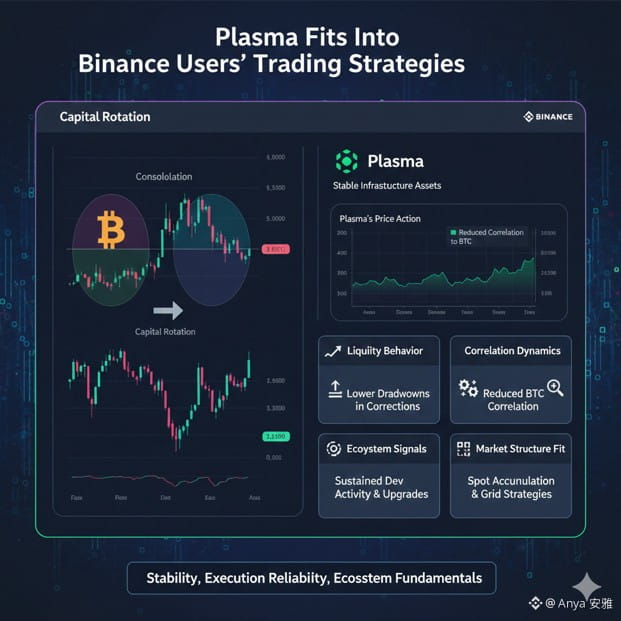
From a market behavior perspective, BTC’s influence remains central. During periods of BTC consolidation or moderate uptrends, traders historically reduce exposure to high-beta assets and increase focus on technologies tied to long-term network utility. Plasma’s trading environment reflects this dynamic, with comparatively stable engagement relative to tokens driven primarily by narrative cycles. Volume behavior across similar infrastructure assets supports this pattern.
On-chain activity trends across scaling solutions further explain Plasma’s position. Networks that prioritize predictable settlement and exit safety tend to retain developer and user interaction even when price momentum slows. Plasma’s design enables users to rely on base-layer security if needed, a feature that resonates strongly during market corrections when trust assumptions are tested. This functional reliability contributes to sustained ecosystem attention.
Comparative performance across crypto sectors highlights the same lesson. Meme-driven and hype-centric tokens often experience sharp spikes followed by equally sharp declines, while infrastructure-linked assets show flatter but more resilient curves. Plasma’s market behavior aligns more closely with the latter group, suggesting that its current phase is less about immediate appreciation and more about structural positioning within the ecosystem.
The psychology behind this shift is observable rather than speculative. As market participants mature, decision-making increasingly incorporates risk management, protocol design, and long-term sustainability. Plasma benefits from this mindset because its value proposition is technical and architectural, not narrative-dependent. This explains why interest can grow even when price action appears quiet.
Another critical factor is ecosystem memory. Crypto markets periodically revisit earlier design frameworks when new solutions expose trade-offs. Plasma’s re-emergence in discussions reflects this cycle, as newer scaling models face challenges around decentralization, trust, or governance. The market’s willingness to reassess Plasma indicates a preference for proven concepts during uncertain phases.
Ultimately, Plasma’s current phase illustrates a recurring crypto truth. When BTC dictates tempo and volatility compresses, patience aligns closely with fundamentals. Development continuity, architectural clarity, and ecosystem relevance become the real differentiators. Anya sees Plasma not as inactive, but as operating within a phase where value compounds quietly—making patience less a virtue and more a measurable market strategy.