
When I spend enough time inside a blockchain ecosystem I stop looking at speed numbers and start watching silence. Silence is where real systems show their quality. Noise can be manufactured but silence only appears when design choices are intentional. This is the frame through which I started observing Vanar Chain. Not through announcements or timelines but through how little confusion it leaves behind when things scale.
Most blockchains treat actions as events. Something is sent it propagates and the system reacts. This looks efficient until activity grows. Then the chain starts carrying assumptions it never declared. Assumptions about timing assumptions about finality assumptions about user behavior. These assumptions create hidden complexity. Over time that complexity becomes invisible work. Retries delayed settlements partial confirmations and silent reversions that never show up on charts. Users just feel friction.
Vanar feels like it was built by people who noticed this pattern early. Instead of asking how many actions can be processed it asks how many intentions can be resolved cleanly. This difference changes everything downstream. When intent is treated as a first class object the system does not rush into execution. It pauses long enough to understand what should happen and what should not. That pause is not delay. It is control.
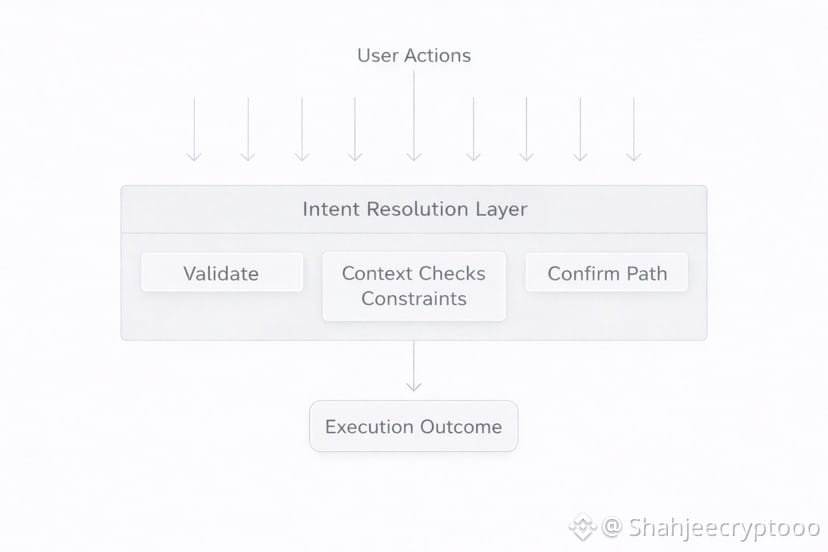
What this design does quietly is reduce decision entropy. Many chains allow execution to fan out and then spend resources collapsing state afterward. Vanar collapses intent before execution so state arrives cleaner. This is not a marketing feature. It is a systems decision. It trades peak throughput headlines for long term composability. Developers benefit first but users feel it later through reliability.
I noticed that this approach also changes how failures behave. In most networks failure happens late. The system executes then discovers something was wrong and then tries to undo it. This is expensive both technically and psychologically. Vanar prefers early failure. If something cannot resolve clearly it does not pretend. It stops and marks the boundary. This makes failure visible and contained. Over time this builds trust because surprises are reduced.
Another thing that stands out is how Vanar treats time. Many chains assume permanence by default. References are expected to live forever. Data is cached without expiry. Contracts behave like the world will not change. This works until it does not. When time finally shows up it shows up as outages migrations and emergency patches. Vanar seems more honest about time. It treats lifecycle as explicit rather than implied.
This is subtle but powerful. When expiry is acknowledged systems become easier to reason about. Dependencies are named. Rotation paths are defined. Cleanup is planned. The system stops pretending and starts managing reality. Builders can upgrade without fear. Operators can observe without guesswork. Users experience fewer abrupt changes.
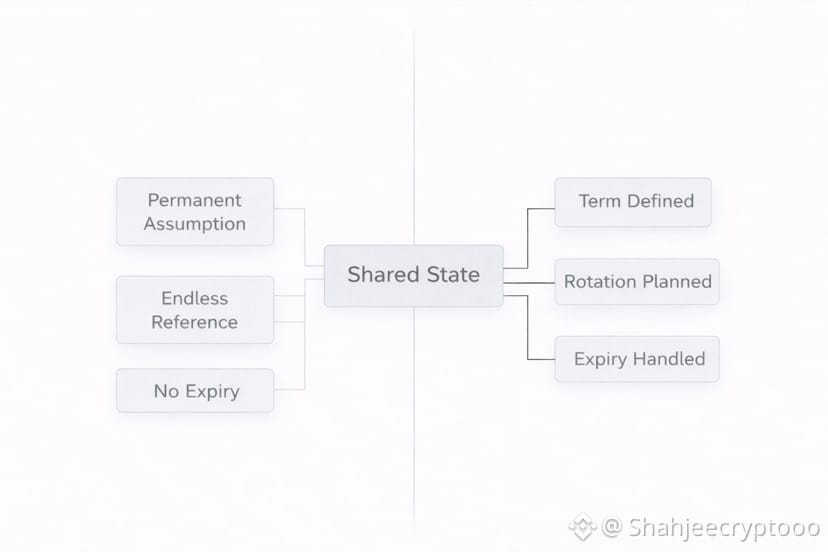
The more I looked at Vanar the more it felt like a chain designed for adulthood. Not early growth chaos but sustained operation. This is not exciting in a short cycle market but it matters when attention fades and real usage remains. Systems that survive those periods are the ones that respected complexity early.
$VANRY fits naturally into this model. It does not try to manufacture urgency. It exists as part of system participation rather than decoration. When usage grows coordination matters. When coordination matters governance matters. The token becomes a tool rather than a promise. This alignment reduces stress between incentives and architecture.
I do not think Vanar is chasing trends. It feels more like it is avoiding traps. Traps that many earlier chains fell into by optimizing for what looked good instead of what lasted. The choices here are quiet. They do not announce themselves loudly. They reveal themselves through absence of problems.
As a user this makes me comfortable. As a builder this makes me curious. As a long term observer this makes me attentive. Not because Vanar claims certainty but because it builds boundaries. It does not say nothing will fail. It says failure should be early clear and contained. That philosophy is rare and valuable.
If Web3 is going to move beyond experiments it will need chains that think like this. Chains that treat intent as meaningful time as real and complexity as something to manage not hide. Vanar feels aligned with that future not by claiming it but by quietly preparing for it.
