
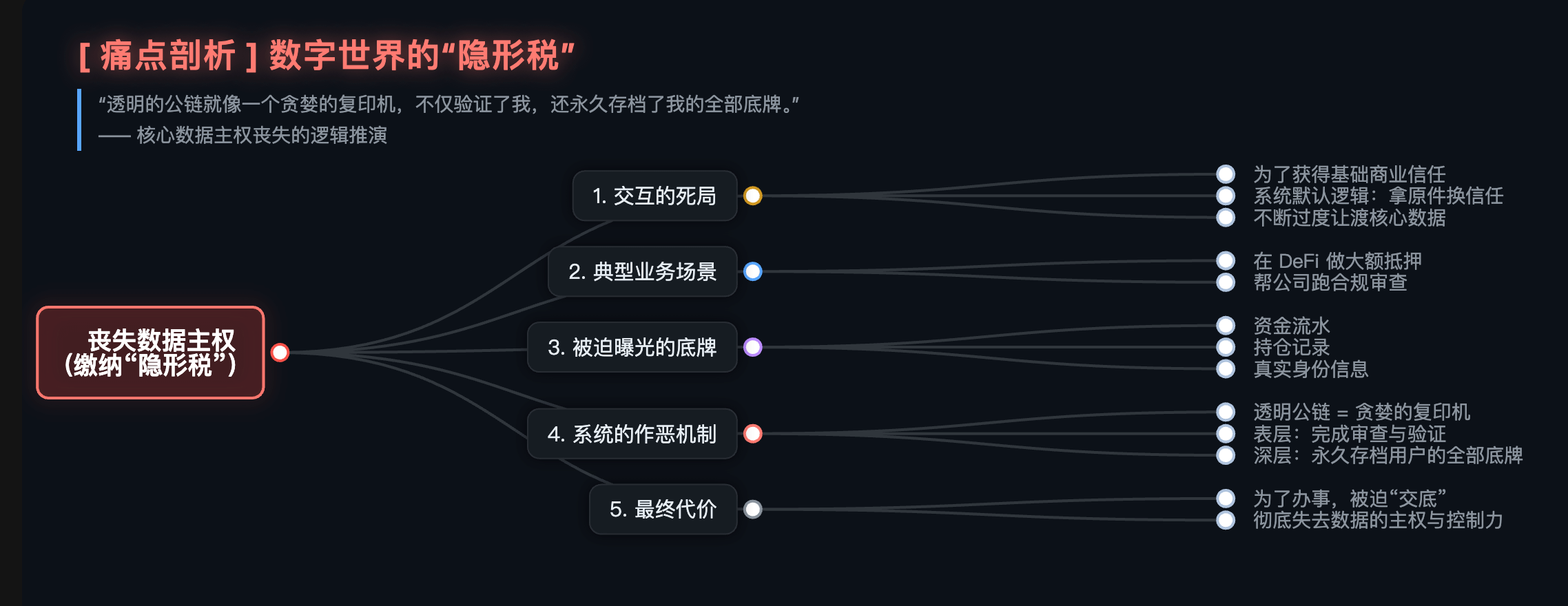
Recently, while reviewing, I found that I am silently paying a kind of 'invisible tax' every day: to gain a bit of basic business trust, I must constantly over-concede my core data.
Every time I want to make a large collateral in DeFi, or help the company run a compliance review, the system's default interaction logic forces me to 'trade originals for trust.' I have to lay out my funding flow, holding records, and even identity information on the table. A transparent public chain is like a greedy copier; it not only verifies me but also permanently archives all my bottom cards. When I am forced to 'disclose' in order to get things done, I suddenly realize: I have actually long lost the sovereignty of my data.
This is also the reason I have been recently fixated on @MidnightNetwork . I see that its truly advanced aspect lies in the fact that it has forcibly separated 'verification' from the deadlock of 'disclosure.'
I hear many people mistakenly believe that Midnight is for 'hiding,' but I think that perspective is too narrow. In my view, the core of Midnight is 'usability.' Through the underlying ZK (zero-knowledge proof) technology, I see Midnight completely flipping the trust syntax of the digital world—from 'I show you the data' to 'I prove the conclusion to you.'
Under this architecture, when an institution (or myself) needs to prove the legality of the source of funds, I no longer need to throw thick transaction flows onto a transparent public chain for everyone to scrutinize. I just need to calculate on my phone or local server and then submit a cryptographically verified 'conclusion' (for example: [My assets are compliant: TRUE]) to the entire network.
The other party obtained a solid pass, while my original ledger has not left my local device even for a bit. The necessary verification still verifies, but my original does not have to go out. This is the 'rational privacy' proposed by Midnight that I highly admire.
I am well aware that to support this shift in business paradigms, technology alone is not enough; an economic engine is also needed. That is why I am particularly optimistic about the dual-token model of $NIGHT and DUST. The public $NIGHT supports the long-term security of the network, while the automatically generated, non-transferable DUST has become my exclusive 'proof of capability' fuel. I find this design not only blocks the possibility of money laundering in gray and black industries but also allows me and businesses to turn 'doing business without exposure' into the default experience of daily operations at an extremely low certainty cost.
It has been proven that without a foundational infrastructure like Midnight that balances data privacy and anti-money laundering compliance, those trillion-level real business flows wouldn't dare to move onto Web3!
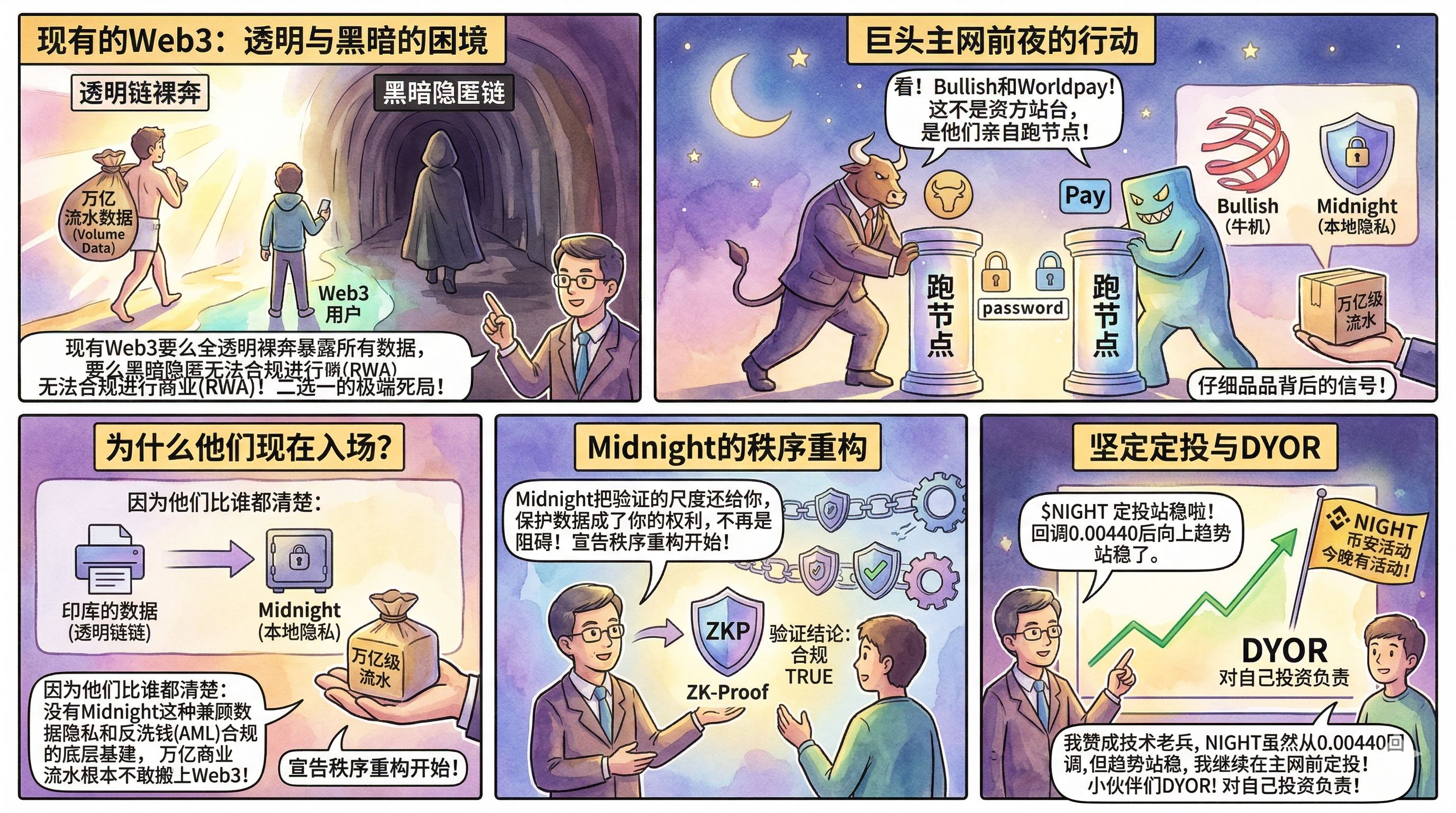
I have always believed that the true Web3 infrastructure should not force me to make an extreme choice between 'transparent exposure' and 'dark concealment.' The strong entry of Wp and Bh has already announced the beginning of this reconstruction of digital order. The hardcore value of Midnight in my eyes is that it has returned the scale of verification to me—allowing me to protect my data, no longer an obstacle to participating in business, but a rightful entitlement. I will continue to steadfastly invest in $NIGHT , although the 0.00440 pullback is considerable, Binance has a night event tonight, but you can see that the trend seems to have stabilized a bit. I will continue to invest before the mainnet launch, of course, my friends are responsible for their own investments, DYOR.
