
Honestly, I see the Sign Protocol data as of March 27, 2026, making my thumbs itch to long. With a market cap of only $52.06M and a still low price of $0.1, the narrative to soar to $1 is very enticing.
But as a trader who has often been rolled by the waves, I don't just look at candlesticks. Mathematically, to reach one dollar, the market cap has to break $1.64 billion!! That's crazy, a 30x increase!
But behind the dream of hitting the jackpot, there's a big hole that always makes me think.
If the price is that expensive, is there anyone willing to use its attestation feature? Or will it just end up being a decoration on the exchange?
The problem is like this, utility tokens are like gasoline. If gasoline prices increase tenfold, you will think twice about going out, right? Now, if the team @SignOfficial doesn't close the gas fees or their service costs, the price of $1 could backfire.
Vitalik Buterin once remarked like this:
"A secure blockchain but costing the daily wage of ordinary people won't become a global speculation."
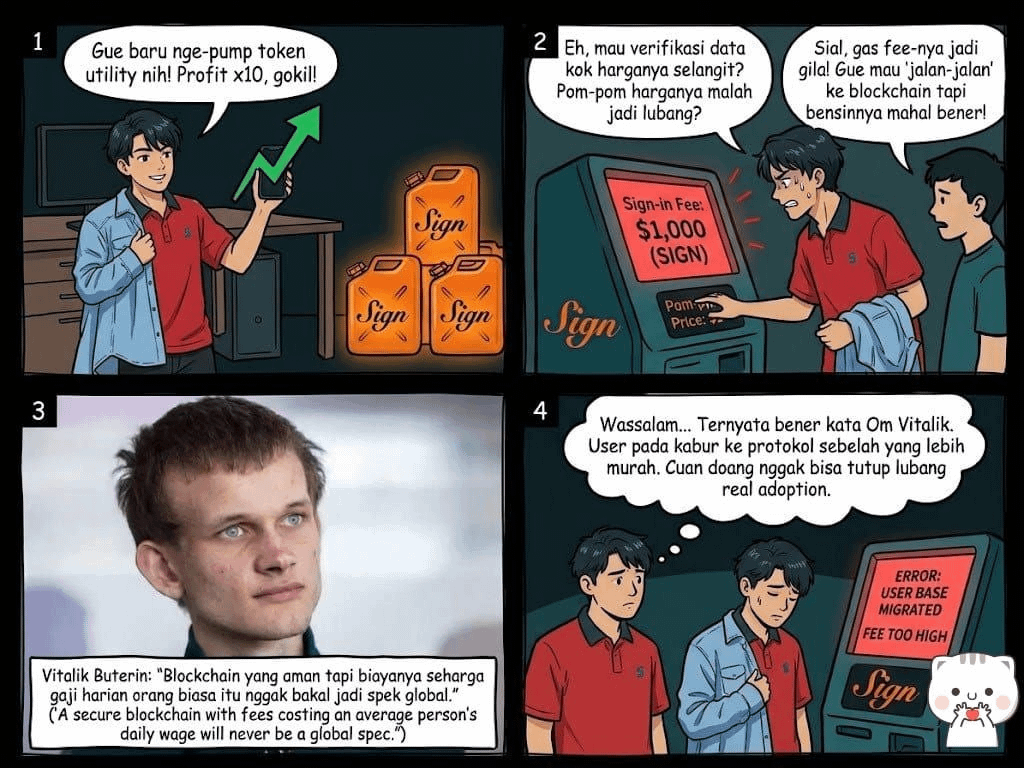
If verifying data requires sky-high costs due to the token price being pumped, then that's it. People will move to the cheaper and more rational protocol next door.
Let's compare this to Google. Why do we still use Gmail or Search even though they have paid services like Google Cloud? Because they wisely provide options that remain free yet still make us dependent.
Google has become a primary digital necessity. The Sign Protocol should be like that as well.
They need to ensure that their truth verification feature becomes a basic necessity that doesn't break the user's wallet.
Let's not let the token price skyrocket kill the ecosystem because no one can afford the fees.
I see the 24-hour trading volume of SIGN on Binance reaching $60.9M, which is larger than its own market cap. This indicates that the market is very aggressive, but most are just day trading or speculating. It doesn't necessarily mean that these people are actually using the protocol for work.
This is a big hole that their team must close. They need to prove that SIGN is the genuine technology that people need. Not just a coin for 'pump and dump' schemes. As Naval Ravikant puts it, money is a social exchange tool; if the price isn't reasonable to use, people will look for another tool.
Now, let me shift our perspective a bit to the Middle East. There, countries like the UAE and Saudi Arabia are crazy about building a digital economy. They really need a trusted identity and contract system, or attestation, to support their smart city concepts.
This is the market for the Sign Protocol! Imagine if they could enter the digital economy circulation in Dubai or Riyadh. But as I said, entrepreneurs there are very calculative. They won't want to use a system with unpredictable costs just because there's a whale manipulating prices in the market.
The Sign team needs to act quickly to close this gap. They need a stable fee mechanism, perhaps by using a clever credit or burn system. So, whether the coin price goes to $1, $10, or back to $0.1, the cost to use the feature remains stable in dollars. If that's the case, innovators and investors in the Middle East can comfortably build applications on top of Sign without fear of bankruptcy due to gas fees.
This isn't just about technicalities; it's about empathy for small developers who want to progress.
Trading with logic means we care about the sustainability of the ecosystem. We want profit, but we also want the projects we hold to be useful for many people.
Sergey Nazarov from Chainlink once said, Trust is not about today's price, but about long-term consistency. If Sign only focuses on the coin price without fixing its cost infrastructure, they are just building a sandcastle that will easily collapse under bearish waves.
So, for the team @SignOfficial please, close this cost gap. Don't let the success of the coin price kill the utility of its features. Don't let users feel trapped.
We need a system that is scalable yet still wallet-friendly. Google can succeed because they are accessible; Sign should be able to too if they don't just chase numbers in the market.
The journey to $1 is a tough test. Will Sign become a digital hero in the Middle East and the world, or will it just be a bitter memory for retail traders who got stuck at the peak? The answer lies in the hands of the Sign team to close those critical gaps. As a trader, I will keep an eye on the supply and demand zones, but as a technology observer, especially in blockchain, I'm waiting for their real execution so that the features remain widely used, not just praised by speculators. If you're more into using $SIGN just for trading, what's the use of its main features? Attestation and verification of your digital asset credentials?
#SignDigitalSovereignInfra #SignProtocol #MiddleEast #TrumpSeeksQuickEndToIranWar #OilPricesDrop
