
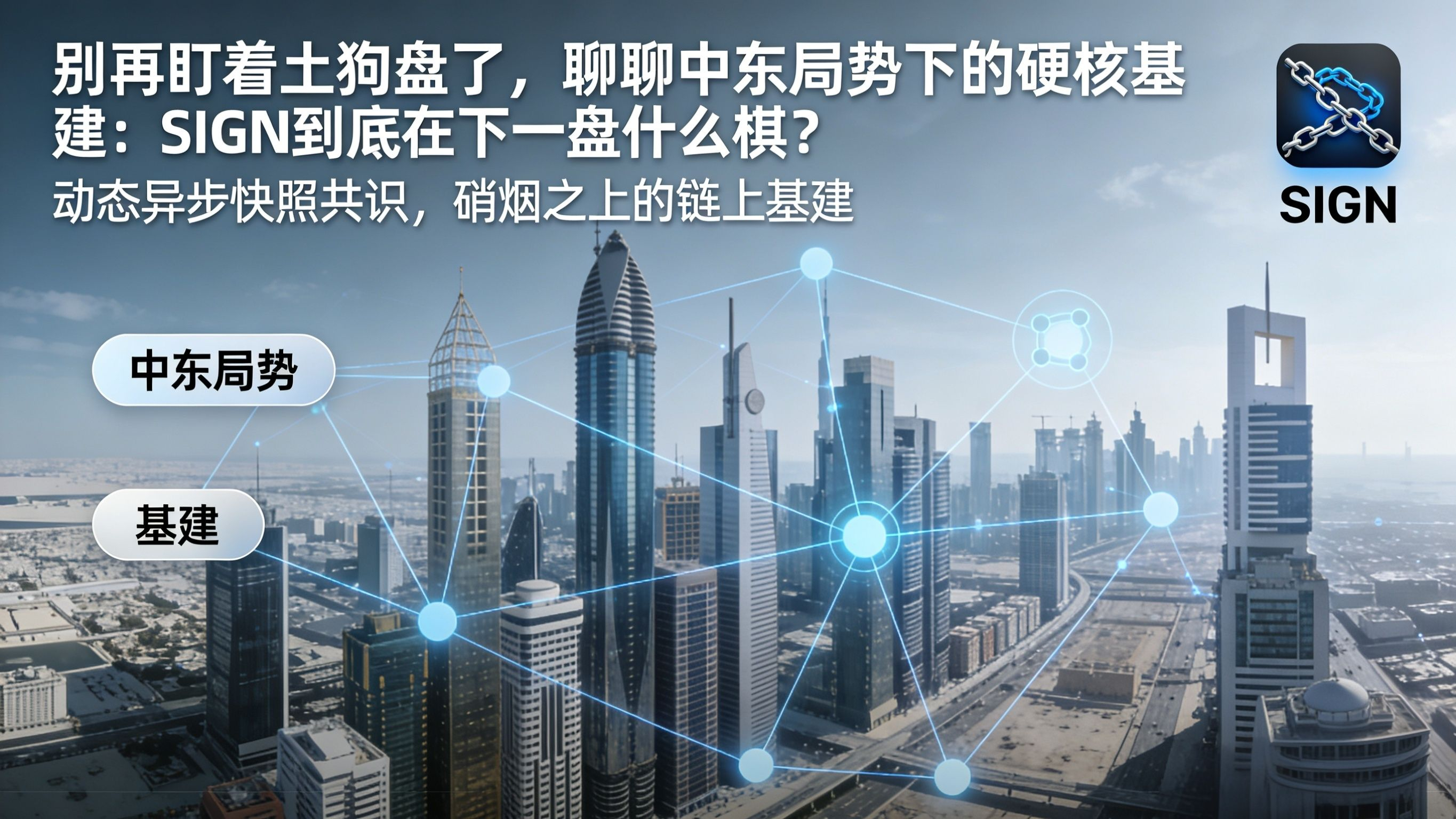
The current state of the crypto world is quite ironic. While everyone is fighting in meme coins, they lament that this circle has left nothing behind except for speculation. But in the past few days, seeing the constantly changing situation in the Middle East, I have begun to reevaluate a project that is often overlooked by many: @SignOfficial .
To be honest, when I first looked at SIGN, I thought it was just another one of those outdated projects that only repeat 'decentralization.' But after carefully studying its white paper and underlying logic, I found that this thing is quite interesting in the current geopolitical environment. It's not about some empty things, but rather solid data settlement infrastructure.
The reason this topic is worth discussing is that the current geopolitical game has evolved from simple firepower coverage to a shadow war of information and asset flow. In the Middle East, where various forces are intertwined and trust costs are outrageously high, traditional trust mechanisms have long since shattered. What you think of as a contract may be worth even less than scrap paper in the face of conflict.#Sign地缘政治基建
Here I want to discuss a technical detail hidden deeply in a white paper that has been overlooked by many: Dynamic Asynchronous Snapshot Consensus. It sounds complicated, but the principle is quite simple. Traditional chains often experience delays when processing cross-border, high-frequency changing data due to the pursuit of absolute synchronization. However, in the logic of SIGN, it allows nodes to take a 'snapshot' of the data first in an unsynchronized state, and then complete the final confirmation in a very short time through a mechanism similar to 'echo validation'. This is literally a lifesaver in regions with turbulent situations and extremely unstable network environments.
Many people ask where the growth space for $SIGN is. In fact, there’s no need to look at those superficial curves. Look at the current Middle East, sovereign funds, energy giants, and various cross-border trades; what they fear most is not losing money, but having their assets inexplicably frozen or their transaction settlement links broken. SIGN provides not just a coin, but a protocol that can operate amidst the smoke of war. When commodity trading no longer trusts traditional wire transfer systems, such resilient on-chain infrastructure becomes a necessity.
Let’s be practical; I don't like to boast when writing. The current $SIGN indeed has many shortcomings, such as its front-end interface that looks like a product from the last century, and the developers in the community are working hard without much communication, which drives people crazy. But from a different perspective, this actually shows that it hasn't been polluted by speculators who only know how to pump and dump. While everyone is playing hot potato, projects that stubbornly focus on the underlying communication and verification logic are more likely to survive in the next cycle.
Those who are constantly speculating on airdrops may not understand: if geopolitical conflicts lead to cracks in the existing financial system, what we need is a settlement system that does not rely on specific powers.$SIGN The current layout is actually paving the way for the future 'digital frontier'. Although the process is slow and may occasionally be frustrating due to technical adjustments, the logic is sound.
Lastly, I want to express that we 'digital nomads' wandering in the digital world are actually not much different from those affected by the fluctuations of the situation in the real world. We are all searching for certainty. On this planet full of uncertainties, code may be the only universal language that can bridge geopolitical divides.
The so-called wealth, if detached from the reconstruction of civil order, is ultimately just a string of meaningless hash values. Projects like SIGN essentially use logic to combat chaos and algorithms to repair the social contracts torn apart by geopolitical conflicts. If technology cannot serve the most basic needs of human survival and cooperation, then what is its purpose?