The market in the crypto space these days is simply duller than plain water. Bitcoin is fluctuating, altcoins are on a downtrend, and in the community, there's nothing but complaints and various statements of giving up.
But I was shocked last night when reviewing the on-chain treasury changes of several leading DAOs (Decentralized Autonomous Organizations) by a set of extremely abnormal data. During this period of low trading volume, several 'ancient addresses' that had been silent for half a year were locking assets into the foundational governance contract of Sign Protocol regardless of cost.
Many people will definitely argue: this project's unlocking is not over yet, the selling pressure above is so heavy, isn't it sending people to their doom to go in now?
To be honest, I used to think so too. But when I set aside the noise of K-line and delved into the new code about 'Governance Multiplier' that was merged in Sign's developer channel over the past 72 hours, I broke out in a cold sweat.
This is not a simple retail buildup at all.
This is top-tier capital on-chain, quietly building its **'governance firewall'** during this unnoticed vacuum period.
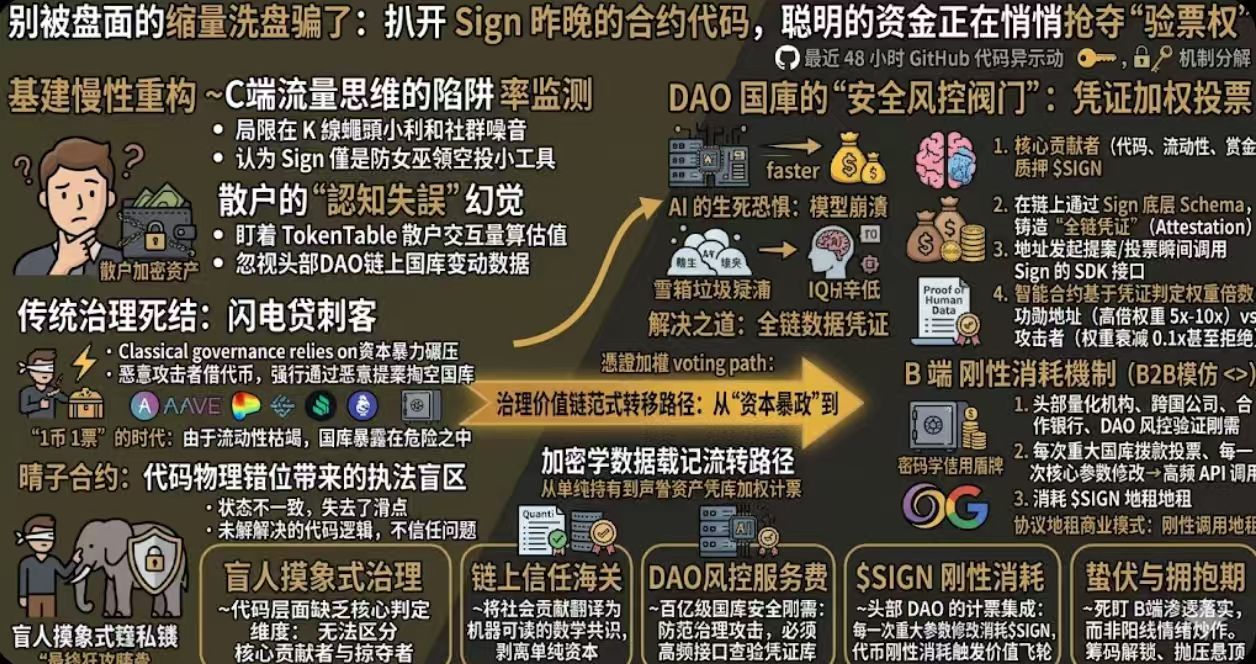
The end of the flash loan assassin: Why has the era of '1 coin 1 vote' ended?
Let’s take out the calculator and calculate an extremely painful account.
Previous on-chain governance, to put it bluntly, was 'capital dictatorship'. As long as I have money in hand, I can borrow ten thousand tokens through flash loans in the second before the snapshot, forcibly passing a proposal that benefits me but harms the project.
This logic of 'money buying power' makes countless project parties with huge treasury funds anxious every day.
What Sign Protocol is doing is directly overturning the table of this old order.
It added a very cold determination logic in the codebase: when the smart contract calculates your voting power, it no longer only looks at how many coins you have in your wallet, but will instantly call Sign's underlying interface to check your 'Reputation Assets'.
If this address is a 'new face' that just came through the cross-chain bridge, or has no historical contribution credentials (such as long-term lock-up proof, code submission records, security audit signatures) in Sign's network.
Sorry, even if you hold one million tokens, your voting weight may be directly reduced by the system by 90%.
What does this mean? It means that Sign is forcibly stripping 'money' and 'power' through immutable credentials.
In the future on-chain, the words of mere capital nouveau riche won't hold much weight; only those with Sign credential protection, the 'meritorious addresses', will hold the final say in treasury fund allocation. This reconstruction of power logic is the real reason why big funds are even willing to seize positions despite the unlocking selling pressure.
The overlooked 'protocol rent': B-end risk control is the ultimate printing machine.
Speaking of this, someone must be asking: what does this high-end governance logic have to do with the $SIGN in our hands?
This is how the accounts should be calculated.
If you only see Sign as a tool for issuing certificates to retail investors, then its ceiling is indeed low.
But what if it becomes a hundred billion-level DAO treasury, the 'ticket checkpoint' for hundreds of decentralized protocols?
These protocols managing vast amounts of capital must frequently call Sign's verification interface to prevent governance attacks. Every major proposal's voting process and every cross-chain parameter modification involves thousands of verifications against the Sign credential repository.
This enterprise-level API verification is the most stable and ruthless **'protocol rent'**.
It does not rely on the emotions of retail investors, nor does it depend on the state of the market. As long as financial activities on the chain continue, and as long as the giants still need security, this rigid consumption will continually feed back into the token's economic model.
The current low-volume consolidation is essentially a large-scale chip cleaning. Those floating chips that do not understand the underlying risk control value are leaving the market, while those whales who deeply understand the premium of 'trust costs' are quietly building their trust moats through Sign.
Strip away the noise: closely monitor these 'right-side confirmation' signals.
During this vacuum period of paradigm shift from 'tool application' to 'underlying risk control infrastructure', as rational traders, what we fear most is being scared away by short-term downturns.
Facing the current fluctuations, I have set two death commands:
First, completely blacklist those shallow indicators that only discuss airdrop hype.
Stop paying attention to how many new wool projects TokenTable has listed today. You need to focus intensely on the download volume and the correlation with third-party GitHub in the Sign developer documentation regarding 'Governance SDK integration'.
Second, make the 'governance model switch of leading DAOs' the final battle cry.
If you observe on-chain that top-ranking DeFi protocols (such as lending and derivatives) are officially announcing that their voting weight will be linked to Sign's credential system.
That means the 'ticket verification rights' transfer in the industry has been completed, and the real business spiral has started.
In this circle, the noisy tide will always recede, and what remains are those 'gatekeepers' who hide below the surface, silently controlling the pulse of on-chain credit. Before understanding this cold governance logic, hold tight to your chips, and don’t get thrown off the train by the washout of big funds before dawn.@SignOfficial