
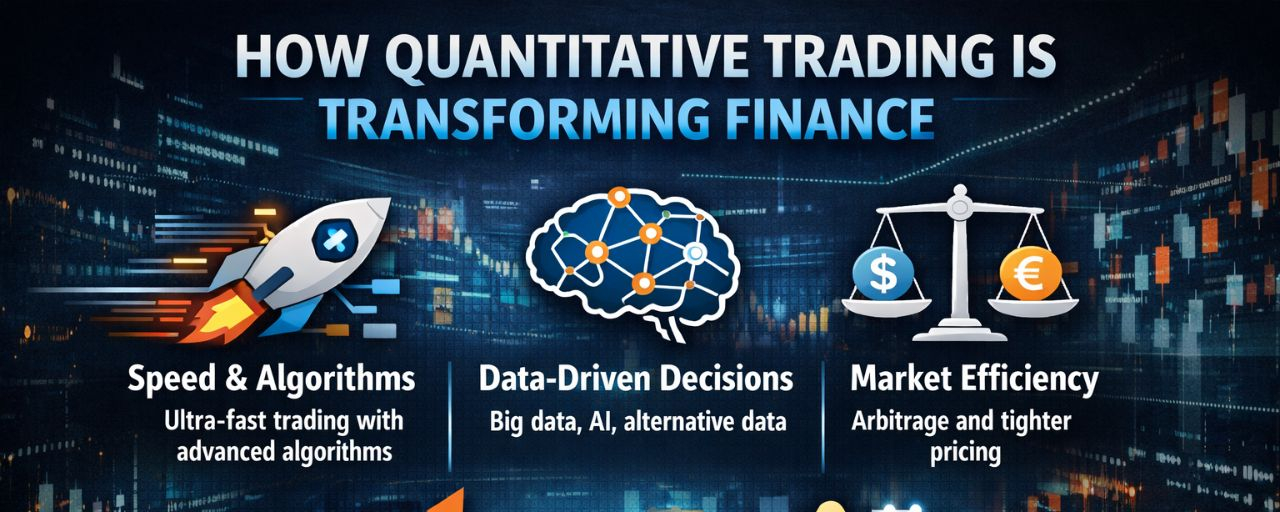
When in a market, the trading speed changes from 'humans pressing buttons' to 'machines placing orders themselves', the financial world has actually begun to be rewritten.
In the past, the public's imagination of trading was often very intuitive: traders staring at screens, analysts looking at financial reports, and fund managers making judgments based on experience, ultimately deciding to buy or sell. However, with the emergence of quantitative trading, this human-centric logic has been replaced by a colder, faster, and more systematic approach. So-called quantitative trading, simply put, is about transforming investment decisions into mathematical models, statistical rules, and program strategies, allowing computers to automatically execute trades based on data. It is not based on feelings, nor on emotions, but rather breaks down market behavior into computable, back-testable, and replicable rules.
This change not only speeds up trading but fundamentally alters the operational mode of financial markets.
First, the most direct change brought by quantitative trading is "speed." While humans are still thinking, quantitative systems may have already completed hundreds or even thousands of transactions. Especially in the field of high-frequency trading, speed is no longer just an advantage, but a condition for survival. Those who can receive market information faster, complete orders faster, and spot price differences faster can seize profits. This has transformed financial markets from the past "asymmetric information competition" into a further upgraded "millisecond-level technical competition." The winners in the market are not necessarily those who make the most accurate judgments; they may be those with the lowest latency, the strongest algorithms, and the hardware closest to the exchange's mainframe.
This also means that the core competitiveness of finance is shifting. In the past, financial institutions competed based on research capabilities, personal connections, and information sources; now, more and more are competing based on data capabilities, model capabilities, computational capabilities, and engineering capabilities. Thus, Wall Street is no longer just the domain of finance professionals; mathematicians, physicists, statisticians, and machine learning engineers are also becoming the most important group in the market. Many hedge funds no longer blindly trust star traders but are frantically hiring those who can write programs, understand probabilities, and handle massive amounts of data. To some extent, the logic of the technology industry has reshuffled the finance industry.
The second change is the significant improvement in market efficiency. One major function of quantitative trading is to quickly capture mispricings. When a temporary price difference occurs between a stock, futures, ETF, foreign exchange, or cryptocurrency, algorithms immediately step in to arbitrage, pulling unreasonable prices back into a normal range. Theoretically, this makes the market more efficient because prices reflect information faster. To some extent, quantitative trading acts like an automatic correction mechanism within the financial market, compressing mispricings that could have lasted for minutes, hours, or even longer into just seconds or even milliseconds.
But the problem lies here. Increased market efficiency means that "simple opportunities" are becoming increasingly rare. Those who previously made money by watching the market with their eyes, relying on experience to catch rhythms, and accessing information half a beat late have seen their space greatly compressed. The market has become smarter, yet also more brutal. Retail investors are now facing not only other retail investors and large institutions but an entire set of twenty-four-hour tireless, emotionless, and unhesitating trading systems that optimize themselves. This has significantly raised the competitive threshold of financial markets, amplifying the advantages of capital and technology.
Third, quantitative trading has changed the structure of liquidity. Many people will say that quantitative trading makes the market more liquid because algorithmic market makers continuously place orders, making it easier for buyers and sellers to transact. This statement is not wrong. Many markets today can maintain extremely narrow bid-ask spreads because they are supported by quantitative market-making systems. They adjust quotes continuously, making the market appear deeper, smoother, and more efficient.
However, this kind of liquidity is sometimes "present in normal times and disappears in crises." When the market is stable, quantitative models are willing to provide liquidity; but once volatility suddenly surges, the models assess the risk as too high, and the system may withdraw orders in a very short time. This is also why, in certain extreme market conditions, a liquidity vacuum can suddenly appear, with prices soaring or plummeting like a cliff. A market that appears deep most of the time can be as thin as paper at critical moments. In other words, quantitative trading improves daily efficiency but may also amplify vulnerabilities in times of crisis.
Fourth, quantitative trading has redefined "risk." Traditional investors understand risk mainly in terms of price fluctuations, deterioration of fundamentals, policy changes, and economic recessions. But in the quantitative era, risk also includes model failures, data errors, program bugs, connection delays, overfitting of parameters, and sudden changes in market structure. You may think you are trading in the market, but in fact, you are also trading the models themselves. Many strategies that look beautiful in backtesting may collapse quickly in real trading due to slippage, transaction fees, trading conditions, or black swan events. This has transformed the financial market from a game of "judging right and wrong" into a war of "system stability."
What is more frightening is that quantitative trading creates a kind of collective risk. When many institutions use similar signals, similar risk control logic, and similar stop-loss rules, once the market triggers a certain condition, everyone may simultaneously take similar actions. The models originally built to disperse risk instead cause synchronized stampedes in moments of pressure. This is also a very ironic aspect of modern finance: models were originally meant to eliminate emotions, but when many models react together, they can create even more intense market emotions.
Fifth, quantitative trading has led the financial world to start becoming "data-driven." The data influencing trading decisions now is no longer just traditional information such as financial reports, interest rates, or GDP. News texts, social sentiment, satellite images, consumption records, logistics data, search trends, and even weather and geographical changes can all become inputs for trading models. Finance is no longer just about interpreting companies and the economy; it has become a large-scale data war. Those who can collect more alternative data, who can clean and analyze it faster, and who can extract effective signals from noise are more likely to achieve excess returns.
This has blurred the boundaries of financial markets more and more. Investment is fully merging with technology, mathematics, psychology, information engineering, and cloud computing. Quantitative trading is not just a financial tool; it is more like a cross-disciplinary combat system. The strongest financial companies in the future may not just be the ones that "invest the best," but those that "handle data the best."
Of course, quantitative trading has not completely pushed humans out of the market. What has changed is the role of humans. Previously, humans made decisions directly; now, they are more about designing rules, monitoring models, correcting risks, and understanding extreme situations. In other words, humans have gradually retreated from front-line traders to behind-the-scenes architects. What is truly valuable is no longer just "do you think the market will go up or down," but rather "can you design a system that can survive in different market environments."
This is also the deepest impact of quantitative trading: it pushes finance from an industry full of subjective judgments towards engineering, scientific, and institutional directions. This does not mean that the market will become predictable; rather, it means that the market will become more complex. As more and more models compete, adapt, and hunt each other, the market resembles an ever-evolving ecosystem where every participant is adjusting, and no strategy can be effective forever.
So, how does quantitative trading change finance? The answer is not singular. It makes the market faster, more efficient, and more technical; it reduces certain mispricings but increases competitive thresholds; it provides liquidity but may withdraw liquidity in times of crisis; it makes investing more like a science, but also makes risk more like a systems engineering problem.
In the end, quantitative trading changes not just the way of trading but the entire power structure of the financial world. Those who master algorithms are closer to market dominance; those who understand data can get ahead; those who can find a balance between speed, models, and risk control are the ones who may survive in this new era.
Finance has never been a static game, and quantitative trading is the engine that pushes this game into the next dimension. In the past, the market was dominated by humans; now, the market increasingly resembles a battlefield between machines. For the average person, this sounds very distant; but in fact, the price fluctuations, transaction speeds, and liquidity depths you see every day are already marked by the traces of quantitative trading.
It did not destroy finance, but it redefined finance.