
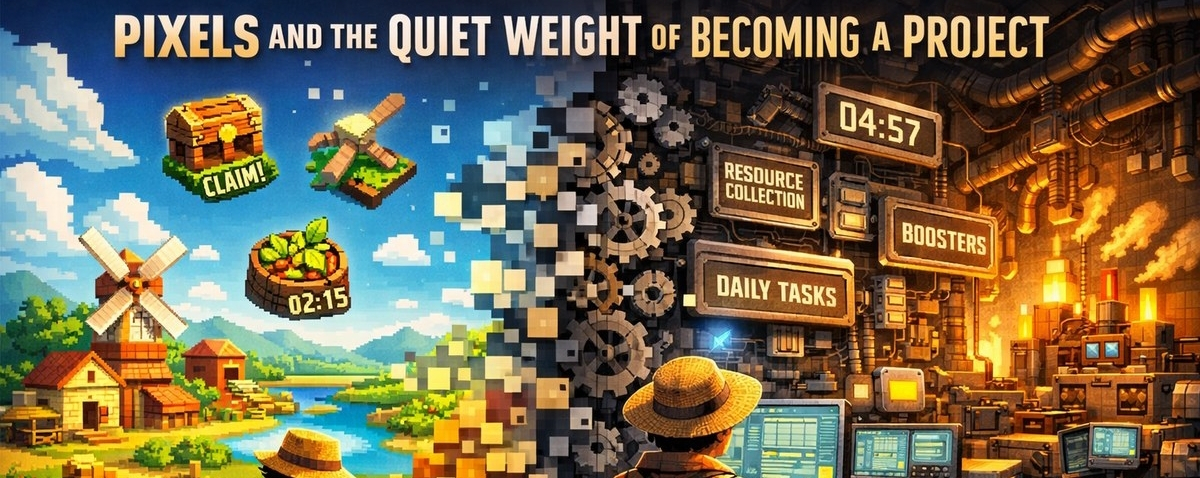
Pixels more closely now, not just as a game I open to pass time but as a project that keeps revealing its real shape in small, quiet ways. I’m waiting to see whether that shape still feels playful or whether it is becoming something heavier. I’m looking at the routines, the extra layers, the little asks that keep stacking up every time I return. I’ve noticed that with Pixels, the truth is rarely in the big update or the big promise. It shows up in the way a session actually feels. I focus on that. I focus on what I do without thinking, what I check out of habit, what I keep maintaining even when I am no longer fully interested.
That is why I keep coming back to the idea of Pixels as a project, not just a game. A game can stay light even when it grows. A project feels different. A project keeps building on itself. It adds systems, adds responsibilities, adds reasons to stay involved. And with Pixels, that is the shift I keep feeling. Every new layer seems to bring more structure, more motion, more interconnected activity. From the outside, that can look like strength. It can look like progress. It can look like the kind of growth people want to see.
But living inside it feels more complicated than that.
What I notice most is how rarely anything truly gets replaced. A new system arrives, but the older system still sits there. The routine does not get cleaner. It gets longer. The project expands, but it does not always become clearer. It just asks for more attention in more places. For a while, that can feel productive. It can make Pixels seem alive, active, full of opportunity. There is always something to touch, something to manage, something to come back for.
Still, I have learned to be careful with that feeling. Activity can be real depth, but it can also be noise that looks organized. A strong project should make the whole experience feel more meaningful. It should make the time inside the world feel more intentional. What gives me pause with Pixels is that sometimes the extra systems do not deepen my attention. They only spread it thinner. I end up doing more, but feeling less connected to any one thing.
That is usually where my skepticism starts.
I’ve noticed that much of my time in Pixels now is not driven by curiosity. It is driven by upkeep. I return because something is waiting. I check because something needs to be completed. I move because there is a sense that stopping halfway would waste earlier effort. It is not harsh pressure. It is softer than that. It is just enough to keep the project pulling me forward, even when the reason for moving is no longer very strong.
And that is what makes Pixels feel less like a simple game loop and more like a mechanism built around continuation. Not because it is empty, and not because there is nothing thoughtful in it. There is clearly thought in it. There is structure in it. But structure alone does not create meaning. A project can become very efficient at keeping people engaged without actually making each layer feel worth engaging with.
I think that difference matters more than people admit. When I say a project feels strong, I do not only mean that it has a lot happening. I mean that the parts support each other in a way that makes the whole thing feel better to inhabit. With Pixels, I sometimes feel the opposite. The parts support each other well enough to keep the loop running, but not always well enough to make the experience feel more alive. The project keeps moving. I am less sure the play always moves with it.
That becomes obvious in small moments. I expect a new feature to change how I think about the world, but often it only changes how often I check in. I expect a new layer to make older activity feel richer, but sometimes it only makes older activity feel more necessary. I expect the project to become more focused as it matures, but often it feels more distributed, more demanding, more dependent on habit holding everything together.
That is why I keep asking myself whether the real strength in Pixels is economic, or whether it is behavioral. There is a difference. A strong economy means the world has internal logic, useful relationships, reasons for effort to matter. A behavioral system is something else. It is a structure that keeps me circulating through tasks because the project has learned how to hold my rhythm. Pixels may have both, but lately I notice the second one more than the first.
What makes this hard to see at first is that momentum hides a lot. When the project is moving, when there is always another task, another step, another thing to prepare for, it is easy to believe all that movement points to depth. I tell myself the current repetition is just part of the setup. I tell myself the next unlock will pull everything together. I tell myself the routine is temporary. Sometimes I believe that for quite a while.
Then the break comes in a very ordinary moment.
I finish a loop. I check another system. I queue another action. And suddenly I can feel that I am not really leaning in anymore. I am just continuing. That is when the weight of the project becomes visible to me. Not as failure. Not as drama. Just as a quiet realization that too much of the experience depends on me staying in motion rather than staying interested.
That is the line I watch most carefully now with Pixels. Not whether the project is getting bigger, because it clearly is. Not whether the project is building more systems, because it clearly is. I watch whether those systems are making the world feel more alive, or just making it harder to step away without losing momentum. Those are not the same thing, even if they can look similar for a while.
So lately I have been playing a little differently. I pay less attention to how much Pixels offers me in a session and more attention to what I would still choose if nothing in the project was gently pushing me back. That answer feels smaller now, but also more honest. And I think I trust that honesty more than the motion.