
When it comes to PIXEL, most people's first reaction is:
"Another chain game currency, looking at the popularity, the theme, and whether it will pump."
But what the Pixels team has recently thrown out, to be honest, is no longer just about 'game currency.'
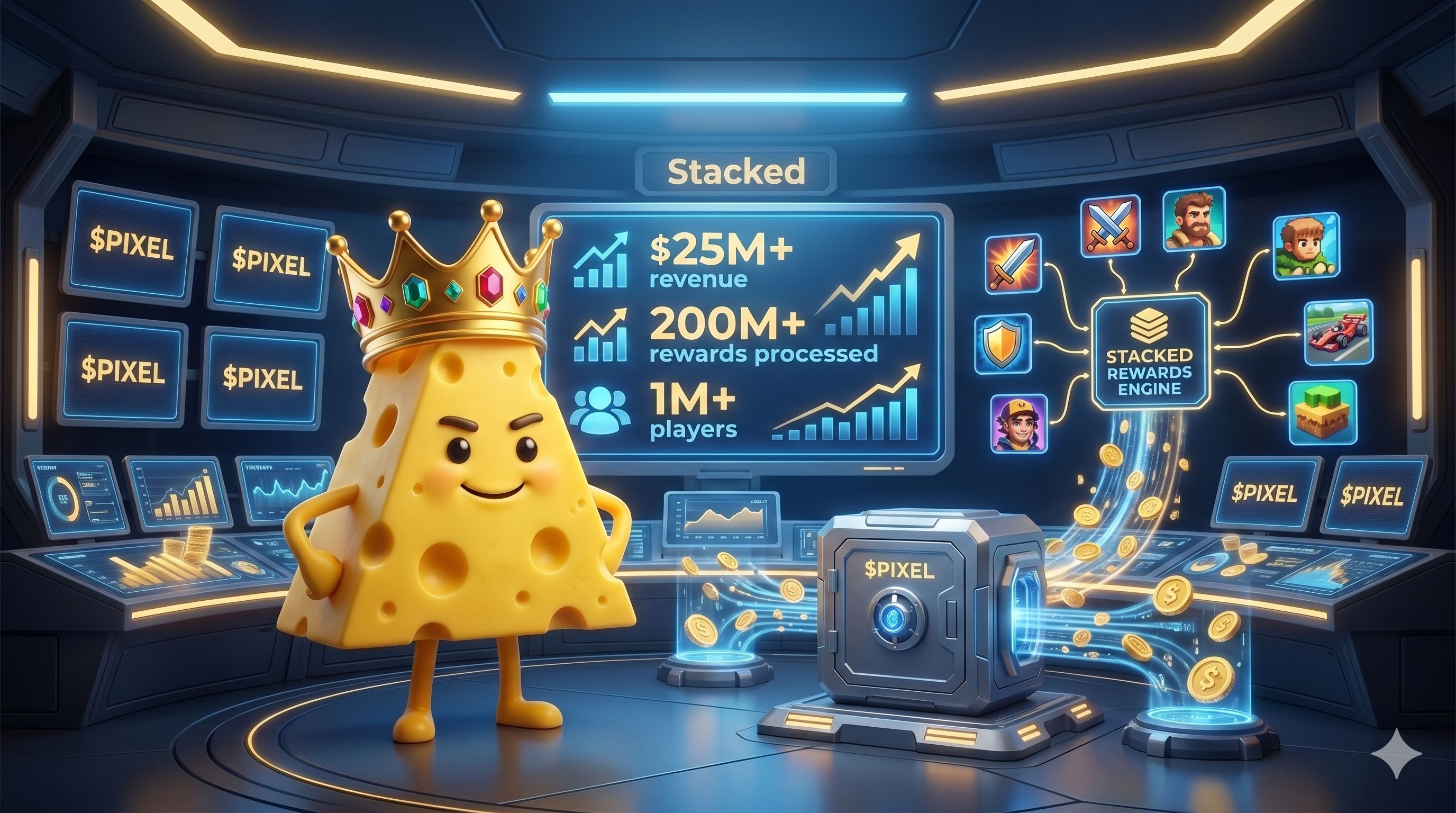
Instead, it's about building a reward infrastructure called Stacked, which is firmly pushing PIXEL towards cross-game rewards and loyalty currency.
In today's article, let's not talk about feelings; instead, we'll directly analyze this from a 'business/data' perspective.
💰 Let's look at the reality: this is not a white paper; it's a system that is already making money.
The positioning of Stacked can be summarized in one simple sentence:
'A LiveOps engine for distributing rewards to game studios, with an AI game economist attached.'
it is even more important that it has already been practically tested in the Pixels ecosystem for a while,
to achieve several critical results (numerical level, not PPT level):
Having processed over 200 million reward distributions,
bringing in over 25 million USD in revenue for Pixels as a whole,
In specific activities, reviving dormant players and achieving:
Conversion rates increased by nearly +178%,
Active days increased to +129%,
The ROI of reward distribution exceeds 130% level.
What do these numbers represent?
It means that this system can help game studios 'convert the rewards distributed into real verifiable income', rather than the traditional GameFi script of: frantically distributing tokens and then experiencing inflation together.
🪙 What role does the PIXEL token play in this machine?
In the past, when we looked at game tokens, most had this structure:
One game → one token → all risks tied to this specific game.
This will lead to two problems:
As long as the game's own popularity drops, tokens will directly become 'memes'.
All rewards are distributed using the same token; the more you distribute, the faster it inflates, and eventually everyone ends up cashing out.
Stacked is attempting to take another route:
PIXEL is designed as a 'cross-game reward and loyalty currency'.
Not only distributing rewards in Pixels,
but also allowing other games that integrate with Stacked in the future to use the same reward system,
Allow players to accumulate the 'same type of value' across different games.
For game studios, Stacked can:
Using PIXEL, stablecoins, or other forms to combine reward packages,
so they don't have to redesign an entire economic model themselves,
more like 'plugging into a verified reward engine'.
In simple terms: PIXEL is no longer just the 'internal circulation token' of the game Pixels, but one of the 'reward main tokens' of the entire Stacked ecosystem.
As the number of games in the ecosystem increases and the frequency of rewards rises, PIXEL's 'place to shine' is no longer just a single field but an entire agricultural area.
🧠 AI game economist: deciding 'how much to distribute, to whom, and when to distribute'
The most fatal problem with traditional GameFi is: rewards are distributed too foolishly.
Distributing rewards indiscriminately leads to inflation when the number of people increases.
Robots can also claim rewards, while real players are suppressed.
Project teams do not know which activities are effective and can only randomly distribute budgets.
Stacked's approach is to turn 'reward distribution' into a set of measurable and optimizable experiments:
Analyzing player behavior:
Which cohort is lost on the 3rd day and the 7th day?
What do the most loyal players do in the first 30 days?
Which type of task mechanism is most helpful for long-term retention?
Then directly issue commands within the same system:
'To increase rewards for this group of players',
'To reduce subsidies for this type of behavior',
'To simply turn off this type of task'
This AI game economist is, to some extent, deciding '$PIXEL the flow and direction within the entire ecosystem',
instead of leaving it to humans to randomly guess.
🧮 From an investment/business perspective, the three things you should really care about
I will look at this matter from three perspectives:
1️⃣ Where does the revenue come from?
It is not 'saying Web3 is great out of thin air',
but rather having actual game revenue, brand partnerships, and event budgets,
transforming into player rewards + studio income through Stacked.
What you see is:
On one side are the numbers obtained from the protocol side (revenue at the level of 25 million USD).
On the other side are the rewards and retention received by players.
2️⃣ What is the role of PIXEL?
If it were just a 'pure reward token',
Ultimately, this often leads to coupon inflation.
But if it is 'a cross-game loyalty and value carrier',
In the future, there will be opportunities to take over:
Rewards from different games,
Governance and rights within the Stacked ecosystem,
And even the identities/points of players across multiple games.
3️⃣ Where are the risks?
This does not mean$PIXEL that there are no risks.
If Stacked cannot attract enough high-quality games in the future,
no matter how 'cross-game' it is, it will ultimately still concentrate on a few projects.If the market returns to a speculative mode of 'only looking at themes, not looking at data',
even the best reward system will be swayed by short-term emotions.
The key is: what you are seeing now is a movement from 'in-game tokens → ecosystem tokens → infrastructure tokens', rather than just adding a new GameFi ticker.
If you are used to opening the chart first and looking at the fluctuations of 15m / 1h, this article might be a bit counterintuitive:
Pixels spent two years not thinking about how to pump up the token first,
Instead, it's about making 'reward distribution' sustainable.
In the next few articles, I will continue to break down:
What new opportunities and limitations does Stacked represent for gold-farming players?
How do designs like PIXEL staking and PopRank tie players and the entire ecosystem together?
Most importantly: as someone who remembers the previous GameFi crash,
What checklist should be used to assess risks this time?
👉 If you want to see 'anatomy of chain games from an investment perspective' rather than just memes,
you can first hit follow, so the algorithm doesn't overlook this series.
You are also welcome to say a word in the comment section:
When you look at chain game tokens now, what you first look at is: themes / data / investors / ecosystem?
You can just type one word: 'theme', 'data', 'investment', 'ecosystem'.
@Pixels $PIXEL #pixel #stacked #Web3Games #CryptoGaming #creatorpad