
When I first opened Pixels, it didn’t hit me with that usual “next big Web3 game” energy.
It felt slower. Almost minimal. Like it wasn’t trying to impress me.
And weirdly… that’s what made me stay.
There were no flashy mechanics, no aggressive rewards pulling me in. The experience just unfolded on its own, which is something most blockchain games don’t even try anymore.
On paper, it’s simple.
You farm, gather, move around, interact. We’ve seen that loop before.
But here, the ownership layer sits quietly in the background. You’re not constantly reminded that you’re earning or “on-chain.” And that changes how you approach everything. You play first. The economy comes later.
That alone flips a pattern we’ve seen for years.
Most Web3 games start with token incentives, pull in users chasing rewards, then struggle when those rewards slow down. It’s not even bad design… it’s just predictable.
Pixels leans the other way.
It builds the experience first, and lets the economy follow. And because of that, your mindset shifts. You don’t log in thinking about extracting value. You think about expanding land, optimizing resources, or just… staying in the world a bit longer than planned.
The pacing helps too.
It’s slower. At first, it feels unfamiliar, maybe even uncomfortable. But over time, that steady rhythm keeps you engaged without forcing urgency. Not intense, just consistent. And that consistency sticks.
At the same time, the economic layer is still there… just less obvious.
And that’s where things started to feel different for me.
I didn’t even know what RORS (Return on Reward Spend) was the first time I felt it.
I was just playing. Planting, harvesting, running tasks, watching Coins stack up like always. Everything felt normal. Same loop, same progress, nothing breaking.
Then something small started to feel off.
Same effort… different outcome.
Not enough to panic. Just enough to notice.
One loop felt closer to actual value. The next one didn’t. I thought maybe I missed something. Wrong timing, wrong tasks, wrong crops.
But the longer I stayed, the clearer it became.
The system wasn’t reacting to what I just did.
It was reacting to something else.
Something I couldn’t see.
Because inside the game layer, everything is smooth. Almost too smooth. You can grind endlessly and nothing pushes back. Coins keep coming, tools keep cycling, land keeps producing.
It feels like the system never says no.
And that’s when it clicked…
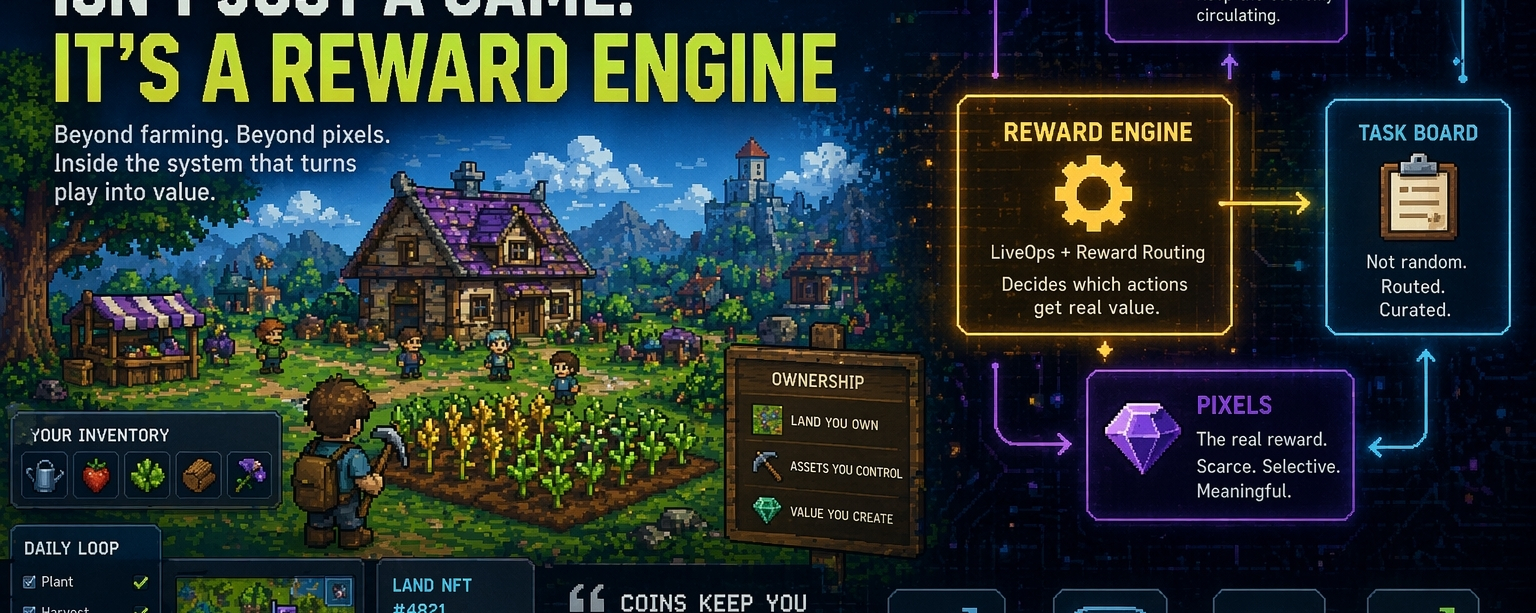
Coins aren’t really the reward. They’re the fuel.
They keep you inside the loop. They absorb your activity so not everything has to convert into real value. They sustain the economy without letting it overflow.
You’re not earning yet. You’re circulating.
But Pixels, the actual value layer, behaves differently.
It doesn’t flow with everything else. It appears selectively. Sometimes the task board has it, sometimes it doesn’t, even when you’re doing the same actions.
And it doesn’t feel random.
It feels… routed.
Like the board isn’t just showing tasks. It’s deciding which actions deserve real value at that moment, and which ones stay inside the loop.
At that point, the task board stopped feeling like a simple interface.
It started feeling like a LiveOps system.
A layer quietly directing rewards, shaping behavior, and controlling how value moves through the game.
And once you see that… you can’t really unsee it.