
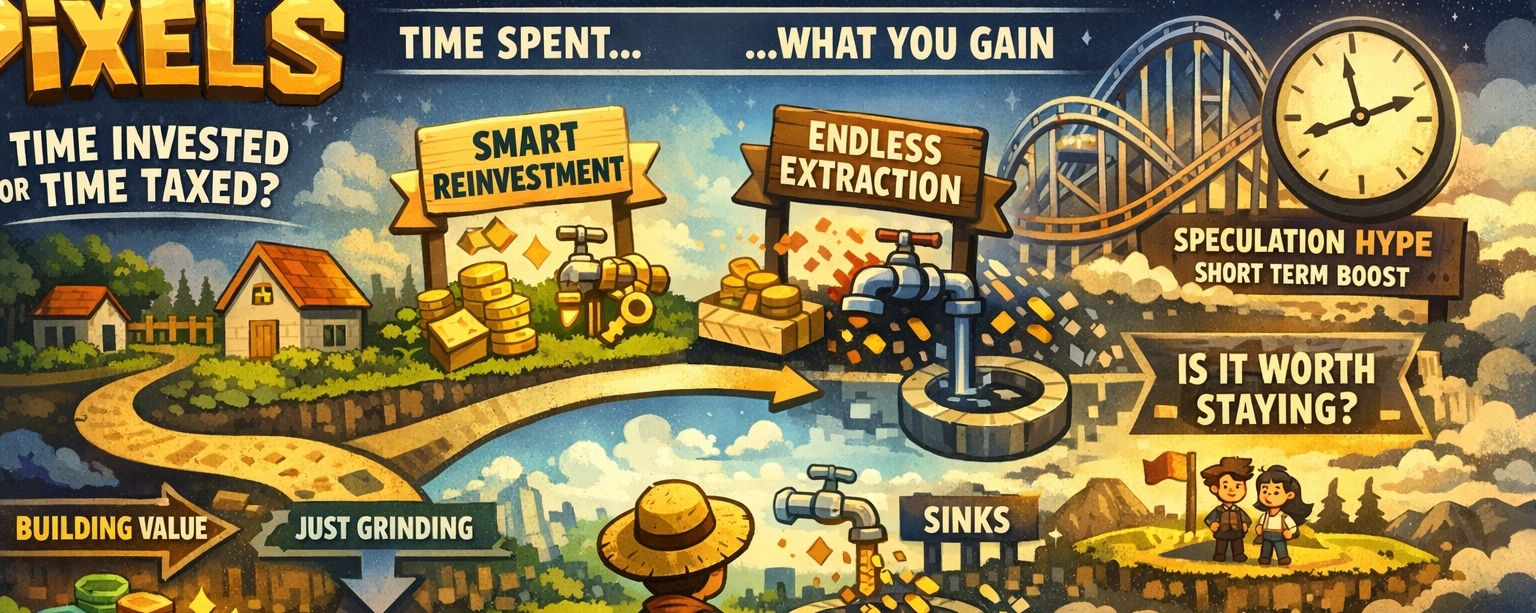

I’m watching Pixels closely, and the thing I keep coming back to is not the token, not the hype, not even the daily activity. It’s time. The simple question sitting underneath everything is whether the time people spend inside Pixels is actually building something for them, or whether it’s just being absorbed by the system. That feels like the real issue to me, because a lot of Web3 games look active before they actually become valuable for the people playing them.
That’s why I don’t like looking at Pixels only from the outside.
From the outside, it’s easy to say the project is doing something right. It has a recognizable style. It feels lighter than most crypto games. The world is easier to understand than the usual mess of tokens, wallets, and confusing mechanics. People can get into it without feeling like they need a finance degree just to plant crops or move through the economy. That matters. In Web3, that kind of accessibility is rare.
But I think the more important question starts after that.
Once someone is already in Pixels, once the novelty wears off and the routine starts forming, what exactly is happening to their time?
That’s the part I keep focusing on.
Because in projects like this, time is the real currency long before the token becomes meaningful. People log in, repeat loops, gather resources, make progress, manage land, upgrade their position, participate in events, and stay connected to the world. On the surface, that all feels productive. It feels like momentum. It feels like you’re moving forward. But movement and value are not the same thing, and I think that difference matters a lot in Pixels.
A player can be active every day and still not be building anything that truly lasts.
That’s where the tension starts.
For me, the real test of Pixels is not whether it can keep players busy. Most games can do that for a while. The real test is whether the project can make repeated play feel like real investment instead of just routine maintenance. If I spend week after week inside Pixels, does my position become stronger in a meaningful way? Do I gain better access, better leverage, better optionality, better ownership, better standing in the economy? Or am I mostly just feeding a loop that depends on constant player effort to keep itself moving?
That difference changes everything.
Because if a player feels like their time is compounding, they stay differently. They become attached to the world. They start seeing their place inside it more clearly. Their decisions matter more. Their assets matter more. Their role matters more. But if the player starts feeling like they are just repeating actions to collect output that quickly loses meaning, then the relationship with the project starts changing. The same loop that once felt exciting starts feeling like work.
And that’s where a lot of Web3 games quietly break down.
Not all at once. Not in some dramatic collapse. More in a slow shift in feeling. Players stop seeing the project as a place where their effort builds something, and start seeing it as a place where they need to constantly perform just to keep up. Once that happens, retention gets weaker, trust gets thinner, and the economy starts relying more on outside excitement than on real belief in the system itself.
That’s why I think Pixels has a deeper challenge than just growth.
It has to make time inside the project feel stored, not spent.
And I don’t mean that only in the price sense. That’s where crypto conversations usually get too shallow. People hear “on-chain value” and immediately reduce it to whether the token goes up. But real on-chain value should be bigger than that. It should mean the player’s time inside Pixels creates something durable. Something that remains meaningful after the session ends. A stronger economic position. A better asset base. A clearer role. More useful ownership. Maybe even a form of reputation or specialization that other players recognize.
Otherwise, what is actually being built?
If the answer is mostly output, then the chain is only recording movement.
And recording movement is not the same as creating value.
That’s why I think Pixels is most interesting when you stop looking at it as a farming game and start looking at it as a system that is trying to turn routine into long-term positioning. That is much harder than it sounds. Farming loops are simple, which is part of why they work. They are easy to understand. They create visible progress. They make the player feel engaged quickly. But simple loops also expose weakness faster. If the deeper economy is not strong enough, repetition begins to reveal the limits of the project.
That’s why incentives matter so much here.
Pixels is constantly teaching players how to behave, whether it means to or not.
That’s true for every live economy. The project is always sending small messages through its design. What gets rewarded. What gets ignored. What is worth holding. What is worth selling. What is worth upgrading. What feels smart. What feels wasteful. Over time, players learn the real language of the project through these signals, not through official messaging.
And those signals shape the future of the economy.
If Pixels mostly teaches players to extract, then extraction becomes the culture.
If it teaches players to reinvest because reinvestment improves their real position, then the economy becomes healthier.
If it teaches players that daily activity matters but only in a shallow way, then eventually activity becomes fragile.
That is why sinks and faucets matter, even if those words sound dry.
To me, they are not just balance tools. They show what kind of relationship the project wants to have with the player.
The faucet side is what Pixels gives out. Rewards, resources, output, token flow, all the value that moves toward the player.
The sink side is what Pixels asks back. Spending, upgrading, crafting, investing in land, participating in progression, consuming resources to build something stronger later.
The problem in a lot of Web3 games is that the faucet feels obvious, but the sink feels forced. So players happily collect value, but when it is time to put that value back into the system, it feels like a tax. It feels like the economy is asking them to solve its problems for it.
That feeling is dangerous.
Because a healthy sink should not feel like punishment. It should feel like ambition.
That’s where I think Pixels has to be very careful.
When players spend inside the project, they need to feel that it is moving them toward a stronger future inside the world. They need to feel that reinvesting changes their position in a real way. Not just cosmetically. Not just temporarily. They need to believe that putting value back into Pixels gives them more leverage, better output quality, stronger access, or a clearer place in the economy.
Without that, people eventually default to extraction.
And once extraction becomes the smartest behavior, the economy starts becoming more fragile than it looks.
That’s also why ownership in Pixels is more complicated than people sometimes admit.
Web3 projects love the word ownership because it sounds powerful, and sometimes it is. But ownership only matters when it does something meaningful. If ownership is mostly passive, or if it mainly benefits a smaller group while the wider player base provides the ongoing activity underneath it, then the economy starts splitting into layers. One group compounds. Another group performs. One group captures upside. Another group keeps the world moving.
That imbalance can exist quietly for a long time.
A project can still look alive while that is happening.
But eventually players notice whether they are building their own future in the game or helping stabilize someone else’s stronger position. And once they start feeling that difference, the emotional relationship with the project changes. It becomes harder to believe the world is truly shared. It starts feeling more like a ladder.
That’s why I think Pixels needs more than daily retention.
It needs meaningful differentiation.
Not every player should feel interchangeable after enough time in the system. If everyone is basically running similar loops with slightly different speed, then time spent in the project becomes flatter than it should be. The real strength of a live economy is when different forms of participation begin to matter in different ways. That is what creates identity. That is what creates trade. That is what creates dependency between players. That is what makes a world feel like a world instead of just a reward engine.
So the deeper question for Pixels is whether time inside the project leads to a more distinct role over time.
Can players become meaningfully better at something.
Can they carve out clearer positions.
Can their decisions shape the kind of economic life they have inside the world.
Can progression lead to stronger identity, not just higher output.
That matters because generic activity is easy to buy for a while. Any project with enough incentives can generate generic activity. But differentiated activity is much harder to replace. It creates real reasons to stay, because the player is no longer just present. They are situated. Their place inside the project means something.
That is where retention becomes real.
Not when users are simply active, but when they start feeling that leaving would actually mean giving something up beyond short-term rewards.
And I think that is the line Pixels is still working to define.
Because the project clearly understands accessibility. It clearly understands how to lower the barrier and make the world approachable. That is not a small achievement. But easy entry creates its own pressure. The easier it is to get people into the project, the more important it becomes to give depth to the time they spend there. Otherwise the system becomes smooth at the front door and thin in the center.
That is the risk.
And this is why I don’t think hype is enough, even if hype helps.
Hype can bring attention to Pixels. It can lift sentiment. It can increase activity. It can make a project feel bigger, faster, more alive. But hype cannot permanently answer the harder question of whether player time is truly turning into durable value. At some point, the player feels the truth of the loop for themselves. No narrative can fully protect against that moment.
If the project is strong, that feeling becomes trust.
If the project is weak, that feeling becomes doubt.
That’s really what I’m watching with Pixels.
Not whether people show up.
Not whether the token gets attention.
Not whether the community stays loud.
I’m watching whether the project can keep making session time feel meaningful after the excitement becomes normal.
Because that is where staying power lives.
A project survives when people feel their time inside it is building a future, not just generating output. When ownership feels active. When progression changes leverage. When effort leaves behind something that matters later. When the economy gives people a reason to remain connected beyond short-term extraction.
That’s the gap between session time and on-chain value.
And I think closing that gap in Pixels means making sure the project rewards more than presence. It has to reward positioning. It has to reward commitment. It has to reward choices that deepen a player’s role in the world. It has to make reinvestment feel smart, not forced. It has to make ownership feel earned, not just held. It has to make the player feel that the project remembers what they have built there.
Because if Pixels gets that right, then time inside the world starts to feel like investment.
If it doesn’t, then even a very active world can slowly turn into a place where people are present without really becoming stronger.
And to me, that is still the real tension inside Pixels: whether the project can turn daily play into lasting position before earning, speculation, and routine start pulling more weight than the world itself.