
I read the technical description about Stacked and stopped at a structure that I think few people pay attention to: "Stacked's main revenue streams come from reward claim fees and LiveOps service fees." That is the driest description in the entire pitch, but it is also the most important sentence.
I read it again twice to make sure I understand what is happening here.
Stacked makes money by charging fees when game studios distribute rewards to their players. And the token that studios use to reward players, $PIXEL, is also the token running in that engine. This means Stacked is using the very product it sells to other studios to operate its own ecosystem. And that product has generated more than $25 million in real revenue before opening up to any external studios.
To understand why that structure is important, I need to explain how Stacked actually makes money.
Stacked charges fees based on two main mechanisms: reward claim fee, which is a small portion calculated on each claim processed through the engine, and LiveOps service fee, which is the fee for studios hiring Stacked to manage the entire reward campaign, including targeting, AI analysis, and fraud prevention. With over 200 million rewards processed and revenue exceeding 25 million dollars contributing to the Pixels ecosystem, the estimated fee rate is around 0.3 to 0.5% of the total volume of rewards distributed. This is one of the few revenue models in Web3 gaming where revenue increases with adoption, not token price. As more studios onboard and run campaigns, volume increases, fees increase, regardless of what price $Pixel is trading at.
But this is the point I find more important than the current revenue figures.
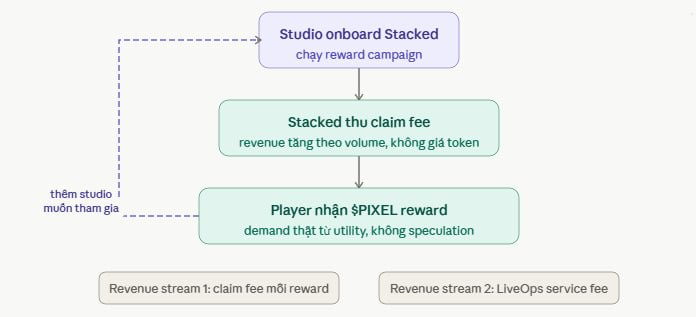 Stacked has just opened up for external studios outside the Pixels ecosystem. This is the point that most analyses of $Pixel completely overlook.
When an external studio onboard Stacked and runs a campaign, two things happen simultaneously. First, Stacked recognizes additional fee revenue from that studio. Second, that studio needs to buy $Pixel to reward their players, creating a new source of demand for the token. These two dimensions do not negate each other but rather increase in tandem with each new studio onboarded. That is the flywheel structure that most game tokens lack because their demand only comes from their own in-game environment, not from the needs of external studios.
This is the point I want to be most straightforward about.
Most people looking at $Pixel are valuing it as an in-game currency, meaning its value depends on player count, engagement of the Pixels game, and the lifecycle of a specific game. That is not wrong. But that is only half the picture.
The other half is that Stacked is running a real distribution infrastructure business, with fee revenue from each claim, and the customer base consists of game studios needing tools to manage player incentives, and TAM is expanding along with the entire Web3 game economy. That revenue is not diluted by the unlock schedule of $PIXEL. It does not depend on where $PIXEL is positioned. And that is what allows Stacked to continue building infrastructure without needing to raise additional funds from outside.
Fraud prevention, anti-bot systems, behavioral data at the scale of hundreds of millions of real rewards, years of operating an economy in genuinely adversarial conditions, these are things that take years to build and cannot be copied with a new whitepaper. Most teams can write about reward infrastructure. Very few teams can show receipts from 200 million rewards that have been processed in production. Stacked has those receipts.
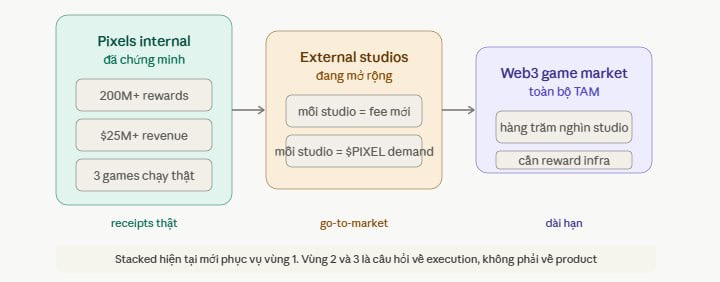
I don't know how quickly external studio adoption will happen. That is a go-to-market and sales cycle issue, not a technical problem. And that is something that has yet to be proven with studios outside the Pixels ecosystem. But this is the point I want to be most straightforward about.
When Binance lists $PIXEL and the Web3 game economy continues to expand, most people will value $PIXEL as an in-game token of a specific game. That perspective is not wrong, but it overlooks the other half of the picture. That half is Stacked operating a SaaS distribution business, with fee revenue tied to the volume of the entire reward ecosystem, not the price of a token. That revenue is not diluted by unlocks. It does not depend on where $PIXEL is in a specific cycle.
The question is not how much $Pixel will increase. The question is when the market starts to value Stacked as an infrastructure business with real fee revenue and an expanding TAM, how does the current market cap of $PIXEL look compared to the trajectory that Stacked is on?