
Let me tell you about an extremely absurd social phenomenon I have witnessed. In my hometown, there is a 'internet celebrity cultural and tourism town' built at a cost of billions, looking as grand as a cyberpunk palace. Every day, countless influencers go there to take photos with thick filters. However, if you actually walk in, you'll find that there isn't even a small shop selling mineral water; just rows of empty, unfinished commercial spaces. At night, the streets, devoid of any vitality, are eerily silent like a ghost town. And right outside the gate of this billion-dollar ghost town, there is an uncle covered in the smell of cooking oil, selling fried rice under a shabby plastic tent. By selling fried rice to these influencers, security guards, and nearby workers, he has managed to achieve a turnover of over 2 million a year.
This magical contrast of being 'glamorous on the outside but completely lacking in blood production capability' is strikingly similar to today’s Web3 gaming circle and the so-called infrastructure track.
Look at the current cryptocurrency market, what are funds frantically pouring into? Various Layer 2s, ZK proof networks, and full-chain game public chains that boast 'top-tier' names. These so-called 'infrastructures' haven’t even launched on the mainnet, and when issuing tokens, their FDV (Fully Diluted Valuation) can easily reach tens or even hundreds of billions of dollars. But if you understand some on-chain tracking technology and check the real data at the browser's bottom layer, you will find that apart from a bunch of mutually cutting meme coins, a few swaps that could run off at any time, and a plethora of headless scripts spamming airdrops, there isn’t even a single real active carbon-based life form. This is the current crypto space: everyone is paying for 'internet-famous ghost towns', indulging in a false TVL (Total Value Locked) while self-high-fiving.
Meanwhile, the protocol that has truly withstood millions of daily active user withdrawals, processed over hundreds of millions of real on-chain interactions, and generated tens of millions of dollars in real net profit, has been looked down upon by those self-proclaimed smart money VCs and traders simply because it wears a shabby exterior of a 'pixel farm'. This extreme valuation distortion is simply the biggest IQ tax in the crypto market.
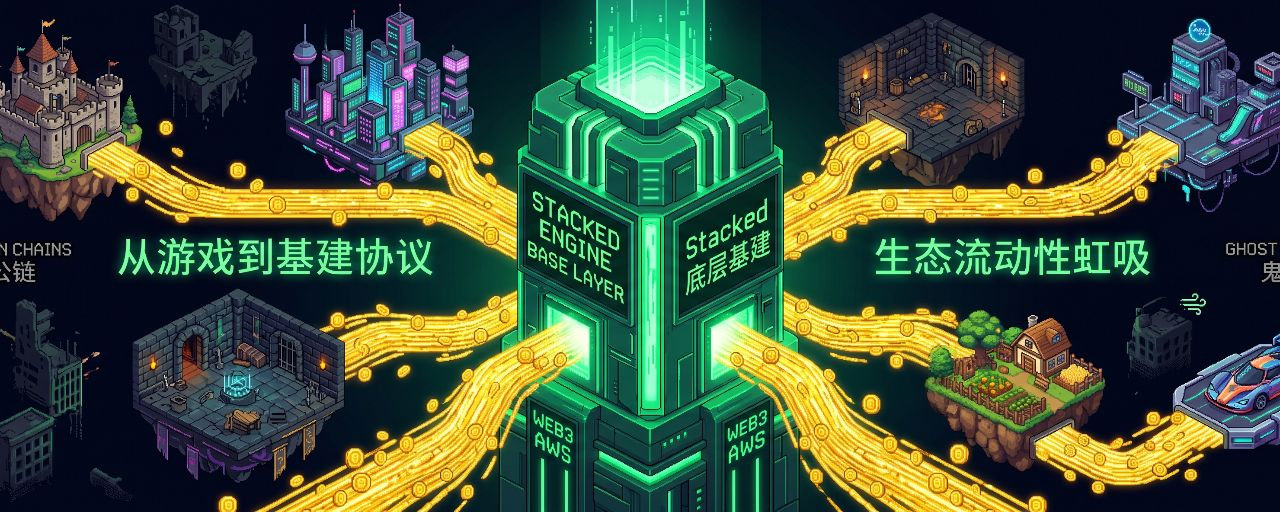
Today, as we wrap up the review of Pixels, we directly pierce its deepest essence: if you are still viewing it through the narrow lens of 'gold farming chain games', then you simply do not understand the chilling ambitions of the Stacked engine. The endgame for these people is to create the AWS (Amazon Web Services) of the Web3 gaming field, completing an epic B2B dimensional reduction strike.
Carefully think through the current industry deadlock: what is the biggest obstacle for traditional Web2 game giants holding top IPs and above to venture into Web3? It’s not the game engine or graphic rendering; it’s that they completely do not understand how to design a token economics that won’t fall into a death spiral, nor do they know how to defend against the concurrent witch attacks (Sybil Attack) from thousands of Southeast Asian data centers.
If traditional large companies go about writing their own on-chain defenses, it’s like going into nuclear war with cold weapons against fully armed professional gray-market entities. The user acquisition funds they pride themselves on will, once they go on-chain, have their pool drained to vacuum within three days by scripting armies.
This is the most terrifying commercial loop of the Stacked engine, and it’s its true moat. The Pixels team is essentially in their own game, enduring the fiercest firepower and billions of real malicious attacks (Adversarial usage) on the internet, using real money and countless days and nights to forge a complete set of 'AI behavioral graph anti-counterfeiting + smart contract-level precise incentives' underlying infrastructure.
Now, the dragon-slaying youths are about to start selling weapons. They are packaging this extremely expensive underlying moat into standardized, plug-and-play SDK interfaces, selling directly to large companies that want to enter the market.
Do you want to launch a chain-reformed game? Do you want to accurately distribute tens of millions of user acquisition budgets to real diamond-hand players instead of paying studio electricity bills? No problem, just connect to the Stacked engine. We not only provide an AI shield that has been battle-tested but also directly connect you to a pool of millions of real, high-net-worth Web3 player traffic.
Do you understand this paradigm shift from 'application to infrastructure'? As more and more external games, applications, and even social protocols connect to this infrastructure, the asset attribute of $PIXEL will undergo an extremely bloody and violent leap—it will no longer be an inflationary coin used to buy seeds in some farm, but will completely transform into the 'universal settlement gas fee' and 'anti-counterfeiting computing power license certificate' at the bottom of the entire Web3 gaming ecosystem. It’s like thinking Amazon was just an e-commerce platform losing money selling physical books online, only to find out they turned around and created AWS cloud servers, directly monopolizing the foundational computing power of the entire internet era. In a dark forest full of PPT lies and zero-sum mutual cuts, only the protocols that master the underlying traffic distribution rights and absolute anti-counterfeiting moats can truly complete the siphoning of liquidity across the entire internet.
Don’t get lost in various technical indicators when it’s time to focus on the fundamentals. The moment you realize that Pixels is transitioning from 'single-player games' to 'global traffic settlement infrastructure', the $P$PIXEL value reassessment has just begun.