
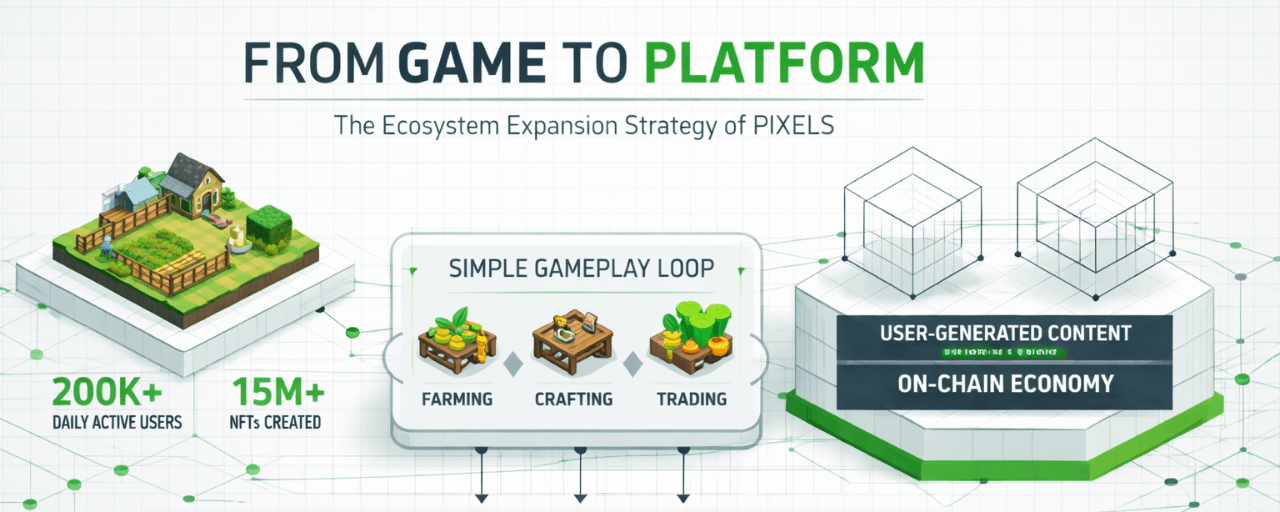
I have seen too many stories that start with “a great game” and end with “a large ecosystem.” It sounds reasonable, sounds familiar, and often it stops at narrative more than usage.
From my perspective, GameFi has never lacked ambition. It lacks repetition, lacks simple enough behaviors for players to return every day without needing to be paid to do so. Most games try to expand too quickly; they add tokens, add layers, add incentives, but fail to maintain the most basic element: a gameplay loop natural enough to exist without needing to pump in additional rewards.
This issue is not new but it is persistent. Players join for the money, stay if they find joy, and leave when neither is present. Most systems try to solve this by increasing rewards instead of reducing friction in gameplay. Too many systems operate like a miniature economy but lack a real society. There are transactions but no reason to interact. There are tokens but no behaviors attached to them.
In that context, the idea of a game transforming into a platform seems to be the next step that many projects are aiming for, not just Pixels, but Pixels is a case worth observing a bit more closely.
The way their current system operates, if looked at closely, is not about expanding the depth of gameplay, but rather expanding the breadth of behaviors. They are not trying to turn a game into a better game in the traditional sense, but they seem to be trying to turn it into an environment where many behaviors can happen simultaneously.
It’s not about X players in a game, but rather many groups of players, many types of activities coexisting in a shared space.
This point sounds familiar but their approach seems a bit different.
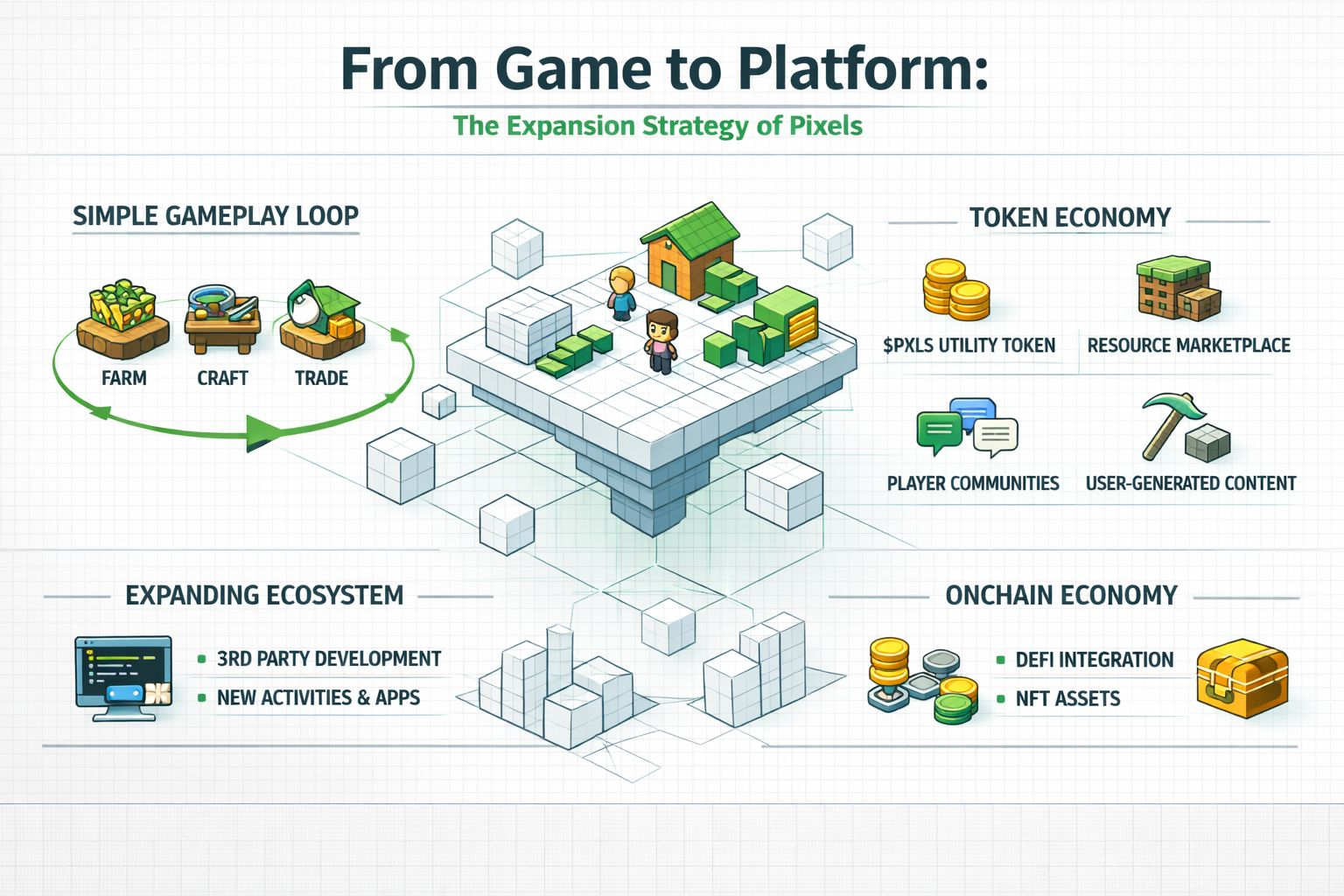
Previous systems often expanded by adding content, adding maps, adding quests, adding features. Pixels seems to be going in the opposite direction, keeping gameplay simple enough to allow surrounding behaviors to develop spontaneously. Farming, crafting, trading, social interaction, none are too deep but enough to create a rhythm.
This leads to a question that I always come back to: does a platform necessarily have to start from a complex system, or can it just need a loop stable enough for the rest to build itself up?
Pixels seems to be trying the second approach.
They don't talk much about becoming a 'metaverse' or 'infrastructure'. At least not in a flashy way, but the way they design the system is heading that way. An environment where resources are continuously created, exchanged, and consumed. A place where tokens are not just rewards but a means of operation.
It's not a game with tokens, but rather an economic system with a game interface.
This difference is small but not unimportant.
However, this is also the part that is easily misunderstood because many previous projects have also said something similar: 'We are not a game, we are a platform.' and then they still die in the same way, with players leaving, liquidity drying up, and loops breaking.
So where does Pixels differ? To be honest, I'm not sure.
It seems they are leveraging something that many projects overlook: player behavior on a chain that already has a gaming culture like Ronin Network. This doesn't guarantee success, but it reduces some initial friction. Players don’t need too much explanation; they are already accustomed to playing, earning, and interacting on-chain.
But that still isn't enough.
A platform is only truly a platform when there are third parties building on it, when behaviors are no longer limited to what the design team envisions, when players begin to create value for each other instead of just receiving value from the system.
Pixels seems to be opening the door for that, but opening the door doesn't mean that people will walk in.
That's the part I'm still waiting for.
The whitepaper isn't very important here, the narrative even less so. What’s worth observing is: do players return when rewards decrease, do behaviors still exist when incentives are no longer clear, and more importantly, does anyone start to build something outside of the system's intentions?
If it exists, it could be a sign of a platform.
If not, it’s still just a game with more layers than usual.
I don't think the answer will come soon. Things like this take time and often fail before they can prove anything.
But anyway, this is one of the few cases that I find worth monitoring further.
At least from my perspective, it hasn't tried to become something too big too fast.
And in this market, sometimes not rushing... is a rare signal.
The rest I will continue to monitor...!