
I remember watching someone play Pixels for the first time and thinking something felt… off, but not in a bad way. There was no urgency. No aggressive push to optimize. No visible pressure to spend or compete. It looked calm, almost indifferent to how the player moved through it.
 But after a while, that impression started to break.
Not because the game changed — but because certain players did.
They weren’t necessarily faster. They weren’t grinding more hours. Yet somehow, they were progressing differently. Their actions seemed to compound. Small decisions turned into better positioning over time, while others stayed locked in loops that felt busy but ultimately flat.
That difference is easy to miss if you’re only looking at activity.
It becomes obvious when you start paying attention to behavior.
Most game economies don’t really evaluate behavior. They measure output.
If you farm more, you earn more.
If you grind longer, you progress further.
The system doesn’t ask whether what you’re doing is meaningful — it simply rewards repetition. Over time, this creates a predictable outcome: players stop thinking about what matters and start optimizing for what is easiest to repeat.
This is where most play-to-earn systems quietly break.
Not because they fail technically, but because they succeed too literally.
Pixels feels like it’s moving away from that model.
Not in an obvious, announced way — but structurally.
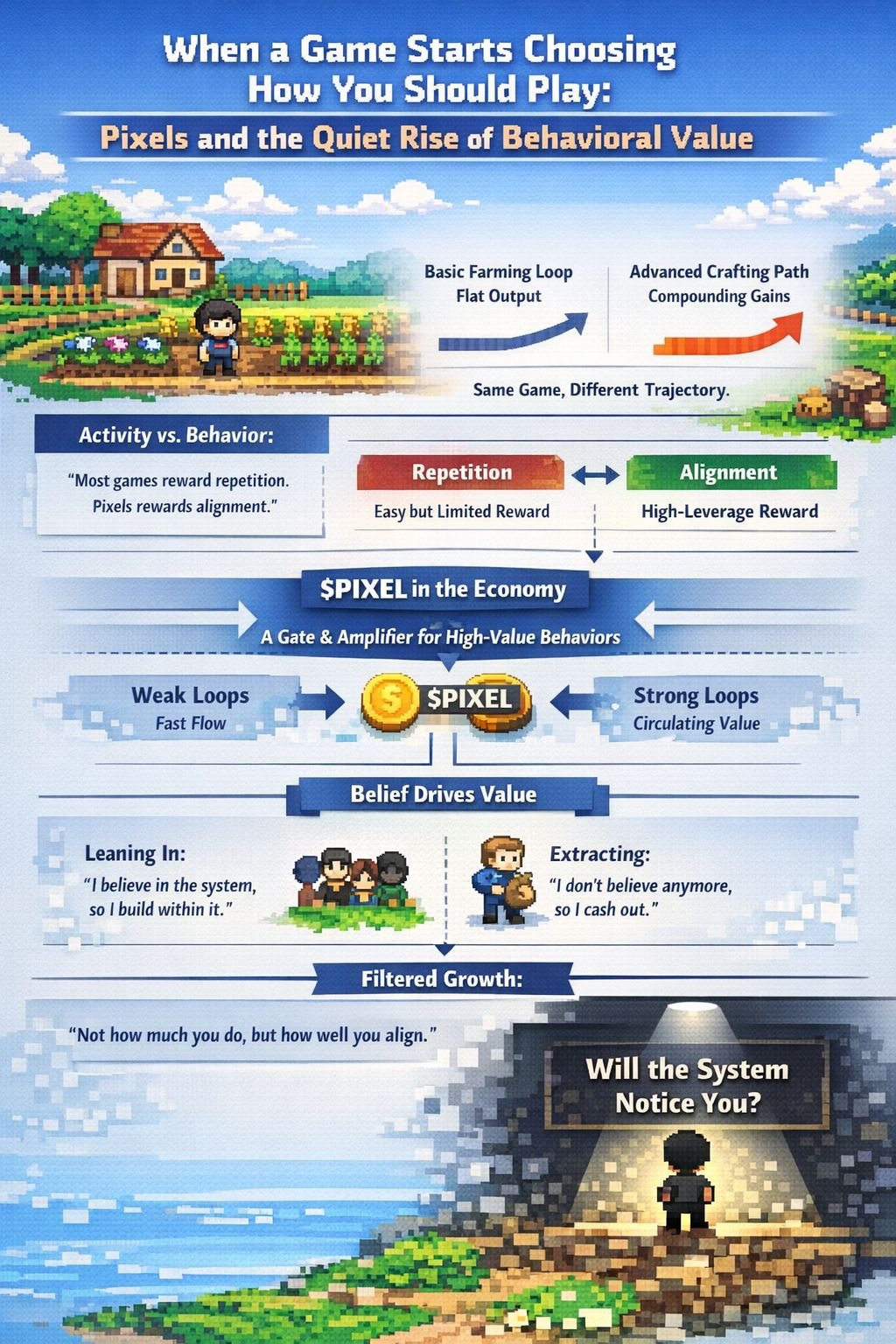
There’s a subtle asymmetry in how different activities evolve over time. For example, players who focus purely on basic farming loops can maintain steady output, but often hit a ceiling where effort scales linearly with reward.
Now compare that to a different path.
A player invests in land, experiments with crop cycles, and builds a simple crafting chain. Instead of selling raw resources immediately, they convert them into higher-value items that require timing and coordination. At first, progress feels slower. But over time, their outputs start stacking — better margins, more flexibility, and access to opportunities that basic farming never unlocks.
Same game. Same time.
Completely different trajectory.
The difference isn’t effort.
It’s alignment.
Pixels is not rewarding activity — it is rewarding alignment.
That shift is easier to understand if you look outside gaming.
On platforms like TikTok or YouTube, not every piece of content grows equally. The system doesn’t reward how hard you worked on a video. It rewards what it can amplify.
Creators don’t always understand why something performs well — but they adapt anyway. Over time, their behavior changes, shaped by signals that are never fully explained.
Pixels is starting to feel similar.
Just slower. And far less visible.
Instead of a central algorithm deciding everything, the game uses economic signals.
Rewards shift. Access changes. Some loops naturally expand, while others remain constrained. You can still choose any path, but not every path leads to meaningful progression.
And this is where $PIXEL becomes more concrete.
It sits directly inside these loops — not just as a reward, but as a gate and amplifier. The more a player aligns with high-leverage behaviors, the more efficiently they earn, spend, and reuse $PIXEL within expanding systems. In weaker loops, $PIXEL flows through quickly. In stronger ones, it circulates and compounds.
That difference is what starts shaping demand.
This also changes how value is formed.
It’s tempting to assume that demand for $PIXEL comes from obvious factors — more players, more spending, more transactions. Those still matter, but they feel secondary to something deeper.
Value begins to emerge from belief.
If players believe that certain behaviors will continue to be recognized and rewarded over time, they lean into them. They refine them. They build around them.
If that belief breaks, the system doesn’t collapse immediately.
Players simply shift from participating… to extracting.
There’s also a risk in systems like this — and it’s not immediately visible.
If the game starts reinforcing the wrong behaviors, players won’t complain at first. They’ll adapt. They’ll find the shortest path to whatever works and repeat it until the system becomes predictable — and eventually, fragile.
We’ve seen this before.
Not because those systems were poorly designed, but because players understood them too well.
There’s another layer that feels harder to resolve.
As rewards become more selective, the system becomes less transparent. That can be a strength — it prevents easy exploitation. But it also introduces a quiet tension.
Players begin to sense that there is a better way to play… without fully understanding what it is.
And in that gap, behavior itself becomes speculative.
Not just the price of the token — but the way you engage with the game.
Maybe that’s the real shift happening here.
$PIXEL is no longer sitting on top of gameplay as a reward layer. It’s becoming part of a selection system — one that determines which styles of play are allowed to scale and which ones remain static.
Over time, that difference compounds into something much bigger than a typical game economy.
It starts to look like a system that is constantly filtering players — not by how much they do, but by how well they align.
And that leads to a harder question.
If the system is always deciding which behaviors deserve to grow…
then the real challenge isn’t how you play.
It’s whether the system ever decides to notice you.
#pixel @Pixels #meme板块关注热点 #cryptouniverseofficial #TrendingTopic #pixel #RAVEWildMoves