
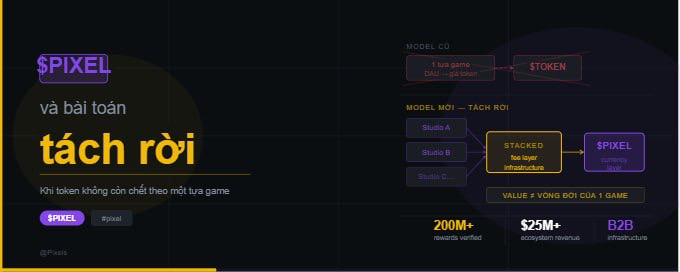
I read the description of Stacked and stopped at a sentence that most people overlook: "Stacked is positioned as B2B infrastructure for game studios, meaning its value isn't tied to the success of any one title."
I read it again twice to make sure I understand correctly what is being said.
This is not a marketing statement. This is a description of a risk structure completely different from any game token I've ever read. Almost all tokens in Web3 gaming die according to a single scenario: the game loses players, the token loses utility, sell pressure from unlock exceeds demand, price goes to zero. That loop has repeated enough times to become the market's unspoken rule. When someone talks about a Web3 game token, the default assumption is that its value is tied to the lifecycle of a specific game title.
$PIXEL starting from that assumption. But Stacked is changing it.
To understand why this is important, I need to explain what is actually happening when Stacked opens up to external studios.
When an external studio in the Pixels ecosystem onboards Stacked to run a reward campaign for their game, $Pixel becomes the reward currency not because the players of that studio are playing Pixels, but because Stacked chose $PIXEL as the payment layer throughout its engine. This means the demand for $PIXEL starts coming from the utility of the infrastructure, not from the engagement of a specific game. If the Pixels game loses 50 percent of DAU tomorrow, Stacked can still continue to charge fees from other studios running campaigns through the engine. Revenue does not collapse along with a game title.
This is one of the few structures in Web3 gaming where a token can survive through the failure of a specific game.
But this is the point I find more important than the simple risk mitigation story.
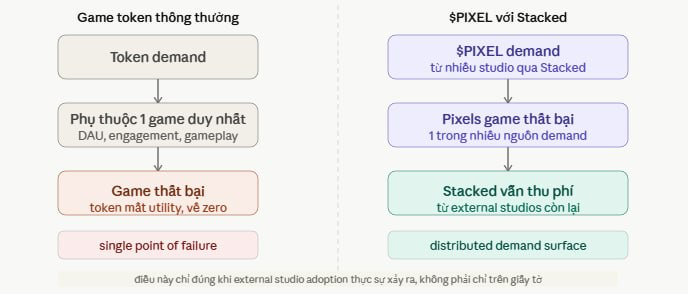
Most people betting on $Pixel are actually betting on the Pixels game. They track gameplay updates, partnerships, DAU, and news about new features. That is the correct way to read a game token. But if Stacked can actually onboard external studios at a significant scale, then that is no longer the correct way to read $PIXEL.
I'm not saying the Pixels game is not important. It is still the largest proof of concept and the place where Stacked has earned real receipts, over 200 million rewards processed and over 25 million dollars in revenue. Those numbers are why Stacked has enough credibility to pitch to external studios. If Pixels had never built a real player base and a real economy, Stacked would have nothing to show when meeting another studio.
But this is the point I want to be the clearest about.
When the market values $Pixel currently, they are using the mental model of a game token. This means that when Pixels has bad news, $PIXEL goes down. When Pixels has good news, $PIXEL goes up. The entire market is reading $PIXEL through the lens of a game title, not through the lens of an infrastructure business.
If the argument about Stacked is correct, there is a significant mismatch between how the market is valuing it and how the token actually creates value.
This is the point I am watching most closely with $Pixel in the near future. Not the DAU of the Pixels game. Not which gameplay patch is coming. But the speed of onboarding external studios by Stacked and the quality of those studios. Each new external studio onboarded is a time Stacked proves that its value no longer depends on a single game. And each time is a time the market's mental model of $PIXEL needs to be updated.
Fraud prevention, anti-bot systems, AI economist analyzes cohort and behavioral data at the scale of hundreds of millions of real rewards, this is the moat that Stacked has built. Very few teams can show receipts from real production at that scale. Those are the reasons studios will choose Stacked instead of building internally, just as merchants choose Stripe instead of building their own payment system.
 I don't know how many external studios Stacked will onboard in the next year. That is a sales and go-to-market problem, not a technical problem. And that is something that hasn't been proven yet. But this is the important distinction with most arguments I read about $PIXEL: the questions can be answered with observable data. There is no need to wait for the token price to know if the thesis is right or wrong. Just track the speed of onboarding studios and the volume of rewards coming from outside the Pixels ecosystem.
If in the next 12 months Stacked cannot show meaningful external studio adoption, the separated thesis collapses and $Pixel returns to the state of a normal game token, valued by the lifecycle of the Pixels game.
The question is not $PIXEL how much it will increase. The question is when the market starts reading $PIXEL through the lens of infrastructure adoption instead of through the lens of a game, will those two numbers converge to the same point, and in what direction will they converge?