
Last night I logged into the game and stood at the marketplace in Pixels for quite a while, not to trade but just to see what people were discussing. At first, it seemed quite pointless, but the more I read, the more I felt something was off with the way I was playing.
That day, a few people mentioned that some resources were 'slightly overpriced' between areas. I didn't react immediately, but about 10-15 minutes later when I tried to sell, the price was nearly 20% higher. The strange thing is that a few days before, I farmed exactly this loop and almost always sold at market price, with very little difference.
That’s when I started to get suspicious. So I tried to pay attention over the next few days. About 5-6 times I saw the same pattern. Whenever someone in the chat mentioned a shortage or demand increase, within 10-20 minutes, prices often deviated by about 10-15%, then gradually returned to old levels after about 30-45 minutes when many started reacting.
Not always true. But it repeats enough that I can't consider it random anymore.
Previously, I thought social in such games was just for fun, or at most, to create a sense of 'community.' Like adding a chat box to avoid emptiness, or to prevent players from feeling lonely. But the more I played, the more I felt that assumption was a bit wrong.
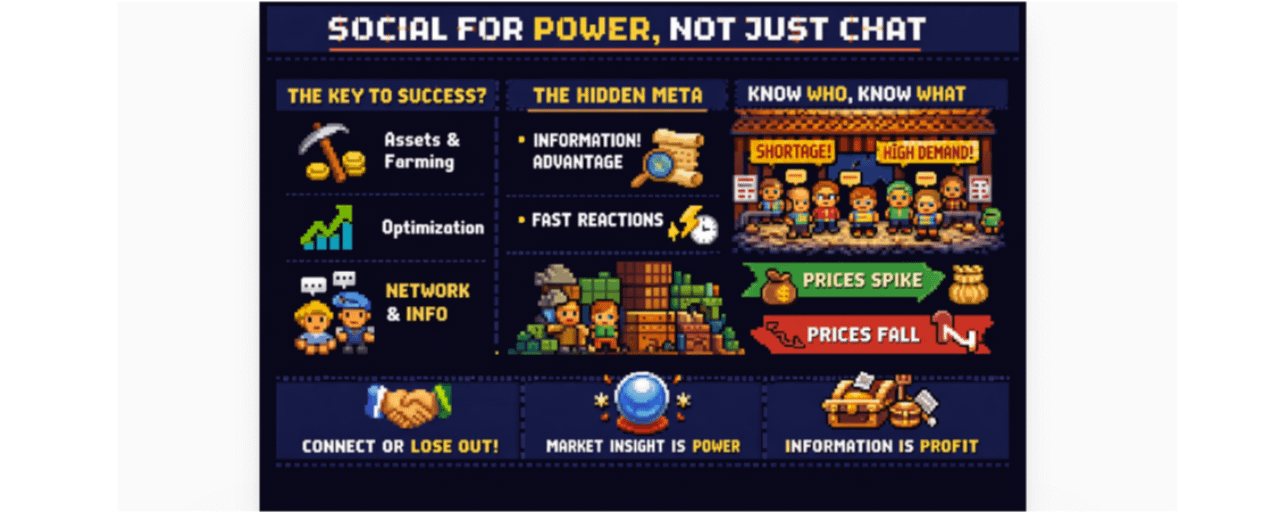
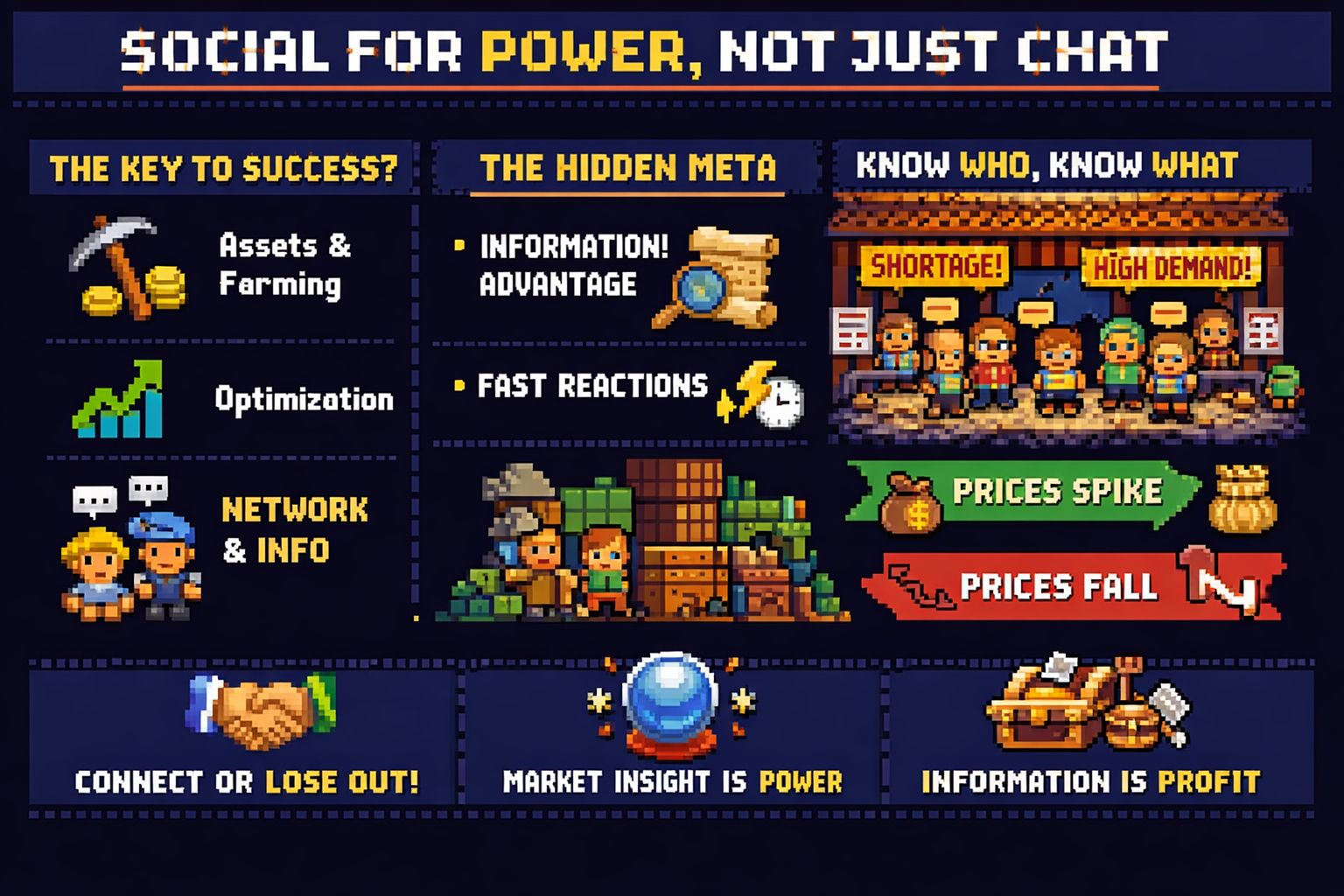
At least for me, social in Pixels isn't for communication. It feels more like a power-creating layer.
I often think simply like this. In a Web3 game, the most important thing is assets and the earning mechanism. Whoever optimizes better wins. But Pixels subtly adds another variable that not everyone notices. That is the network.
A very clear example. If I play alone, I will have to test what to farm, what to craft, when to sell. The whole process is trial and error. But if I'm in a small Discord group, or just need to follow a few right people, I almost have information ready.
The same gaming system, but the output is completely different just because of access to information.
This reminds me of the real-world market. In theory, anyone can view on-chain data. But in practice, not everyone reads it in time.
For instance, during farming airdrop events, those in the same group often share optimal strategies early. One route may yield high in the first 24 hours, but after spreading, rewards are quickly diluted. I've seen cases where, just after 48 hours, APY dropped from 80-100% to below 30% due to rapid cash flow.
Or like in DeFi, there are liquidity pools when incentives just open. In the first few hours, the TVL is still low, so the actual yield is very high. But just a few large groups coming in first, sharing information, can triple or quintuple the TVL within a day, quickly pulling the yield down. Those who come later are almost left with scraps.
Pixels almost replicates that logic, but in a game environment, and on a smaller scale.
At this point, I start to see something a bit different.
If it were just random, then these patterns wouldn't repeat with quite a similar rhythm. And if it were just 'social features for fun,' it wouldn't directly affect economic output like that.
The more I look back, the more I feel this is not a side effect. It feels like something designed.
It's not designed in an explicit way, no tutorial tells you this. But the reward system quietly prioritizes those with better networks, quicker responses, and earlier access to information.
This means the game doesn't just measure what you do.
It measures both what you know and how early you know it.
Compared to the real world, it's like going to the market. A person going alone will have to individually check prices at each stall. But if you know a few sellers, or hear 'news in the market,' you'll know where things are being dumped, and where prices are about to rise. The same market, but a completely different experience.
The interesting point is that Pixels doesn't need to create a complex social ranking or reputation system. Just let players form their own network is enough. Power comes from who you know, and what you hear.
But it's precisely this part that makes me feel a bit 'uncomfortable.'
Because if you look straight out, this is almost a form of hidden meta. The game doesn't tell you to 'build a network to earn more.' But if you don't do that, you will always be at a disadvantage.
Newcomers don't just lose in resources. They lose in information. And that gap isn't easily filled just by playing harder.
After a while, I started to change my way of playing. No longer just asking 'what is the most profitable to farm,' but starting to pay attention to 'who is saying what,' 'where this information comes from,' 'should I trust it.'
It sounds more like trading than playing a game.
And perhaps that's the point I find most thought-provoking.
Some blockchain games don't try to make gameplay more complex. Instead, they bring very real things like networks, information, and human advantages into the system.
At that time, blockchain is not just a place to store assets.
It becomes a place where the advantage doesn't lie in what you own.
But it lies in where you stand in the flow of information.
