
Table of contents
I. One Million Barrels Per Day: From "Investment Success" to "Energy Control"
II. A Hidden, Larger Variable: 850,000 Old Oil and Gas Wells
III. Core Investment Opportunities in 850,000 Oil and Gas Wells
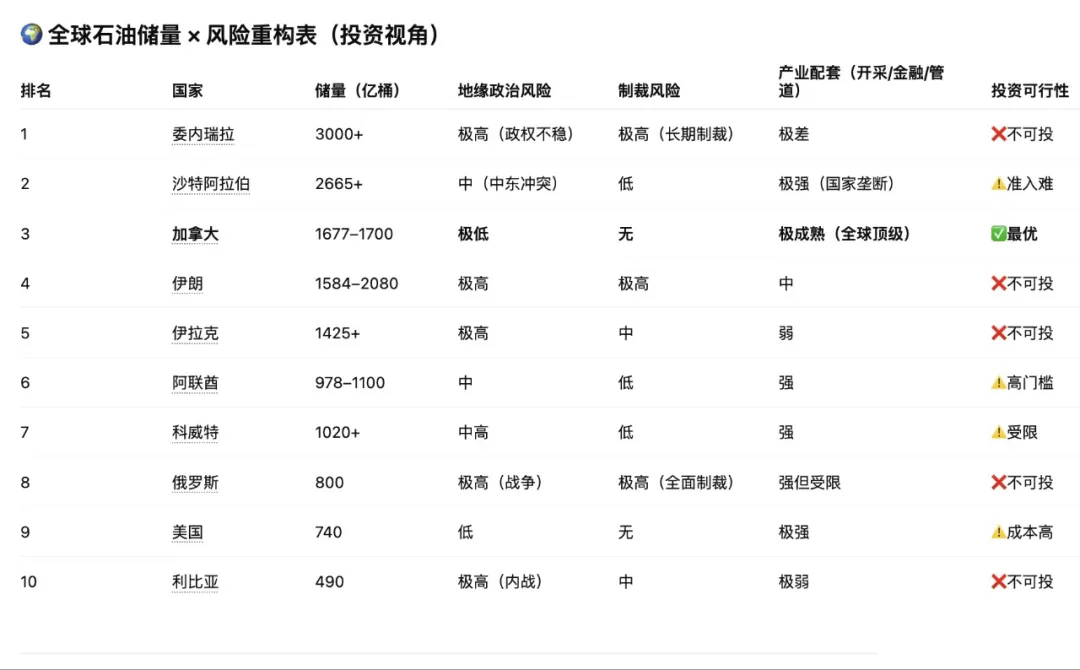
IV. Why are opportunities emerging in Canada (rather than in other countries)?
V. Returning to Li Ka-shing: What should domestic capital really learn?
VI. Conclusion: Two main themes, two opportunities
A Huge Opportunity Behind 850,000 Oil and Gas Wells: Why Canada is Becoming a “Certainty Hotspot” for Global Energy Capital
Li Ka-shing's Canadian oil production reaches one million barrels per day: accounting for one-fifth of Canada's total, reshaping the energy landscape—what should domestic capital learn from the pool of 850,000 oil wells?
In-depth analysis of financial reports: Li Ka-shing's Canadian oil assets revealed, with a daily production of nearly 1 million barrels and extraction costs as low as $30 per barrel.
Li Ka-shing's oil empire exposed: raking in 700 million a day, this is a true "money printing machine".
When Li Zeju mentioned at the earnings conference that "Canadian oil production is approaching 1 million barrels per day," the market's first reaction was one of shock at the scale; but what's truly worth analyzing are the two structural signals behind this:
First level: Million-barrel-level production capacity → National-level energy control
Second layer: 850,000 oil wells → World's largest energy asset restructuring pool
If the former explains how Li Ka-shing "won"...
Then the latter determines who can replicate or even surpass this model in the future.
I. One Million Barrels Per Day: From "Investment Success" to "Energy Control"
With Cenovus Energy as its core platform, the Li Ka-shing family has built a complete energy system through 40 years of counter-cyclical integration:
* Equity production: Approximately 1 million barrels per day
* Represents approximately 20% of Canada's total production (approximately 5 million barrels per day nationwide).
* Cost structure: approximately $26–35 per barrel
* Reserves base: billions of barrels
This means:
👉 This is not a simple equity investment, but a deep integration into national-level energy production capacity.
In a horizontal comparison, this is equivalent to the total output of a medium-sized oil-producing country (such as Ecuador or Oman).
Key Insight: When Li Ka-shing's son, Victor Li, casually mentioned in an earnings call that "Canada's daily oil production is close to 1 million barrels," the market often only focused on the number itself. But the truly important structural signal is that the Li Ka-shing family has upgraded from "investors" to "system participants," possessing the infrastructure capabilities to influence regional energy pricing.
II. A larger hidden variable: 850,000 old oil and gas wells!
In the Western Canada Sedimentary Basin, more than 850,000 wells have been drilled. This number determines:
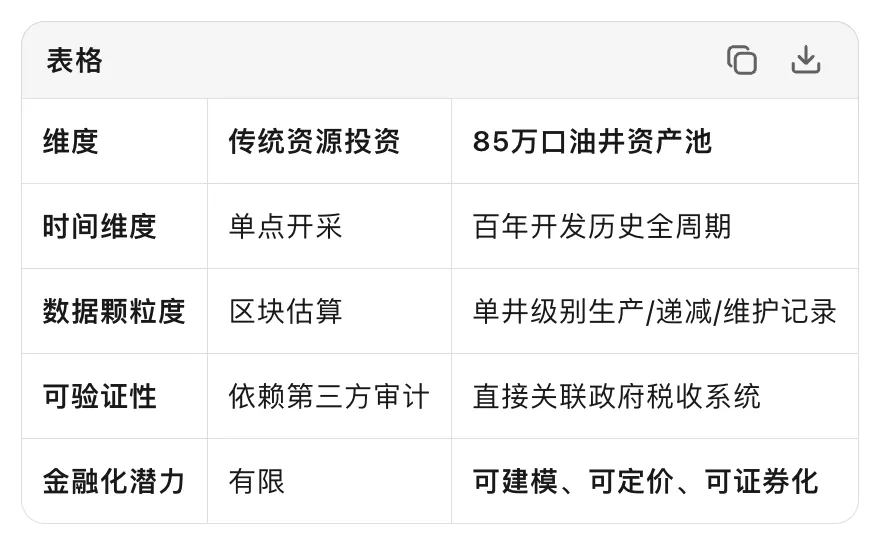
1) The world's most complete energy data asset repository
* A century-long development history
* Single-well level production and decline data
* Full lifecycle record of costs, pressures, and maintenance
👉 The essence is not resources, but rather:
An asset database that is "modelable, priceable, and securitizable"
2) The industry has entered the "era dominated by established wells".
Structural Reality:
* High-yield new wells: Limited
* Inefficient wells / marginal wells: hundreds of thousands
* Idle / Orphan Wells: Continuously increasing
👉 The conclusion is very clear:
Canada doesn't lack oil; what it lacks is the "capital capacity to restructure these oil wells."
3) Reversal of supply logic
* New drilling: Approximately 5,000–7,000 wells per year
* Existing wells: 850,000
👉 Industry from:
"Finding oil" → "Developing assets"
III. Core Investment Opportunities in 850,000 Old Oil and Gas Wells
This part represents the most practically significant "executable opportunities" for domestic capital.
1) Cash flow arbitrage in old wells (basic layer opportunity)
Typical parameters of old wells:
* Daily production: 5–80 barrels
* Lifecycle: 5–10 years
* Decline rate: 15%–25%
* CAPEX: $300,000 – $800,000
feature:
* Stable cash flow
Low maintenance costs
* Can quickly recoup costs
👉 The essence of investing:
Acquire stable cash flow assets at a discount (similar to "rent collection in the energy sector").
2) Asset portfolio integration (intermediate opportunity)
Current market situation:
Large oil companies divest non-core assets
Small operators lack financing capabilities
Operation path:
* Acquisition of 10–100 wells
Unified Operations and Maintenance (Cost Reduction)
* Improve oil recovery rate (technical optimization)
👉 Essence:
Transforming "dispersed assets" into "standardized asset packages"
3) Structured financing and securitization (advanced opportunities)
Based on the Canadian regulatory system:
* Alberta Energy Regulator
* Canadian Association of Petroleum Producers
It can achieve:
* Reserves-backed financing (RBL)
* Cash flow packaging (ABS)
* Yield-type assets
👉 Core Upgrade:
From "Acquiring Assets" to "Building Capital Structure"
4) Energy RWA (Core Future Opportunity)
Convert oil wells into:
Divisible income rights
* Assets that can be issued on-chain
* Can raise funds globally
Analogy path:
* Real Estate → REITs
* Power Plant → YieldCo
* Oil well → Energy RWA
👉 This step is the key to the valuation leap.
IV. Why are opportunities present in Canada (rather than in other countries)?
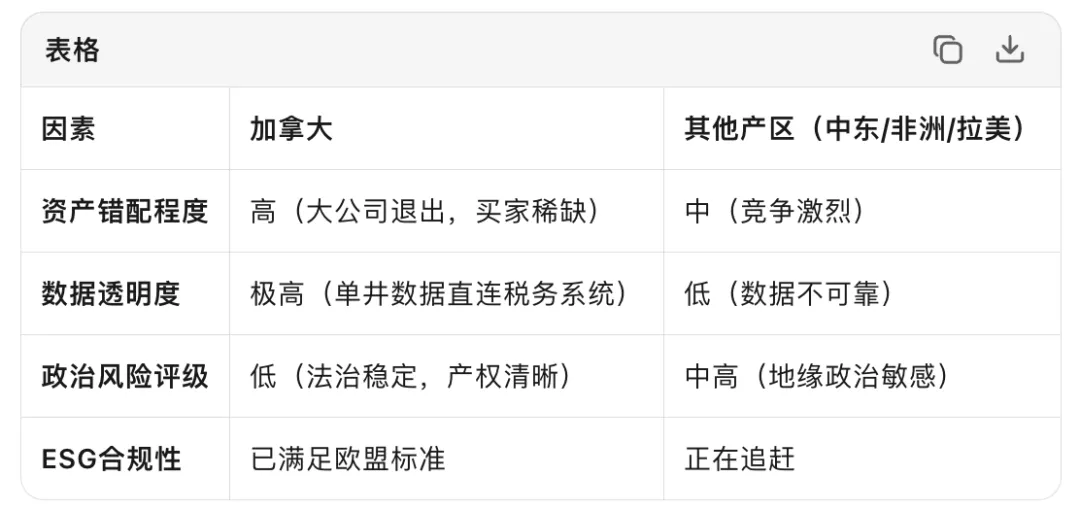
Three core determining factors:
1) Asset mismatch (the most critical)
Large companies exit
* ESG pressure rises
High-quality assets sold at low prices
2) Data and regulatory transparency (extremely critical)
* The production output of a single well is real and verifiable.
* Data directly linked to taxation
* Full lifecycle record
👉 This is a condition that is extremely rare in the world.
3) "Energy security asset" attribute
Compared to the Middle East / Africa / Latin America:
Canada has:
Political stability
* Legal Improvement
Clear property rights
👉 The essence is:
A pool of low-risk, long-term-holdable energy assets
V. Returning to Li Ka-shing: What should domestic capital really learn?
It's not about simple copying, but about extracting three "transferable capabilities".
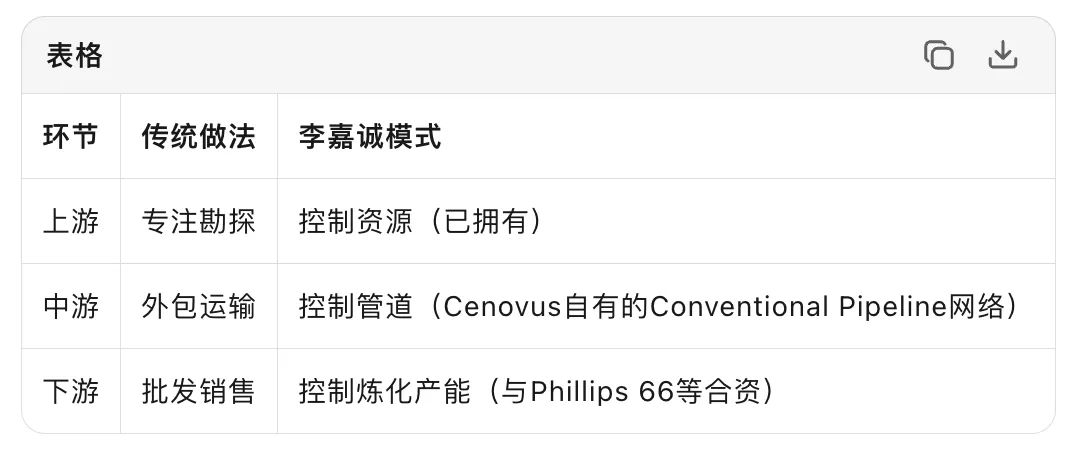
1) Counter-cyclical capability (trading time for space)
Acquire assets at industry lows
* Leveraging cost advantages to navigate economic cycles
2) Full-chain control capability
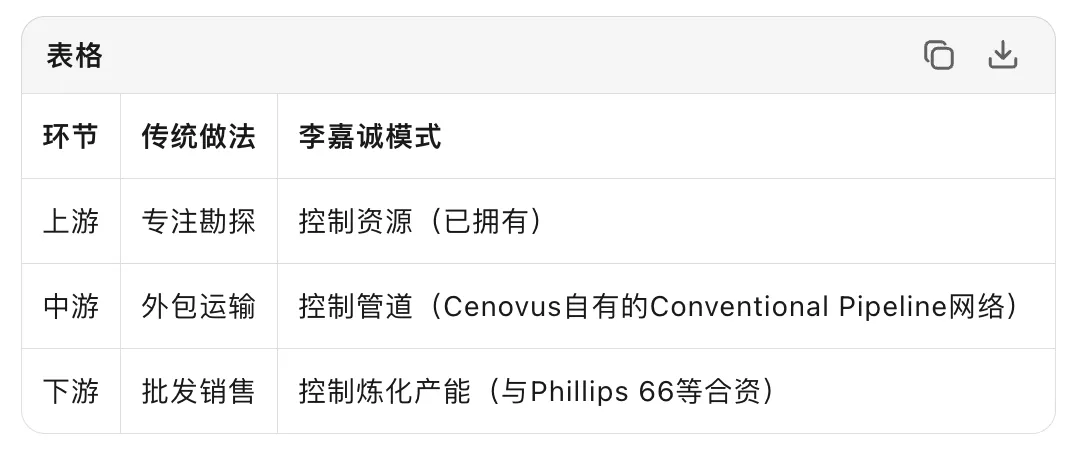
Not just upstream:
Upstream: Resources
* Midstream: Pipeline
Downstream: Refining
👉 Control cash flow, rather than just betting on oil prices.
3) Asset management capability (most critical)
Future competition will not be:
❌ Who owns the oil well?
Instead:
✅ Who can turn oil wells into "financial assets"?
VI. Conclusion: Two main themes, two opportunities
What this article truly aims to express are two completely different paths:
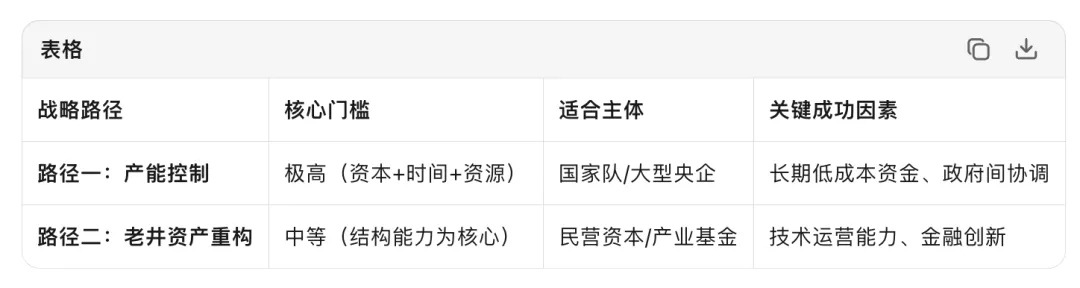
Path 1 (Li Ka-shing Model)
👉 Controlling production capacity of one million barrels
👉 Become a core participant in the energy industry
Barrier to entry: Extremely high (capital + time + resources)
Pathway Two (850,000 oil well opportunities)
👉 Restructuring of Laojing Assets
👉 Do cash flow and financial structure
Entry threshold: Accessible (structural capabilities are the core).
Final judgment:
Li Ka-shing defined the scale dimension of "energy control," while 850,000 oil wells are defining the financial dimension of "energy asset pricing power."
For domestic capital: the former is the benchmark, while the latter is the window of opportunity to enter – the current period is the explosive phase of the valuation cycle of Canadian energy assets, and it is also a historic opportunity for domestic capital to achieve "Chinese-style control" of overseas energy assets through the dual drive of technology and finance.
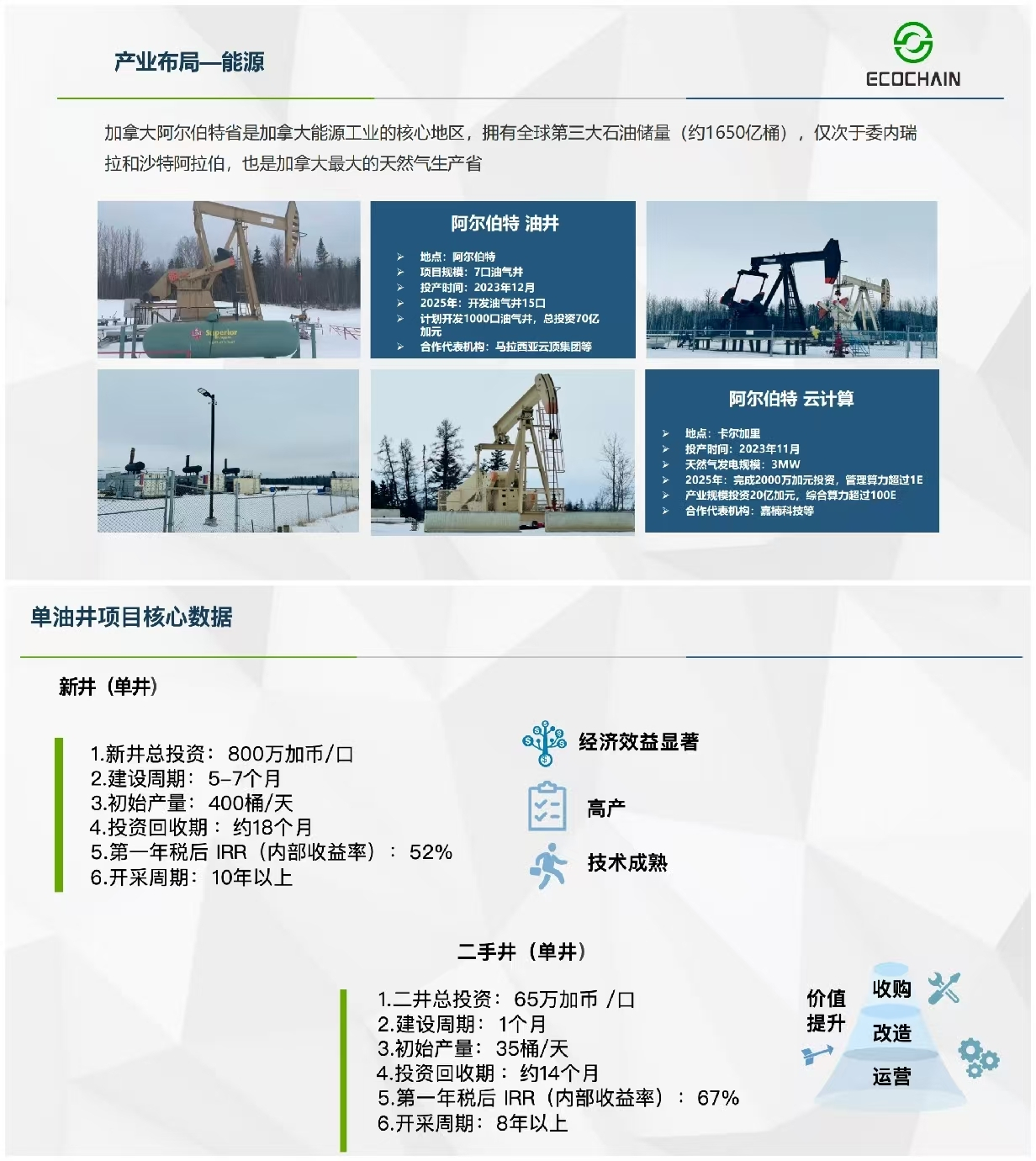
The following are the cooperative business opportunities in Canadian oil and gas exploration: