


When I consider Dock (DOCK) in the context of price expectations for 2026, 2027, and 2030, I find it more useful to begin with the structure of the system rather than the numbers themselves. Price, in isolation, reflects market behavior, but market behavior is often a delayed reaction to underlying design choices. In systems built around verifiable credentials and identity, adoption tends to be gradual and dependent on institutional trust rather than speculative cycles. This creates a slower feedback loop between utility and valuation.
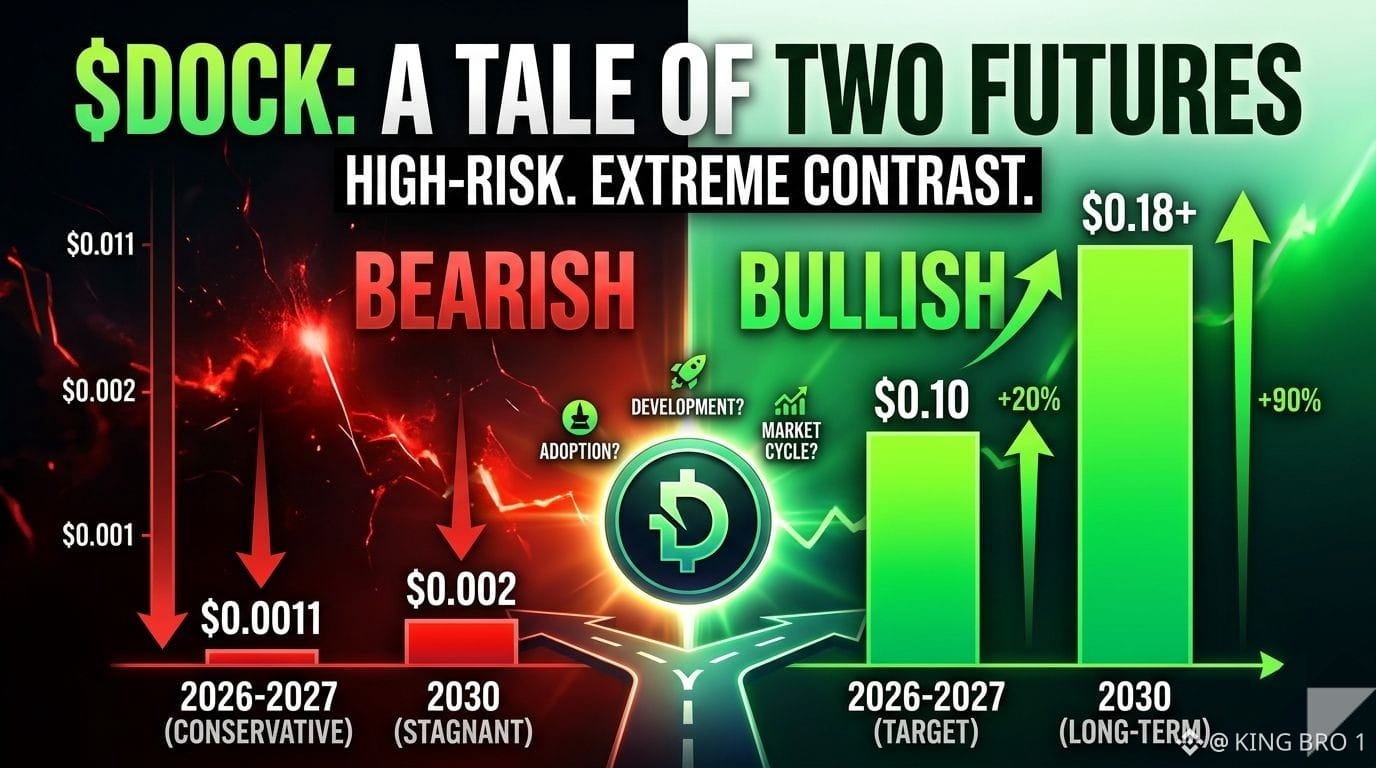
In the 2026–2027 period, most projections vary widely, and that variability is itself informative. It suggests that the market has not reached a stable consensus on how to value the system. In practical terms, this usually indicates limited liquidity, evolving use cases, and uncertainty around long-term positioning. Under such conditions, price movements are less about steady growth and more about intermittent reactions to sentiment, integration updates, or broader market cycles. For operators and analysts, this makes forecasting less about precision and more about understanding the range of possible outcomes.
Looking further toward 2030, the discussion shifts from short-term volatility to structural durability. For a system like Dock, long-term value depends on whether it can maintain consistent behavior under real-world constraints such as compliance requirements, auditability, and operational reliability. These factors are rarely visible in price charts, but they determine whether institutions are willing to rely on the system. If the infrastructure remains predictable and verifiable over time, it supports gradual adoption. If not, price projections become irrelevant regardless of earlier optimism.
An important consideration in this timeline is the presence of transitional or structural changes within the ecosystem, such as token migrations or shifts in governance models. These events introduce discontinuity in how value is measured and transferred. From an engineering and compliance perspective, such transitions must be handled with clarity and traceability. Otherwise, they create gaps that complicate auditing and reduce confidence. For investors, this means that historical price behavior may not always map cleanly onto future expectations.
In the end, projecting a precise price for 2026, 2027, or 2030 is less meaningful than understanding the conditions required for those prices to be sustainable. Systems tied to identity and credentials are evaluated not by rapid growth, but by their ability to remain stable, transparent, and verifiable under scrutiny. If those properties hold, valuation can follow over time. If they do not, even optimistic projections lose their foundation.
#DOCK #dock $DOCK $CHIP #MarketRebound