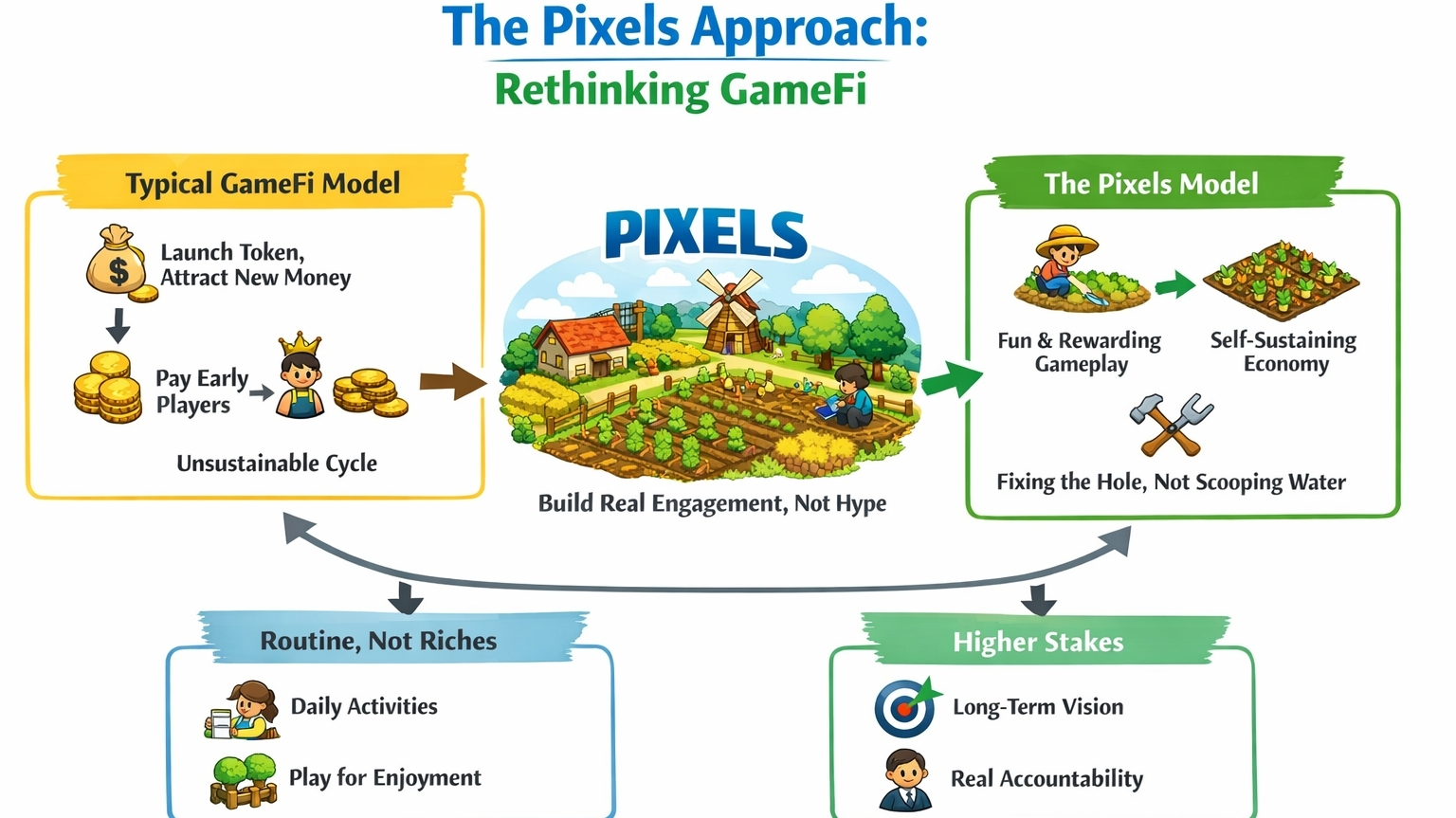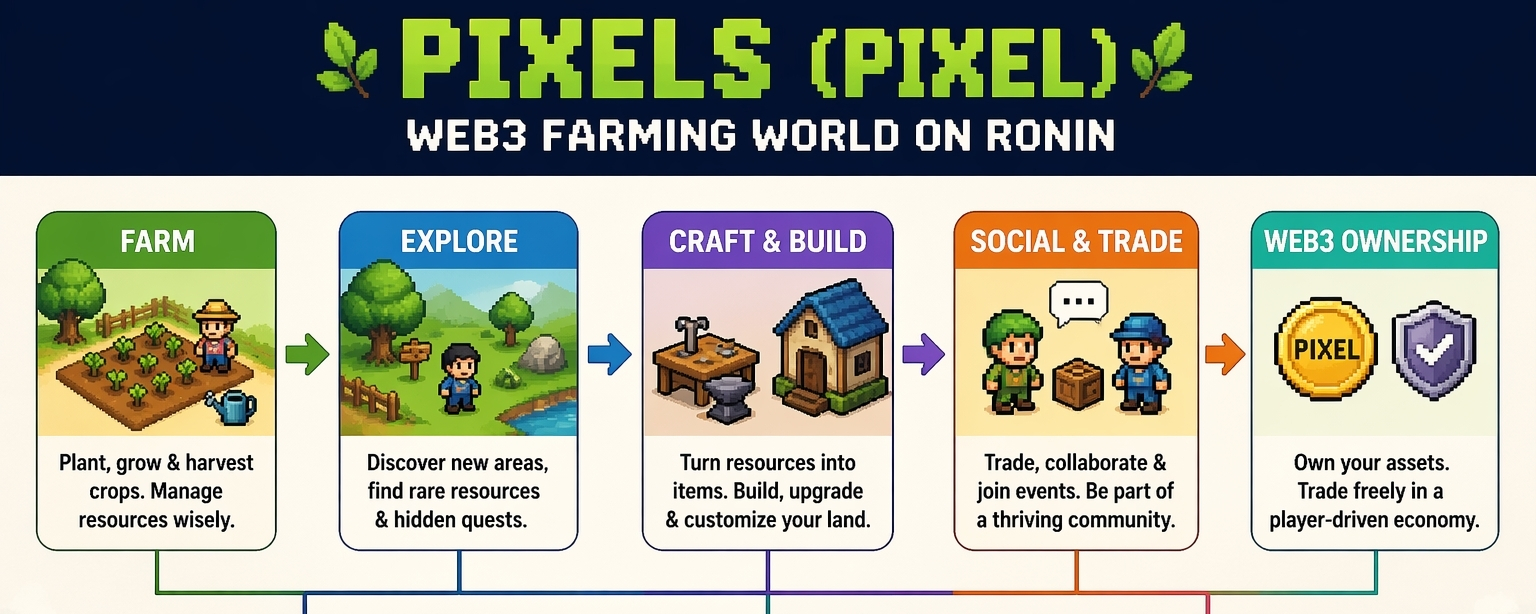
Gaming has slowly shifted from something we just play to something we also build trade and even earn from In this evolving space Pixels has carved out its own identity as a social open world Web3 farming game that runs on the Ronin Network At first glance it looks like a simple farming simulator but once you spend time inside it you realize it is more like a living digital society where farming exploration and community all blend together
Pixels has gained attention not just because of its gameplay but because of how it reimagines ownership and interaction in games Instead of everything being locked inside a traditional game system players actually participate in an economy where their time effort and assets can carry real weight
A farming world that grows with you
At the heart of Pixels is farming This is not just a side activity it is the foundation of the entire game
You start with a small patch of land You plant seeds water crops wait for them to grow and then harvest them It sounds basic almost old school but the depth comes from how everything connects The crops you grow become resources and those resources are needed for crafting trading and upgrading your progress
Imagine it like running a small digital farm in the beginning but over time it becomes a system where every decision matters Do you use your resources to upgrade tools or do you trade them for something more valuable later That constant decision making is what keeps the loop alive
Farming is tied to energy and efficiency systems You cannot just spam actions you need to plan That limitation makes progress feel more meaningful rather than repetitive
Exploration that keeps curiosity alive
If farming is the foundation exploration is the heartbeat that keeps the game from feeling static
The world of Pixels is not just a flat farming map It is filled with different areas NPCs hidden tasks and resource zones that encourage movement and discovery You do not always get direct instructions either Sometimes you are given vague hints and have to figure things out yourself
That design creates a human feeling of curiosity It is similar to walking in a new city without a map you do not know exactly what you will find but that uncertainty is what makes it exciting
Exploration also ties into resource collection Certain materials only exist in specific areas which pushes players to travel interact and revisit parts of the world regularly
Crafting and creation turning resources into progress
One of the most satisfying parts of Pixels is how raw resources turn into useful items
Players can cook food craft tools build items and upgrade their land It is not just about collecting things it is about transforming them into something better
For example you might spend time gathering basic materials like wood or crops On their own they do not feel powerful But once you start crafting those same resources become tools that improve your farming speed or unlock new gameplay options
This creates a simple loop gather craft upgrade expand
Over time your farm starts to feel less like a starting point and more like a customized space shaped entirely by your decisions
A social world not a solo game
What separates Pixels from a traditional farming game is its social layer
You are not alone in your world Other players exist in the same ecosystem trading resources sharing knowledge and participating in group activities There are guilds community events and interactions that make the world feel active rather than empty
Think of it like a virtual village Some players focus on farming others on trading and some on exploration Everyone plays a different role but the system connects them together
This social structure is what gives the game long term life A farming game without interaction would eventually feel repetitive but here the presence of other players constantly changes the experience
Web3 and digital ownership
One of the biggest differences between Pixels and traditional games is its Web3 foundation
In simple terms Web3 allows players to have real ownership of certain in game assets Items land and resources can exist as digital assets tied to blockchain systems instead of being locked inside a single game server
Pixels uses this idea to create a system where player progress is not just temporary Instead it becomes part of a larger digital economy where ownership has meaning beyond the game itself
This also affects how the in game economy works Resources items and tokens interact in a way that reflects supply and demand When more players want something its value can increase When supply is high value can shift again It feels more dynamic compared to fixed in game currencies in traditional games
Why Ronin Network matters
Pixels runs on the Ronin Network which is specifically designed for gaming
The reason this matters is performance Web3 games can sometimes feel slow or expensive if built on general purpose blockchains Ronin is optimized to avoid that problem
In practical terms this means smoother gameplay faster transactions and a more stable experience overall When you are managing resources trading items or interacting with others you do not want delays getting in the way Ronin helps reduce those friction points making the game feel more responsive and fluid
The balance between simplicity and depth
One of the most clever things about Pixels is how it balances two different audiences
On one side you have casual players who just want a relaxed farming experience They can log in grow crops and enjoy slow progression without stress
On the other side you have more dedicated players who go deep into optimization maximizing efficiency trading strategically and exploring every system in detail
Both types of players coexist in the same world without conflict That is not easy to design but Pixels manages it by keeping core mechanics simple while allowing advanced systems to exist underneath
Final thoughts
Pixels is not trying to reinvent gaming with flashy mechanics or complex combat systems Instead it focuses on something more subtle turning simple actions into meaningful progression inside a connected world
Farming becomes strategy Exploration becomes curiosity Trading becomes interaction And over time all of it blends into a shared digital ecosystem where players shape their own experience
What makes it stand out is not just the technology behind it but the way it turns slow steady progress into something that feels alive It is a game where small actions matter and where the world quietly evolves with the people inside it