


I can still recall my last cycle. It would be a tearing apart of tokens, a rush of dashboards, posting up the same lap of victory by all, and then a fortnight later the whole affair would be a deserted fairground. The life seemed to have been in the measures up to the point when the incentives got exhausted, and you found out that most of that power was rented. That scar is what causes me not to be able to look at Pixels and cheer activity spikes any more. The more significant step is the retention issue rather than the celebration step because the real test is whether people will still come back when the simple extraction turns into a more difficult task.
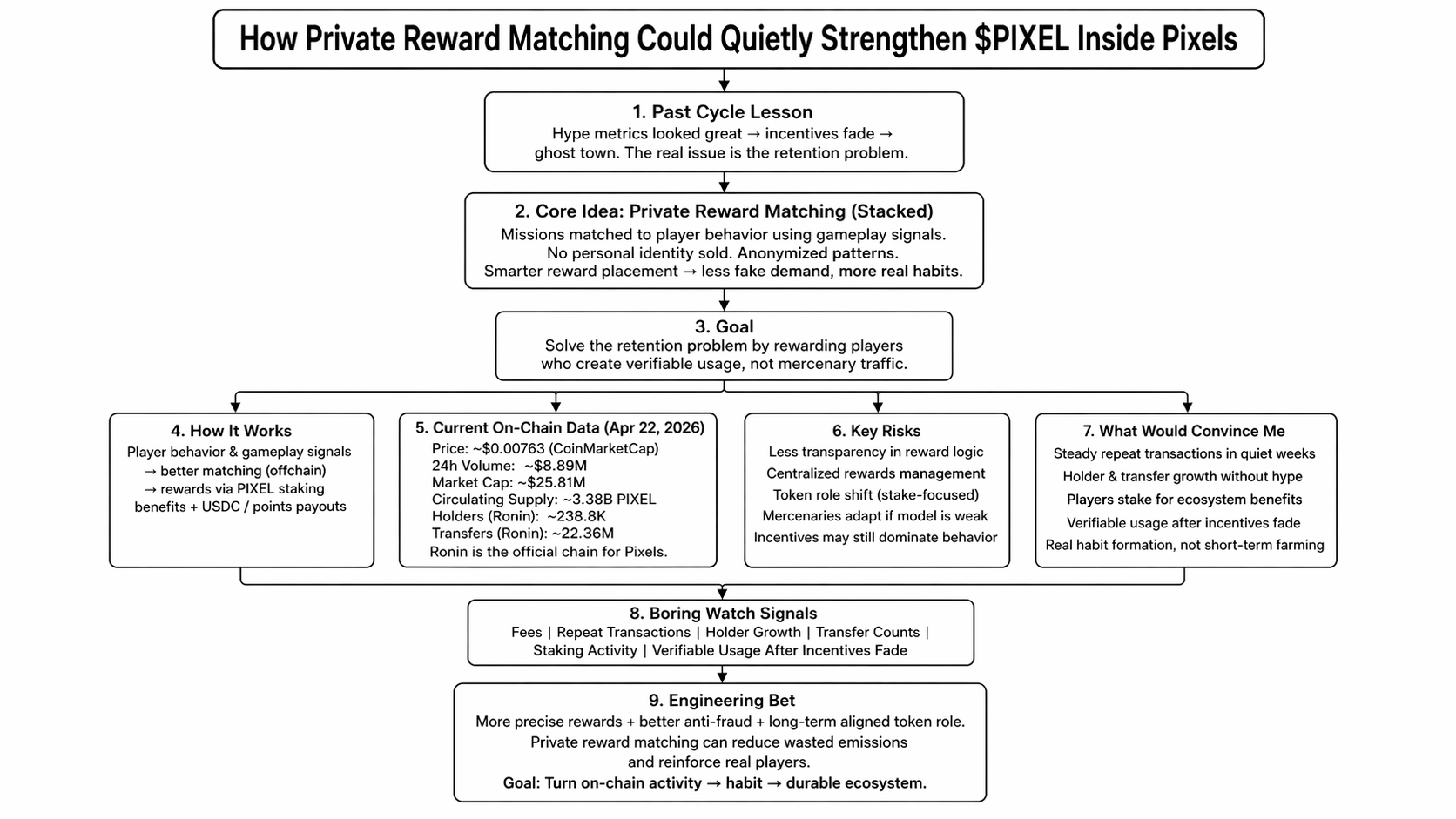
This is the reason why the reward that is equivalent privately is the more appealing to me than another loud reward campaign. Stacked is suggesting a system where missions are determined by the players actions and the gameplay indicators are used to improve matching and no personal identity is being sold, and anonymized trends instead of the usual ad-tech personal-data harvest. The unspoken idea of this is not simply additional rewards. It is pre-ferential placement of rewards. As the system grows smarter regarding who and what ought to receive what, Pixels stands a chance to stop paying money to fake the demand and start strengthening the actual practices in the game cycle. That is rather a different bet than the old play-to-earn where incentives were thrown about and hope that a community would emerge out of thin air.
The more I think it is, the more it appears this is an attempt to bring about the retention problem on the allocation aspect of the marketing problem rather than the marketing aspect. Luke Barwikowski described Stacked as the product of years of trying to make token live ops work, having hit bots, sybil behavior, and the reality of just putting rewards onchain. He stated that the team was data rewards oriented, segmentation and centralized rewards layer and started to shift to a model where PIXEL would become stake-oriented and USDC or points to cash-out rails would be used to shift user rewards. This is significant because blind token emissions will mostly generate mercenary traffic, but a more discriminating matching can sometimes compensate the players who actually do generate verifiable usage and not just those who are just learning how to game the system to their best advantage.
Market background is not spectacular, but real. On April 22, 2026, CoinMarketCap listed PIXEL at a price of around $0.00763, and with a volume of approximately 8.89 million and a market capital of around 25.81 million and a circulating supply of around 3.38 billion tokens. The token page of Ronin had shown it had around 238.8 thousand holders and around 22.36 million transfers at around the same snapshot. I am placing Ronin here instead of BaseScan because the Pixels site itself mentions the economy as Ronin and Pixels itself assist documentation on both deposits and withdrawals Binance specifically recommends that users must select the Ronin network when using PIXEL. The chain reference that is cleaner is called Ronin, as far as on-chain activity is concerned.
But here the doubting is returned. The matching can be used as a private reward to strengthen the economy and making the audit of the economy complex on the other hand. By aligning the offchain models and internal segmentation to the rewards, the players are being asked to believe that the system is fair, efficient, and not easily and simply manipulated without any knowledge of the logic behind the system. That’s one risk. Another is centralization. In the interview, it is very apparent that Stacked was evolved into a centralized rewards management solution, which can be viable, but it also suggests that the largest aspect of value distribution is concentrated in a layer that the user lacks any control over onchain. A third risk is the threat of token displacement. Turning PIXEL into a stake-only system at a very gradual pace, and moving cash incentives to either USDC or points, will definitely reduce the incentive to sell, but it also raises the more challenging question of whether the token's purpose is diluted or is made more concentrated. And, needless to say, the oldest risk will not disappear: in case the anti-fraud and matching stack is not good enough, the mercenaries will develop faster than the model.
and what would convince me indeed? Not the first week blow. Not the huge campaign thread. No temporary rise in volume. I would watch boring material that nobody wants to capture a screen shot. I would keep an eye on the repeat transaction to stay productive during lean weeks. I would see the holder growth and transfer counts trending on without a gigantic narrative candle doing all the heavy lifting. I would note that players would keep betting PIXEL on ecosystem benefits instead of transforming each reward touchpoint into an on-ramp. And I would be glad to know whether the game will be used in a verifiable way after the disappearance of the incentives, as this is really the whole argument. And in the event that matching is enhanced and the same users churn as the farm gets less juicy nothing fundamental was repaired.
My bet in engineering is elementary. Noisier rewards will not be as essential in Pixels. It needs more detailed rewards, greater anti-fraud measures, and a token purpose linked to long term alignment rather than short term extraction. This type of reward equivalence can privately help in that respect, especially in the event that it reduces wasted emissions and does shift value to those players who do actually improve the ecosystem. But I can not say that a more intelligent reward router has resolved economics. Not the same thing. The real test will be whether this system is capable of converting the on-chain activity into habit and habit into something enduring that the world will not turn dead when the easy money crowd will run out of interest.
And what do you think?--asked I. Will the private matching technology actually increase retention or merely hide the subsidy in a more genteel fashion? And so long as PIXEL keeps sinking into a more stake-based position with diversification of payouts, is it a healthier or a less critical token in the long-term?
@Pixels #pixel $PIXEL
