
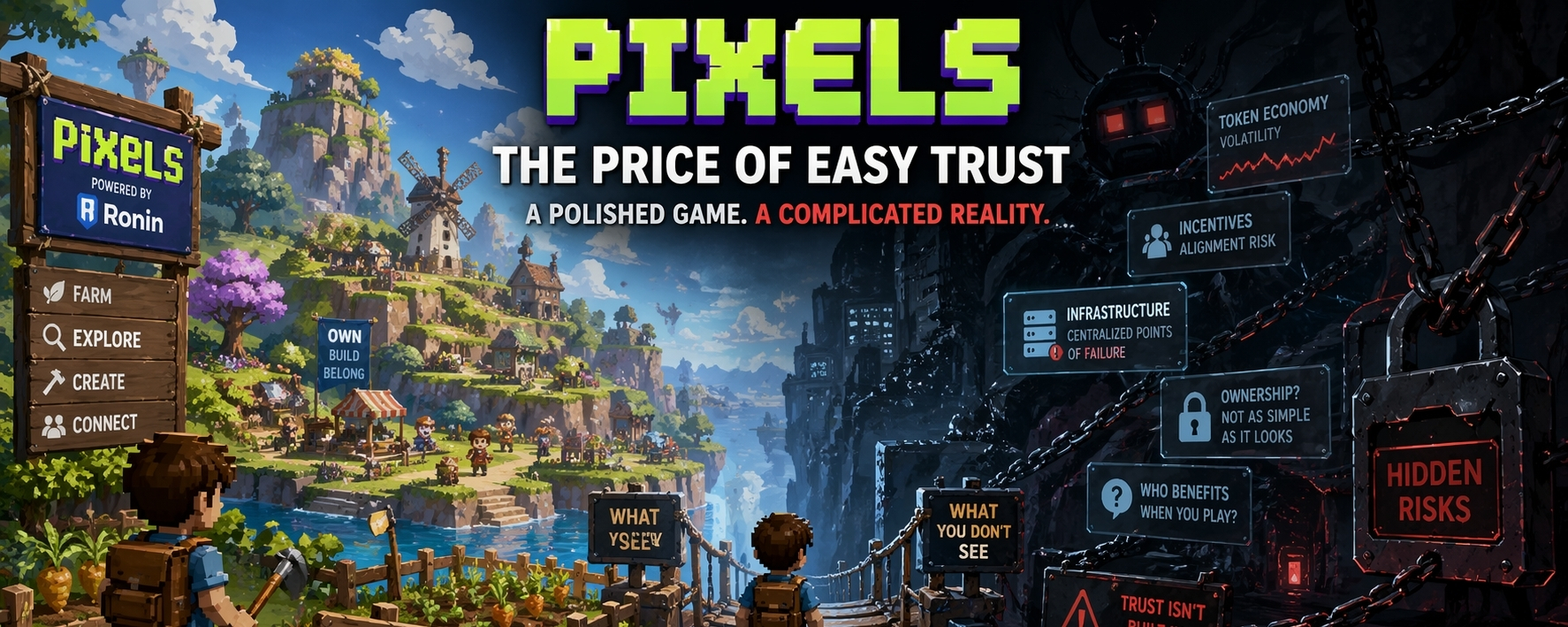
At first glance, Pixels (PIXEL) makes me uneasy in the specific way that polished products often do. Not because the idea is obviously wrong. Quite the opposite. It feels engineered to be easy to like. A social casual game. A familiar loop of farming, exploration, and creation. A friendly open world. A Web3 wrapper that promises ownership without demanding too much attention. It is the kind of pitch that arrives already translated into comfort.
That is exactly why I hesitate.
Because when something in crypto sounds this clean, this coherent, and this ready for mass adoption, the first question is not “Is it fun?” It is “What is being simplified away?”
And to be fair, some of what Pixels is trying to do is smart. It understands that most people do not want another opaque financial instrument disguised as a game. They want a loop they can immediately grasp. They want low friction. They want a world that feels accessible rather than technical. They want the emotional texture of play, not a lecture about tokens. In that sense, the project is not naive. It is strategic. It is trying to make blockchain infrastructure disappear behind a soft surface of ordinary game behavior.
That is a legitimate insight.
A lot of Web3 projects failed because they insisted on making the user notice the machinery. Pixels, at least in concept, moves in the other direction. It leans into usability. It makes the pitch social instead of ideological. It says: do not think about the chain, think about the world. Do not think about the wallet, think about the farm. Do not think about the abstraction, think about the experience.
That part is not silly.
But the deeper concern starts right there, because usability is not the same thing as assurance. Adoption is not the same thing as trust. And a polished interface does not answer the hardest question in Web3: what, exactly, can go wrong when the surface still looks fine?
That is where the romance of these systems starts to break down.
A game like Pixels depends on a layered stack of assumptions. The game has to remain engaging. The incentives have to remain aligned. The token economy has to avoid becoming a speculative circus. The social layer has to feel authentic enough to keep people returning. The infrastructure has to stay dependable. The surrounding network has to remain healthy. The governance has to stay legible. The product has to keep meaning one thing to players and a slightly different thing to traders without those two realities collapsing into each other.
That is already a lot. More than most glossy descriptions admit.
And then there is the hidden problem: once a game becomes financially legible, every action starts carrying a second meaning. Harvesting is not only harvesting. Crafting is not only crafting. Exploration is not only exploration. It becomes activity, yes, but also yield, signal, speculation, extraction. The game may look casual, but the incentives are not casual. They are structured, monitored, and ultimately vulnerable to players who care more about optimizing value than enjoying the world.
So what happens then? What happens when the people building the world are not the same as the people gaming the system? What happens when the most rational participant is not the most engaged player, but the most efficient extractor?
This is the trust gap that Web3-friendly games rarely confront honestly. They want users to believe in ownership, but ownership in these ecosystems is always partial, conditional, and entangled with systems the user does not control. The user may own a token or a digital asset in one sense, but the actual experience still depends on developers, servers, policies, incentives, and the continued credibility of the whole arrangement. The promise is decentralization, but the lived reality is usually dependency with extra steps.
That is not a minor contradiction. It is the central one.
Pixels, like much of the Web3 space, invites players to trust a hybrid system that is constantly asking for confidence while offering only fragments of it. Confidence that the economy will stay coherent. Confidence that the social world will stay lively. Confidence that the incentives will not drift into parody. Confidence that the project will not quietly become more about retention metrics and token flows than about play. Confidence that “open world” means depth, not just sprawl. Confidence that the experience can remain delightful even after the novelty wears off.
And novelty does wear off.
That is the hidden risk. Not immediate failure, but the slower and more embarrassing kind. The kind where a project does not explode; it just gradually reveals how much of its appeal depended on the audience being willing to overlook structural uncertainty. At first, the world feels fresh. Then it feels busy. Then efficient. Then repetitive. Then opportunistic. Then, eventually, like a system whose best argument was always the smoothness of its pitch.
How much of the appeal is the game itself, and how much is the story we tell ourselves about what it represents? How much is actual player value, and how much is the emotional comfort of participating in a platform that claims to merge fun with ownership? Those are not hostile questions. They are the questions a serious product should welcome.
The problem is that Web3 projects often confuse visible activity with durable trust. A busy marketplace can look like a healthy ecosystem. A lively community can look like product-market fit. A rising token can look like validation. But none of those things answer whether the system is robust under stress, whether the incentives will survive a downturn, or whether users would still care if the financial sheen were removed.
That is the uncomfortable contrast here: usability versus trust.
Pixels may succeed at usability. It may even succeed at creating a world people enjoy inhabiting in bursts. But trust is harder. Trust requires users to believe that the structure beneath the interface is not only functional, but resilient; not only convenient, but honest about its trade-offs. And in Web3, honesty is often the first thing polished away.
So yes, I understand the appeal. I even think part of it is intelligent. A game should feel inviting. It should not announce its complexity every time a player takes an action. But the more confidently a project hides its machinery, the more carefully we should ask what else is being hidden with it.
That is the real test, not whether Pixels looks polished, but whether it can survive the moment when players stop admiring the surface and start asking who really carries the risk.
Because in the end, the warning is simple.
When a Web3 game feels effortless, do not assume the system beneath it is simple.
Assume it is expensive somewhere else.
