
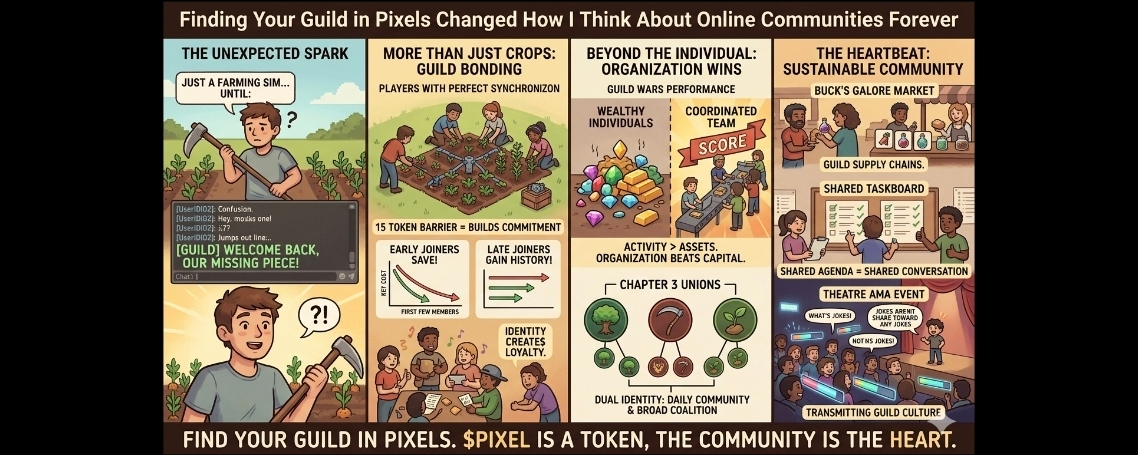
I want to talk about the moment this game stopped being a farming simulator and started being something I actually cared about
It wasnt the first time I harvested a rare crop
It wasnt the first time I completed a difficult crafting recipe after grinding a skill tree for three days
It was the moment I joined a guild and realized that twenty other people had been waiting for exactly the kind of player I was building myself into
That feeling is harder to engineer than any blockchain mechanic and @Pixels somehow pulled it off
The guild system requires 15 tokens to create which sounds like a barrier until you understand what that friction is actually doing
It filters out throwaway communities created on impulse and replaced within a week
The bonding curve pricing for guild membership means early members pay less to join than later members which creates genuine incentive for founders to recruit actively and for early joiners to feel like they got in on something before it grew
A guild with 50 members that started with 10 has a real internal history that newer members can feel even if they werent there for the founding
That history creates identity and identity creates loyalty
Loyalty is the only thing that keeps a community alive past a bear market
And the Guild Wars seasons give that identity something to fight for which is the design element I think is most underappreciated in the entire game
Guild Wars Season 2 ran a 4 million dollar prize pool distributed across competitive rankings that rewarded collective farming output rather than individual token holdings
A guild that organized their members around coordinated crop cycles and resource sharing and task completion timing could outperform a guild full of wealthier but less coordinated players
I watched smaller guilds beat larger ones during that season because the smaller ones had tighter communication and clearer daily plans while the larger ones assumed their member count would carry them
Organization beats capital when the scoring system measures activity rather than assets
The Chapter 3 Union system built on top of the guild foundation in a way that I find genuinely exciting as someone who studies community dynamics professionally
Three factions named Wildgroves Seedwrights and Reapers compete for Yieldstone territory control with prize pools that scale based on total participation
But the genius of the Union layer is that it gives guilds a larger identity to belong to without replacing the smaller community they already built
Your guild is still your guild
Your Union is the coalition your guild chose to align with
That two tier identity structure means players have a close community for daily interaction and a broader faction for competitive events without either one cannibalizing the social function of the other
Two homes instead of one
Both of them real
The marketplace inside Buck’s Galore is where I watch guild economies express themselves in ways that most players dont consciously notice
Guilds that have coordinated their member specializations create internal supply chains where the farming members supply raw crops to the cooking members who produce energy items that the whole guild uses to farm more efficiently
When that internal economy runs well the guild becomes partially self sufficient and its members spend less time in the open marketplace competing against strangers for resources they need
When a player from outside the guild wants access to what that internal economy produces they pay marketplace prices that reflect the genuine coordination cost embedded in that supply chain
The best guilds arent just social groups
They are small functioning businesses
The daily Taskboard creates a shared rhythm inside guild life that most members dont explicitly acknowledge but everyone benefits from
When your whole guild is completing the same rotating set of daily tasks the conversation in guild chat naturally organizes around those tasks
Someone posts that they finished the cooking tasks and asks if anyone needs the energy items they produced
Someone else mentions they have excess Marble from the mining tasks and wants to trade
The Taskboard generates a daily agenda for guild economic cooperation without the leadership having to mandate it
Shared goals create shared conversation without any management overhead
And the Theatre AMA events are where guild culture gets transmitted to new members most effectively in my experience
When the team holds a live community broadcast and players earn energy for attending the guild members who show up together create a shared reference point that newer members can tap into later
The jokes that get made in guild chat during an AMA become inside references that mark someone as a real member rather than a recent joiner
The energy bar filling in the corner while your guildmates riff on developer answers in chat is one of those small experiences that turns a game into a place
A place you come back to because people you like are there
I want to be honest about the time investment that finding the right guild actually requires because I think friendly articles about this game often skip past the real friction
The Reputation Score system means new players cant trade immediately which limits how useful they can be to a guild in their first days
The skill trees take real time to level which means a new member cant contribute meaningfully to high tier crafting chains until they have put in the hours
A guild that accepts everyone immediately will have a lot of enthusiastic new members who dont yet understand the economy well enough to participate in coordinated play
The good guilds have onboarding processes
The great guilds have mentorship cultures
What I keep coming back to about the @Pixels community in April 2026 is that it has survived things that should have destroyed it
A 99 percent token drawdown
Hundreds of thousands of bot bans
The loss of players who came purely for airdrop speculation and left when the speculation stopped paying
What remained after all of that attrition is a community of players who stayed because they had found people inside this world that they genuinely wanted to farm next to
That is the most durable foundation any online community can have
Not token price
Not feature announcements
Not influencer coverage
Just people who showed up for the game and stayed for each other
If you are thinking about trying Pixels for the first time my genuine advice is to spend your first week finding a guild before you optimize anything else
Not the biggest guild or the most decorated one
Find one whose members are online when you are and whose chat feels like a conversation rather than a broadcast
Complete your daily tasks alongside them
Trade with them before you trade with strangers
Let the game introduce you to the economy through people who already understand it and want to help you understand it too
The farming will make more sense once you have someone to farm with
The crafting will feel less overwhelming once someone in your guild has already figured out the recipe you are struggling with
And the days when the token price makes you wonder why you are playing at all will feel more manageable when there are twenty people in your guild chat who are wondering the same thing and farming through it anyway
$PIXEL is a token
The community around it is something harder to price
