
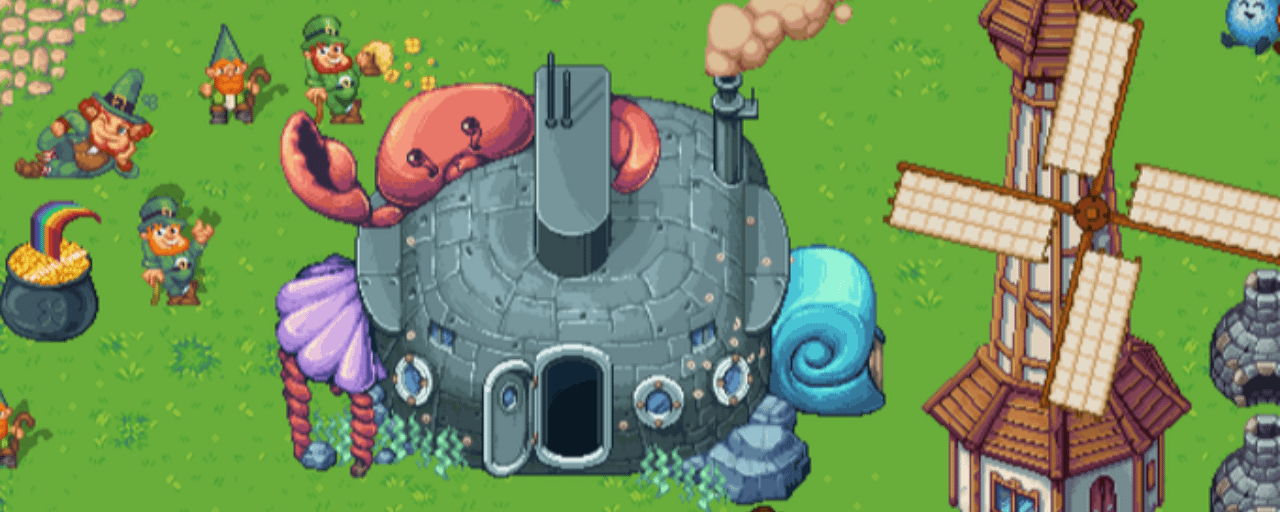
Guys, I'm back to talk about @Pixels again. Today, I want to discuss something that gives players a sense of 'belonging' in Pixels—the Guilds 2.0 system.
Honestly, the concept of guilds in blockchain games has been overused. Most projects set up guilds just to rake in members and boost daily active users; fundamentally, it’s just a 'gold farming operation' where nobody knows each other, and everyone just logs in to grab a task and then splits. But after a whole week of playing with this guild update in Pixels, I found out they’re seriously deepening the idea of 'community'.
So how does this guild system really work?
To put it simply, Guilds have borrowed the logic from FriendTech. If you want to join a guild, you need to buy a membership, and the price is automatically set by the Bonding Curve. The more people there are, the pricier the membership; the fewer people, the cheaper. You can also sell your membership anytime, but there’s a 5% tax on trades that goes to the guild treasury and Pixels official.
Ningfan's first reaction: isn't this turning social relationships into financial products?
But after playing for a few days, Ningfan realized—this is precisely the unique value of Web3 social. In traditional games, if someone leaves a guild, that's it; your contributions, your connections, your identity—all gone. But in Pixels, your guild membership is a blockchain record that has market value. If a guild has a great vibe, plenty of resources, and active members, the membership appreciates. Conversely, if a guild turns into a ghost town, the price will naturally drop. The market is pricing 'community quality.'
Plus, each guild has its own treasury. The 5% tax from buying and selling memberships continuously feeds into the treasury, which can be used for events, benefits, or resources. There are even rankings among guilds, competing for honor, rewards, and status within the ecosystem. The Guild Charter itself is also an NFT asset, with more features yet to be unlocked in the future.
From solo play to team-up, why is Pixels investing so much thought into social aspects?
Ningfan has been immersed in Pixels for almost a year, and the deepest insight is: what retains people is never the token rewards, but the relationships.
Think about it, why do you log in every day? It’s not just for the 0.0002 tokens waiting for you, but because you know your crew in the Union is waiting to tackle Bountyfall together, because your guild has an event tonight, or because someone @mentions you to help feed the animals on the farm.
Pixels has evolved from a farming simulator to the Bountyfall alliance system, and now to Guilds 2.0. The whole social layer is progressively complex. Now you have a Union as your major faction, a Guild as your small circle, and Land as your personal space—this three-tier social structure covers all social scenarios from macro to micro.
Ronin is migrating to L2, and Pixels is riding the wave.
By the way, Ningfan recently came across another major announcement: the Ronin network will officially migrate to Ethereum Layer 2 on May 12.
This news is definitely a boon for Pixels players. After the Ronin migration to L2, cross-chain asset transfers will be safer and more efficient, and the liquidity within the ecosystem will improve. Moreover, after the migration, the inflation rate of RON tokens will drop significantly from over 20% to below 1%, leading to a noticeable improvement in the economic health of the entire ecosystem.
Pixels, as one of the leading games in the Ronin ecosystem, has surpassed 120,000 daily active users, growing 167% since 2026. This upgrade of the Ronin foundation means Pixels can accommodate more mainstream users, run more complex gameplay, and integrate more external game studios. The entire ecosystem's ceiling has been raised.
Of course, Ningfan has to be honest: while the Guilds system is a brilliant concept, it’s still in the early stages. The guild charter, ranking system, and treasury functions are all gradually being perfected. But what Ningfan values is the direction—the Pixels team hasn’t taken the shortcut of 'piling on token rewards to attract members'; instead, they've chosen to turn community relationships into assets, using market mechanisms to incentivize a positive community culture.
This path is tough, but once you navigate it, it redefines not just a game, but the ancient concept of 'online social relationships' in the Web3 era.
Hey bros, have you joined a guild yet? How much do you think your guild membership is worth? Let's chat about it in the comments! #pixel
