
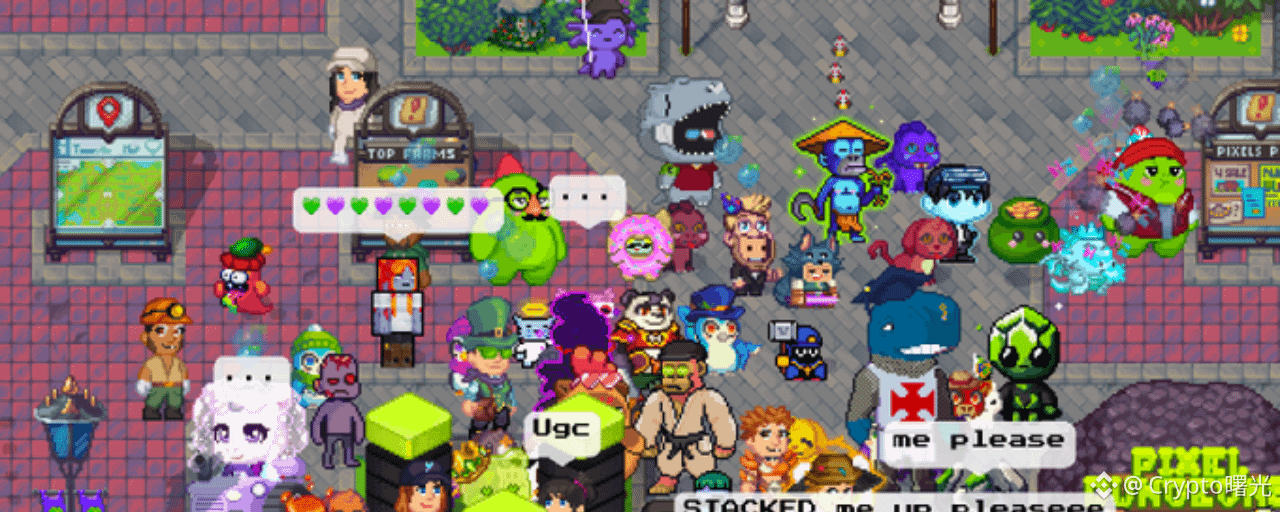
A lot of folks are glued to their screens, staring at those tiny pixelated characters, thinking this is just another "click-to-earn" farm game, a tired hype trick. But as I sit in this less than twenty square meter apartment in Tokyo, watching the endless stream of people in Shibuya outside my window, and then looking back at my screen where I'm mindlessly repeating harvesting actions, it suddenly hits me: maybe everyone's missing the point. Sure, the price action and ROI cycles are important, but what really determines the fate of this game is the core mechanism in the whitepaper that almost everyone overlooks—the Trust Score System. This isn’t just a simple anti-bot tool; it’s a sophisticated "digital personality filter." It quietly gathers your wallet age, asset holdings, task completion consistency, interaction frequency with other players, and even your daily login patterns... all your on-chain activities are transformed into a cold, hard score.
@Pixels Unlike most projects shouting 'decentralized freedom', it goes against the grain by constructing a harsh digital hierarchy. It sees clearly: in the chain's desolate landscape filled with scripts and bots, total freedom only leads to destruction. Therefore, it needs a threshold to filter out those speculators who just want to cash in and run, leaving behind the 'digital residents' it truly desires. You think you’re farming or picking fruits, but in reality, you’re proving to the algorithm, through high-frequency, low-effort, repetitive labor: I am a real person. This is a 'proof of authenticity' completed with time and patience—the more diligent you are, the more human you appear.

This design carries a strong sense of irony. We entered the crypto world to break free from traditional authority and escape centralized control, yet now we find ourselves farming day in and day out in pixel grids, just to earn the algorithm's 'trust'. Landholders have become the new landlords, while ordinary players without land are quietly suppressed with extremely low resource acquisition efficiency. Class stratification happens here faster, more directly, and more starkly than in the real world. The most sobering and brutal aspect of Pixels is that it doesn’t sugarcoat things. It bluntly admits—resources are scarce, and not everyone deserves equal returns. This uncomfortable economic model is, in fact, closer to a real society than those polished 'everyone gets rich' narratives. Today's players are living in a state of conflict.
On one hand, we complain that this mechanical repetition is a waste of life; on the other, we can't help but get hooked. Because in a reality filled with uncertainties, a click of the mouse guarantees some outcome; this predictable certainty has become the cheapest form of psychological comfort for many. From a certain perspective, Pixels is building a massive attention-capturing loop. It doesn’t require you to be smart or strategic; it just wants you to stick around. Every second you linger, every click you make, adds liquidity and data to this pixelated world.

What's the endgame of this whole crypto scene? It might not be about getting rich quick or even finding real happiness. It's more like a massive sociology experiment: how do we, as humans, navigate when all our social interactions are reduced to codes, tokens, and incentive mechanics? How do we seek a sense of control and existence within these algorithmic walls? We hustle, farm, and trade in these tiny pixelated matrices, trying to stitch together our own meaning from the fragmented logic. In the end, we’re frantically clicking away, maybe not just for that token, $PIXEL but to stubbornly prove our presence in a world dominated by algorithms and scripts.
I’ll still get tired, I’ll still vent, I’m still a flesh-and-blood individual. This is probably the most helpless yet hardcore way to survive in our era.#pixel $PIXEL
