
@Pixels I keep seeing Pixels get talked about like it’s “just a game,” but honestly the more I look at it, the more it feels like people are missing the actual experiment here.
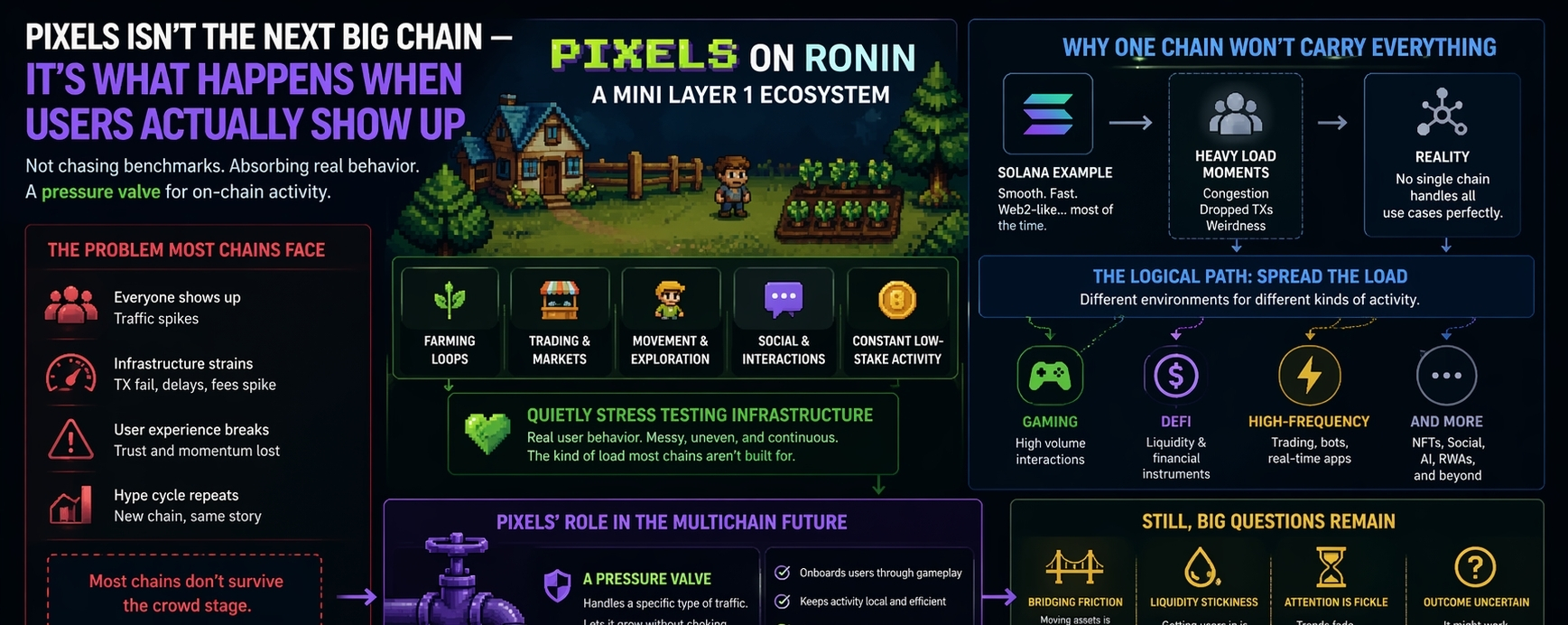
Everyone keeps chasing the “next big chain” like we didn’t already do this cycle five times. Same script. Faster TPS, lower fees, cooler branding, anime farmers or AI agents slapped on top. Then traffic hits and suddenly everything stutters, fees spike, or something just… breaks. Not because the tech is fake, but because real usage is messy and uneven and people all show up at once.
That’s the part most chains don’t survive. Not the whitepaper stage. The crowd stage.
Pixels sitting on Ronin and behaving like a mini Layer 1 ecosystem is actually kind of interesting in that context. It’s not trying to win a benchmark war. It’s just absorbing real user behavior. Farming loops, trading, movement, constant low-stakes interactions. The kind of stuff that quietly stress tests infrastructure without announcing it.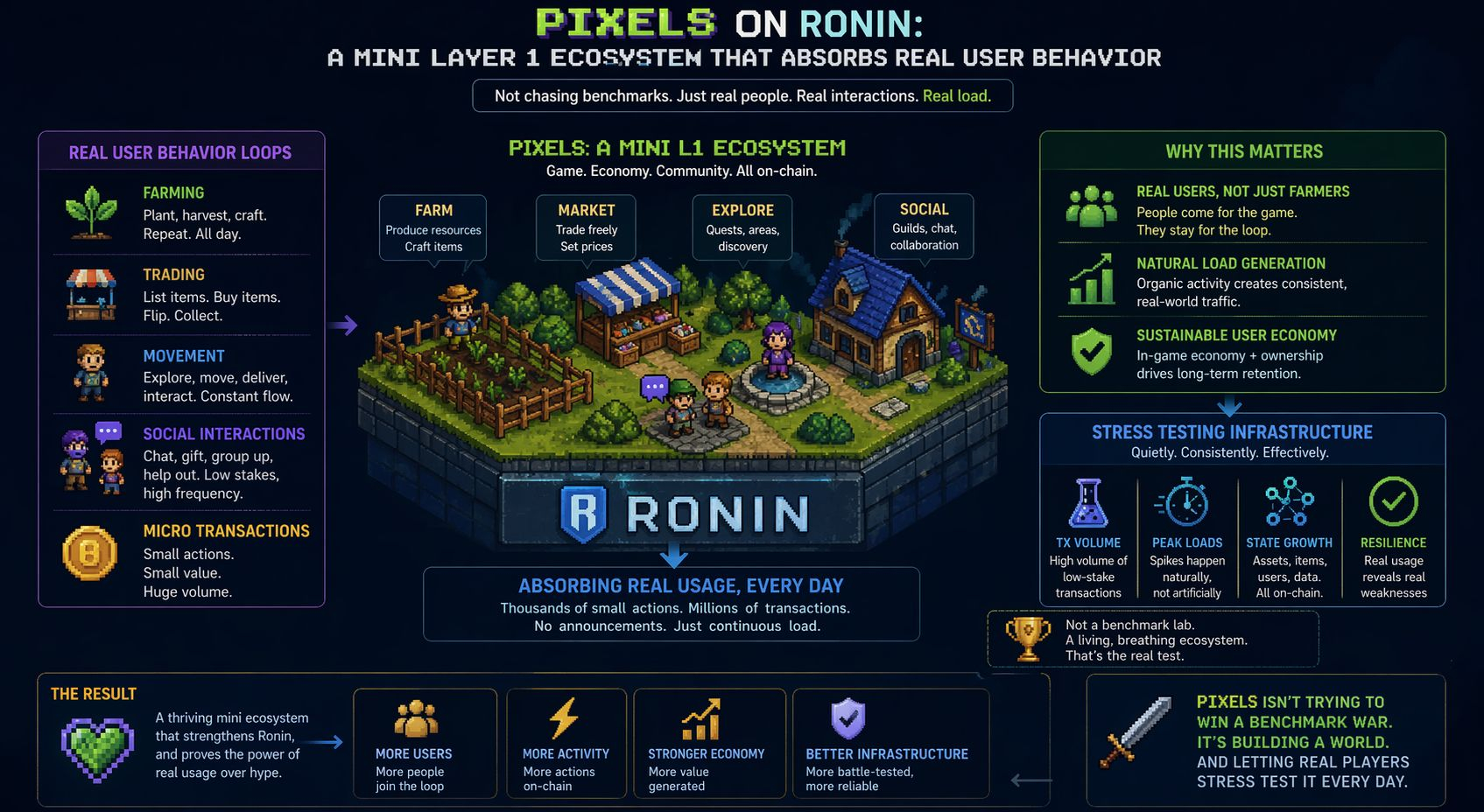
And yeah, we’ve all used Solana. It feels smooth. Probably the closest thing to Web2-like responsiveness most of the time. But even that has had moments where heavy load turns into weirdness. Congestion, dropped transactions, whatever version of “it’s fine but not really” we’re calling it now.
So the idea that one chain is going to carry everything feels… outdated. Or maybe just naive. The logical path is spreading load. Different environments handling different kinds of activity. Games here. DeFi there. High-frequency stuff somewhere else.
Pixels kind of fits into that picture. Not as “the chain,” but as a pressure valve. A place where a very specific type of traffic lives and grows without immediately choking something bigger.
Still, I’m not fully convinced. Getting users into a game is one thing. Getting real liquidity to stick around is another. Bridging friction is still annoying. People don’t move assets unless there’s a clear reason. And attention is fickle. Always has been.
So yeah, I’m watching it. Not hyped. Not dismissing it either.
If anything, it feels more grounded than most of what’s being pushed right now. Less narrative, more usage. Which is rare.
It might work. Or nobody shows up.
