
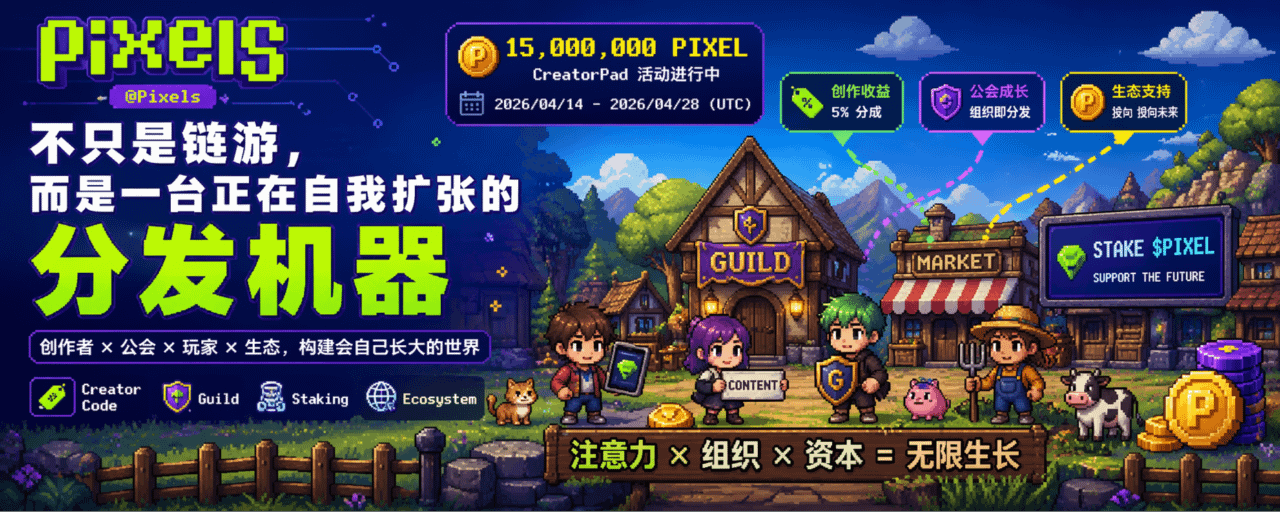
A lot of people look at Pixels and instinctively focus on the surface level: pixel art, farming, tasks, land, pets, social features, version updates. Digging a bit deeper, you might find tokens, hype, activities, and sentiment. While this perspective isn't wrong, I increasingly feel like it's missing the point. If you really break down the world structure of Pixels, you'll discover that what’s most worth studying isn’t just a gameplay loop or a specific event, but rather the slow emergence of a capability that many Web3 games aspire to but few actually achieve: creating a self-expanding distribution network that unites creators, guilds, and everyday players.
Why did I suddenly approach this from this angle? Because most blockchain games eventually face a very real issue: no matter how hard the project team tries, it's tough to keep pushing traffic back on their own. You can do version updates, airdrops, incentives, or collaborate with KOLs, platforms, and ecosystem links, but most of these are still driven by 'external forces.' External heat is certainly useful, but it usually comes quickly and leaves just as fast. What can truly thicken a world over time is not a single major exposure, but whether there is a mechanism that can continuously replicate, spread, and draw newcomers from within. In other words, the real ceiling for a project isn't whether it can get seen once, but whether it can enable 'those already inside' to spontaneously become the next batch of user entry points.
I think the most commendable aspect of Pixels right now is precisely here. Many people view it as an ordinary project logic of 'creating content, issuing rewards, and maintaining activity,' but if you look at CreatorPad events, Content Creator Code, Guild, Guild Shards, Verified Guild, and Staking together, it is not just about creating content anymore; it is doing something smarter: allowing external dissemination, internal organization, economic distribution, identity consolidation, and ecological expansion to begin interlocking. Simply put, many previous games operated under the logic of 'the project team produces content, and players consume content'; while Pixels increasingly resembles 'the project team provides the world framework and then lets players, guilds, and creators become the dissemination nodes of this world.' When a project starts to possess this structure, its narrative no longer centers on 'what this game has updated,' but evolves into 'whether this world can grow by itself.'
The CreatorPad event is actually like a magnifying glass. On the surface, it’s certainly a platform event, bringing exposure and content supply to m-25 from Binance Square, with a prize pool of 15,000,000 PIXEL, and the posting rules are quite clear: include t-27, include c-29, mention Pixels, and the content must be original and strongly related to the project. Many people interpret this as a simple content acquisition, but I don't completely see it that way. The reason this event is particularly valuable for Pixels is not just the short-term attention it brings, but because it naturally aligns with what Pixels is already doing: allowing 'the people who talk about this world' to also become a part of its economic ecosystem. Creation is no longer just external promotion but is gradually being integrated into the internal benefit structure.

This is exactly why I think Pixels is smarter than many ordinary blockchain games. Most projects understand the importance of creators, but their approach is often superficial: either a one-time collaboration fee, a whitelist, some perks, or getting KOLs to help promote it. The problem with this approach is that the relationship between creators and projects remains an 'outsourcing relationship.' Collaborate when the hype is there, and disperse when it's gone. However, Pixels at least offers another possibility: it doesn't just let creators 'speak for the project,' but starts allowing creators to participate directly in the value flow of this world through code, discounts, revenue shares, community, and guild structures. The official help center states clearly that the Content Creator Code will give buyers a 5% discount, and creators or guilds can also earn a share from the corresponding PIXEL purchases; creators have a tiering system with revenue shares at 3%, 5%, and 7%, while guild and developer codes maintain a 5% share. This means that creators are not just here to 'bring the hype'; they are starting to have a revenue pipeline that can be tied to the project long-term.
Why is this important? Because it changes the incentive logic for creators. Previously, you might write about a project just for traffic, advertising, or competition rankings; now if you can receive long-term feedback from purchasing behavior, community growth, and user conversion within the world, your relationship with the project deepens. You are no longer just looking to ride a wave of hype but will start thinking: how to bring in more people who will genuinely stick around? How to create a stronger connection between your community and the project? How to transform content from merely 'telling' into 'organizing'? Once a world enables creators to evolve from content producers into internal revenue-sharing dissemination nodes, its distribution logic changes entirely. That distribution is no longer a one-way throw from the project but will gradually grow into a multi-node, multi-center, profit-bound dissemination network.
If we bring Guild into the picture, the line becomes clearer. The official help center details that creating a guild requires a reputation/trust score of 2050 and 15 PIXEL; guild owners can earn a 5% fee from users purchasing shards that go into the treasury; guilds can also set whitelists, assign member roles, and manage member permissions; landowners can even link NFT Farm Land to the guild, allowing only guild members to access or use it. Furthermore, Pixels also offers a guild verified checkmark, requiring the guild leader to have over 3500 reputation, at least 30 members in the guild, and attached socials to match the applicant. These mechanisms combined create not just a simple 'community feature,' but a very typical 'organization as distribution' structure.
Why do I hold Guild in such high regard? Because if a blockchain game relies solely on the project team for operations, its scale will quickly hit a ceiling. You can maintain one community, ten communities, or dozens of communities, but it’s challenging to endlessly extend your reach into every niche layer. The way to truly break through this limitation has never been for the project team to work harder, but to let the organization grow itself. The significance of the Guild is not just gathering people to chat, but allowing different groups to establish their own order, identity, treasury, and expansion logic around the same world. As long as the guild itself has economic feedback, member thresholds, role hierarchies, and land or resource cooperation, it will no longer be just a loose chat group but will gradually evolve into a small autonomous node. If a project can grow many such nodes within its world, its distribution capability will start to detach from a single official account, transforming into a model driven by 'community organizations + creators + project framework' working together.
More crucially, Pixels does not place Guild outside the world but embeds it within it. Guild is not just a text-based community; it is connected to Land, role permissions, shards, verified status, and reputation. If you want to build a guild, you must first manage yourself; if you want the guild to be more trustworthy, you must meet higher thresholds; if you want members to truly feel a sense of belonging, you need to make the guild more than just a name, but a place that can interact with land, roles, and resources. This way, Guild becomes not just an empty shell where 'anyone can shout,' but gradually forms a well-organized, filtered, and economically bound internal distribution node. You could even understand it as Pixels turning the originally very abstract 'community' into a tangible entity that can be seen on-chain and within the game, participating in economic distribution.
If we look at the Creator Code and Guild together, it becomes clearer why I say Pixels is creating a distribution machine rather than just a game. The Content Creator Code gives content spreaders a revenue loop, Guild provides organizers with a treasury and member structure, while events like CreatorPad cyclically bring external attention in. Thus, the entire system forms an interesting closed loop: external platform activities bring in new traffic, creators engage that traffic with content, guilds manage relationships, and the Creator Code and Guild Treasury reinvest part of that value back into the world. Once this closed loop starts running, the project team is no longer the only engine. It resembles maintaining a machine that continually grows new wheels. The more wheels there are, the harder it becomes for the project to rely solely on a single breakout point, and instead, it slowly forms a capacity to 'spread itself further.'
This is also why I believe many people currently have a shallow understanding of the valuation logic of Pixels. The market most easily sees the token price, activities, versions, and hype, but these are all results. The more fundamental question should be: what is actually driving the growth of this project? If a project's growth can only rely on 'the official has made another move,' then its ceiling is always obvious; but if a project begins to allow creators, guilds, supporters, and regular players to each have their reasons to expand this world, then it has the opportunity to shift from 'project-based growth' to 'network-based growth.' The difference between the two is huge. The former relies on a single point, while the latter relies on nodes; the former fears fatigue, while the latter fears not having enough nodes; the former empties out when the hype fades, while the latter can still keep rolling forward even if the official pace slows down, thanks to the community and creators.
And at the Staking layer, it just happens to add another leg to this distribution network. The official help center has clearly stated that users can choose the games they want to support at staking.pixels.xyz by staking PIXEL into different projects; unstaking will have a 72-hour lock period; the official FAQ directly mentions that staking is to 'grow the ecosystem' and 'influence the future of the games you love.' I find this design very important, as it adds a dimension of 'capital support' beyond dissemination and organization. Creators can distribute attention, guilds can organize relationships, and stakers can distribute resources. At this point, the world of Pixels is not just filled with players, writers, and organizers, but also people allocating capital to different future directions. The most concerning thing for an ecosystem is not the lack of hype, but rather having hype and resources constantly revolving around the same point in the short term; at least structurally, Pixels has begun to make 'different people supporting the same world in different ways' possible.
So when I look back at @Pixels now, I feel that the real reason it deserves to be re-evaluated may not even be about whether the farming gameplay still has vitality, but whether it has the chance to become a self-spreading Web3 world. The spread of this world relies not just on advertising, nor solely on KOL retweets, but on creators wanting to keep creating, guilds wanting to keep recruiting, supporters wanting to keep staking, and regular players wanting to keep joining a node, ultimately transforming the world’s dissemination from a one-way broadcast into multi-point growth. For a blockchain game, this ability is extremely rare. Because gameplay can be replicated, art style can be replicated, and events can be replicated, but a distribution network that has already connected creator incentives, guild organization, social relationships, economic distribution, and ecological support is the hardest to completely duplicate.
I even feel that if this line continues, the real big imagination behind m-47 might not be 'is it a strong blockchain game?' but 'could it become a blockchain world that grows its own nodes?' The so-called long nodes refer to today adding a creator, tomorrow adding a guild, the day after adding a staking community supporting a subproject, and later adding a small community formed around guild treasury, creator code, or land collaborations. You will find that what the project team truly needs to do is not to handle everything by itself, but to place the rules, revenue sharing, identities, and tools there, allowing more nodes to grow by themselves. As long as nodes can grow, the world can expand; as long as the world can expand, what PIXEL accommodates isn't just a consumption logic within a game, but a network logic that continuously weaves attention, relationships, and capital together.
So if I had to summarize my latest thoughts on Pixels in one sentence, I would say: its strongest point is not that it has created a playable pixel world, but that it is slowly integrating 'who tells this world, who organizes this world, and who supports this world' into one cohesive system. Once this system truly runs smoothly, m-73 will no longer be just a project needing promotion, but will increasingly resemble a network that inherently possesses dissemination capabilities. By that time, when everyone looks at PIXEL, it may no longer just be viewed as a game token, but rather as the core connector within this network: connecting creator revenues, connecting guild treasuries, connecting player participation, connecting ecological support, and connecting whether the world can continue to grow outward. For me, this is the most interesting and easily underestimated aspect of Pixels right now.t-75