
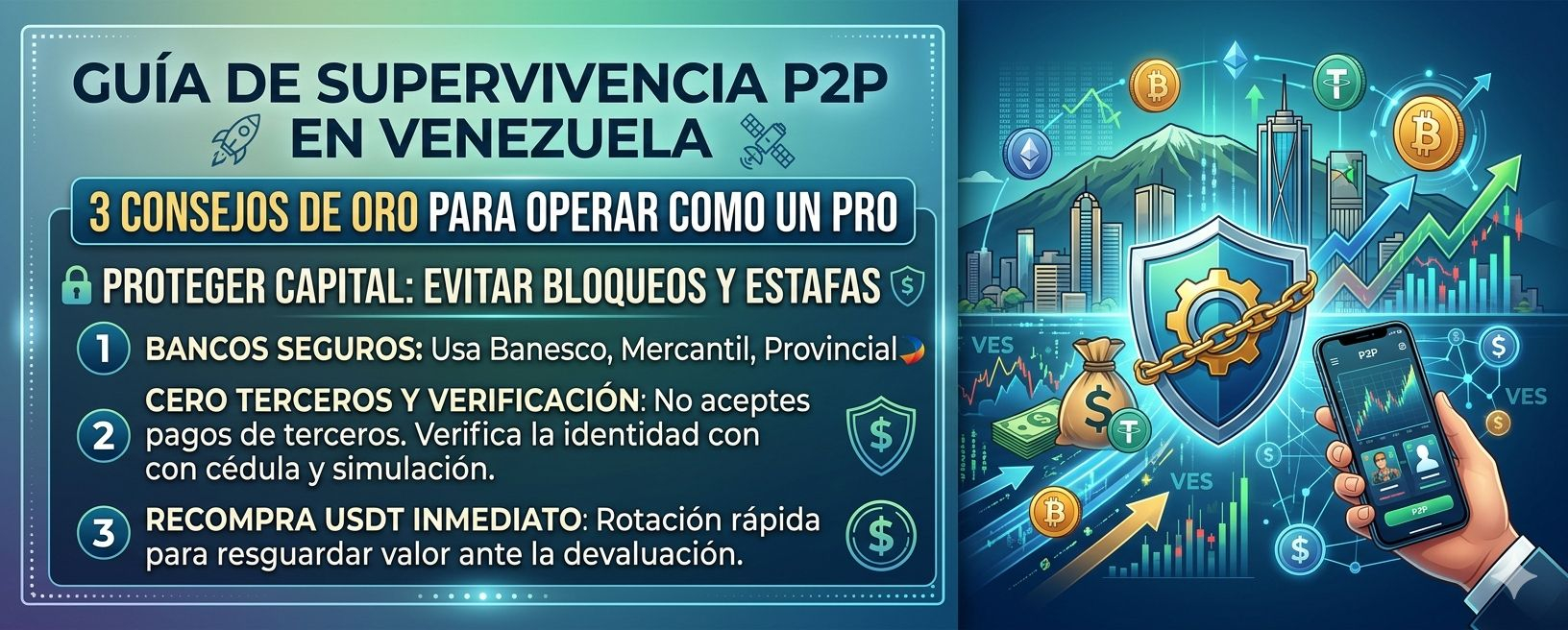
Trading on the Peer-to-Peer (P2P) market in Venezuela is an art that blends finance, digital security, and a dash of market psychology. In such a volatile economy, it’s not enough to just buy low and sell high; true success lies in safeguarding your capital from bank blockades and scams.
If you're just starting out or looking to professionalize your trading game, here are the 3 fundamental pillars straight from the Venezuelan digital trenches:
1. Choose your allies wisely: Stay away from Public Banking.
In Venezuelan P2P, the bank you choose can be your best partner or your worst nightmare. There's absolute consensus among experts: do not use Banco de Venezuela (BDV) to receive funds from strangers. This bank is extremely prone to freezes due to investigations (RAS), which can lock your money for months, resulting in massive devaluation of your capital.
💡 Winning strategy:
Use the "Golden Trident": Focus your trades on Banesco, Mercantil, and Provincial. They are the fastest and most efficient for P2P.
Professionalize your account: Don't wait for the bank to call you. Update your records every 3 to 6 months.
Justify your funds: Have an Income Certification ready and write a simple Explanatory Letter detailing that your economic activity includes crypto asset arbitrage.
Use strategic terms: When justifying high transaction volumes, use terms like "Digital Assets" or "Financial Advisory."
2. Shield "No Third Party" and Strict Verification
The biggest threat for a trader in Venezuela is triangulation. This occurs when a scammer uses a stolen (or hacked) bank account to pay you. If you accept that money, you could end up facing subpoenas from the CICPC. Your golden rule must be unbreakable: never accept or make payments from third-party accounts.
🛡️ Unbeatable security protocol:
Real-time verification: Before sending your payment details, request a photo of the counterpart's ID.
Cross-check the information: Simulate a transfer on your bank's website/app to confirm that the account holder's name exactly matches the name verified on Binance. If they don't match, cancel the appeal.
Leverage technology: Use tools like @CedulaBot on Telegram to verify the validity of identities.
Don't trust the "captures": Many scammers edit receipts in seconds. Don't release the cryptocurrencies until the balance is liquid and available in your bank account.
3. Master the "Cycle" and Market Volatility
In Venezuela, the bolívar doesn't forgive. A moment's neglect can turn your profit into a loss due to exchange rate jumps. The key to profitability is rapid rotation and timing.
📉 Market Tactics:
The Immediate Repurchase Rule: Due to constant devaluation, the golden recommendation is to repurchase USDT immediately after selling your assets for bolívares. Never hold bolívares longer than strictly necessary to safeguard your capital's value.
Strategic Timing: Trade when the market is more stable. Usually, this is early in the morning (6:00 AM - 9:00 AM) or in the evening (after 5:00 PM). If you're inexperienced, avoid trading on Monday and Tuesday mornings, which tend to be highly volatile.
The Path to Merchant: Your initial priority shouldn't be making a lot of money, but rather accumulating volume and reputation. Focus on achieving the Verified badge (P2P trader). Moving volume (e.g., at least 1 BTC in 30 days with a high completion rate) will grant you access to better profit margins and more reliable clients.
Conclusion
P2P in Venezuela isn't a sprint but a marathon of discipline and security. By securing your relationship with the bank and being relentless with your security protocols, you'll be ready to scale your capital in the region's most vibrant market.
#p2pvenezuela
#cryptovenezuela
#tradingvenezuela
#cryptocurrencyvenezuel
Trade with awareness and protect your financial future! 🚀🛰️