


A thought started bothering me on Wednesday that I had not really considered before, and it had less to do with rewards or token mechanics than with something much softer attention. I was moving through a normal session in @Pixels , doing familiar loops, checking markets, adjusting small things, when I realized not every opportunity in the system seems to compete for resources first. Some seem to compete for attention. That sounds obvious at first, almost too obvious, but the more I sat with it, the stranger it became. We usually talk about scarcity in these economies through land, supply, emissions, token sinks hard things. But what if one of the hidden scarce things inside #pixel is player attention itself? That thought came from noticing how often players face more possible actions than they can seriously evaluate. Multiple routes to optimize, tasks worth considering, signals worth interpreting. At some point you cannot process everything equally, so you start filtering. And once filtering begins, some opportunities receive focus while others disappear into background noise. That made me wonder whether part of economic value may form not only around scarce assets, but around what successfully captures sustained attention inside the system.
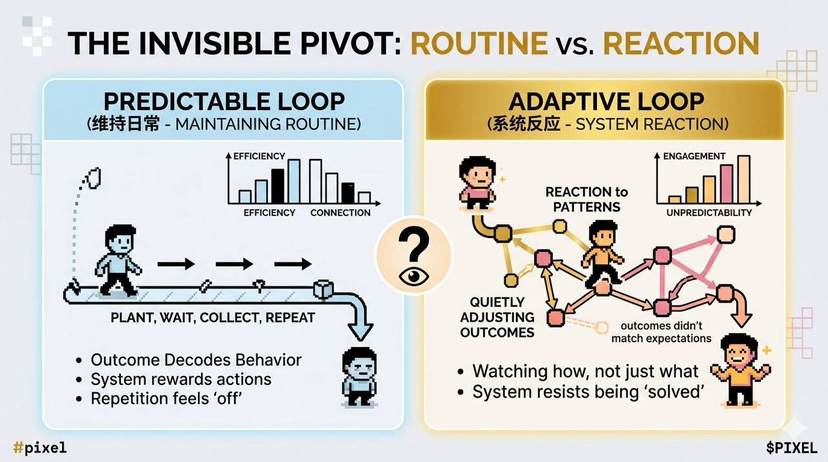 That changed how I started thinking about $PIXEL too. People usually frame the token around progression or demand pressure, but what if some of its deeper relevance sits where attention concentrates? Not because the token literally buys attention, but because players may direct disproportionate focus toward decisions where $PIXEL meaningfully affects outcomes. If that is true, then some token value may partly emerge through attention density, not only transactional usage. And the more I thought about it, the more uncomfortable it became. Because if attention itself acts like a scarce resource, experienced players may have an edge not only through assets or skill, but through knowing where to place limited focus. A newer player may spread attention across too many possibilities, while a veteran may concentrate it where marginal decisions matter most. Same system, different cognitive positioning. That feels like a much stranger source of advantage than people usually discuss in GameFi.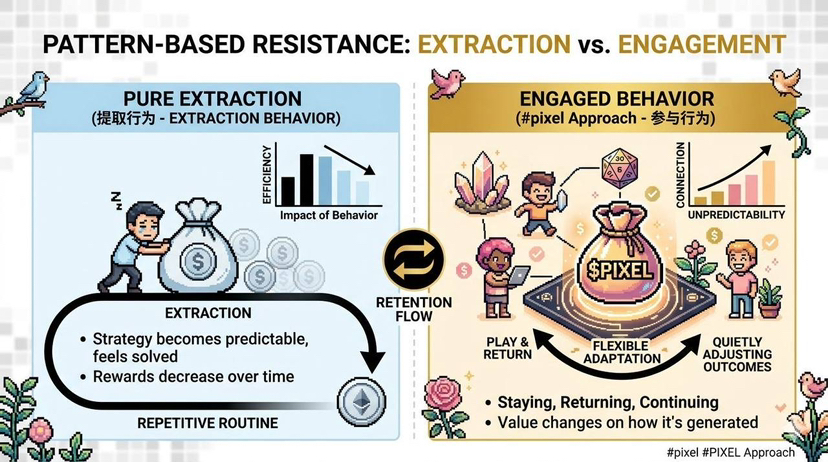
There is tension in that idea too, because if too much value concentrates where collective attention clusters, the economy can narrow. Everyone watches the same signals, the same loops, the same opportunities. Discovery shrinks. But if attention disperses too widely, coordination weakens. Somewhere between overconcentration and fragmentation may be where healthy systems live. And maybe that balance matters more than people realize. I started seeing parallels outside games too. In markets, scarcity is not only about assets. Sometimes it is about attention bandwidth — too many signals, too little capacity to process them all. Participants who allocate attention better often outperform not through superior information, but through superior focus. That possibility kept pulling me back to @Pixels, because maybe some of what looks like economic behavior is partly attention behavior wearing an economic surface.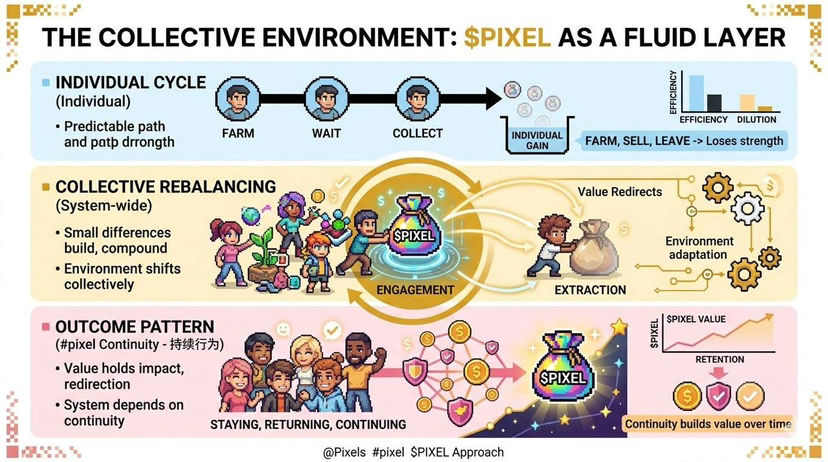
People often ask whether users stay because rewards remain attractive, but maybe sometimes they stay because the system keeps producing enough unresolved signals to hold attention. That is different from reward extraction. It is closer to cognitive engagement. And that may have very different implications for $PIXEL, because if part of the token’s role sits where attention repeatedly returns, then demand may not only depend on utility pressure. It may depend on whether the system continues generating focal points worth sustained thought. That is much harder to measure than transaction counts, but maybe much more important. Maybe I am overreading a Wednesday observation, but I keep returning to the same question. When players compete inside @Pixels , are they only competing over resources, or also over where limited attention gets concentrated? Because if attention itself is part of what gets allocated competitively, then the economy may be doing something much stranger than simply rewarding activity. It may be organizing scarcity at the level of focus, and that is not something I expected to be thinking about in a farming economy.