
Most Web3 games don’t fail because of poor design or missing content. They fail because they miss something more fundamental: why people play games in the first place.
For years, the industry tried to make profit the main focus, hoping that asset ownership alone would make an experience meaningful. It rarely works. Players don’t stick around for empty mechanics, regardless of the financial incentives. This is why Pixels feels different.
Familiarity Over Complexity
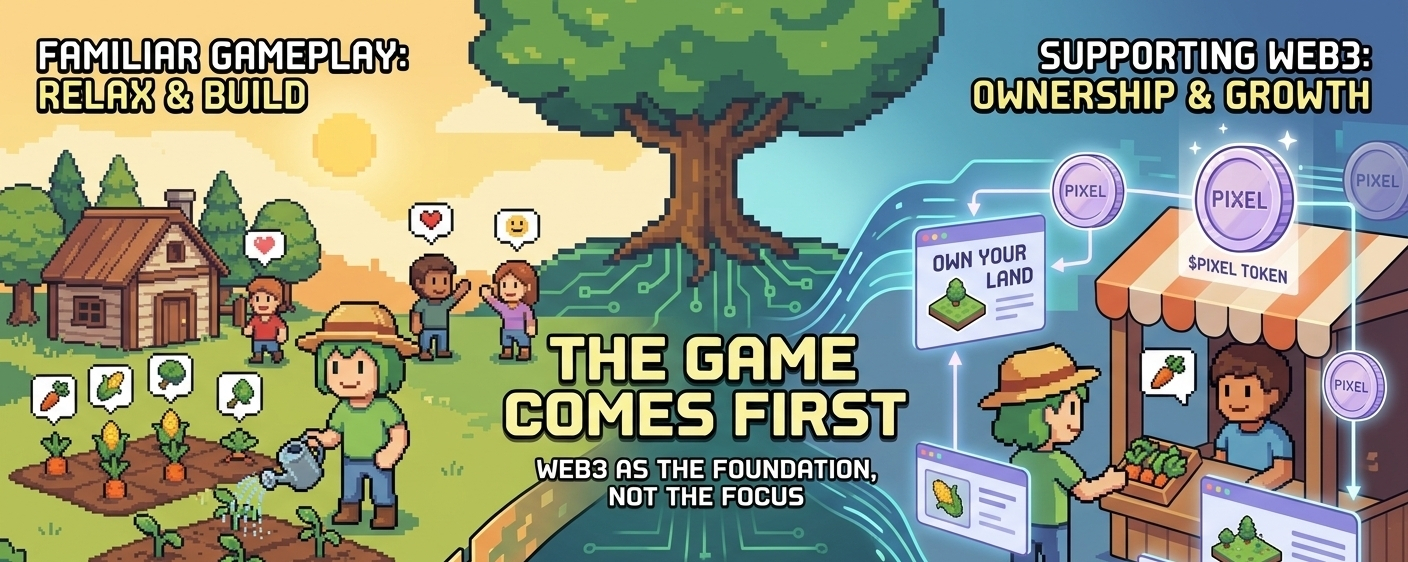
Pixels doesn’t lead with grand promises or convoluted systems. It starts with a simple, recognizable foundation: farming, exploring, and building. You can jump in without a degree in blockchain technology. You aren't overwhelmed; you just start playing.
The core loop follows this logic: gather resources, plant crops, and upgrade your land. While repetitive, it’s a calm, purposeful rhythm rather than a boring grind. Over time, these small actions transform into a genuine sense of progress. Nothing is rushed—it all unfolds at its own pace.
The Role of the PIXEL Token
The $PIXEL token remains quietly in the background. Unlike projects where the token is the "main character," here it acts as a supporting element that facilitates trade, progression, and player coordination.
The real challenge, however, is maintaining that balance. Once money enters a system, it tends to demand center stage. Pixels attracts two types of players:
The Casuals: Those here to relax and enjoy slow growth.
The Optimizers: Those here to extract maximum value.
The game's survival depends on balancing these two groups. If the system leans too heavily into short-term rewards, it risks losing the "fun" that brought people there in the first place.
The Power of Restraint
What makes Pixels interesting isn’t that it’s groundbreaking—it’s that it holds back. It doesn't overwhelm players or force the economy to be the main attraction. It tests a rare hypothesis in this space: Can Web3 enhance an enjoyable game without breaking it?
The Path Ahead: Risks and Realities
Success is not guaranteed. Maintaining long-term engagement in a casual ecosystem is a difficult balancing act. The greatest threat is speculation; if the financial hunt begins to overshadow the actual gameplay, the community’s stability could shift overnight. Furthermore, being deeply tied to a specific blockchain ecosystem introduces an inherent layer of technical and market uncertainty.
Ultimately, Pixels feels less like a finished product and more like a live experiment in human-centric design. It is exploring whether a Web3 game can feel natural rather than forced—a place players return to because they actually want to be there, not because they’re chasing a paycheck. In a world of hype, that’s a much more authentic place to start.