
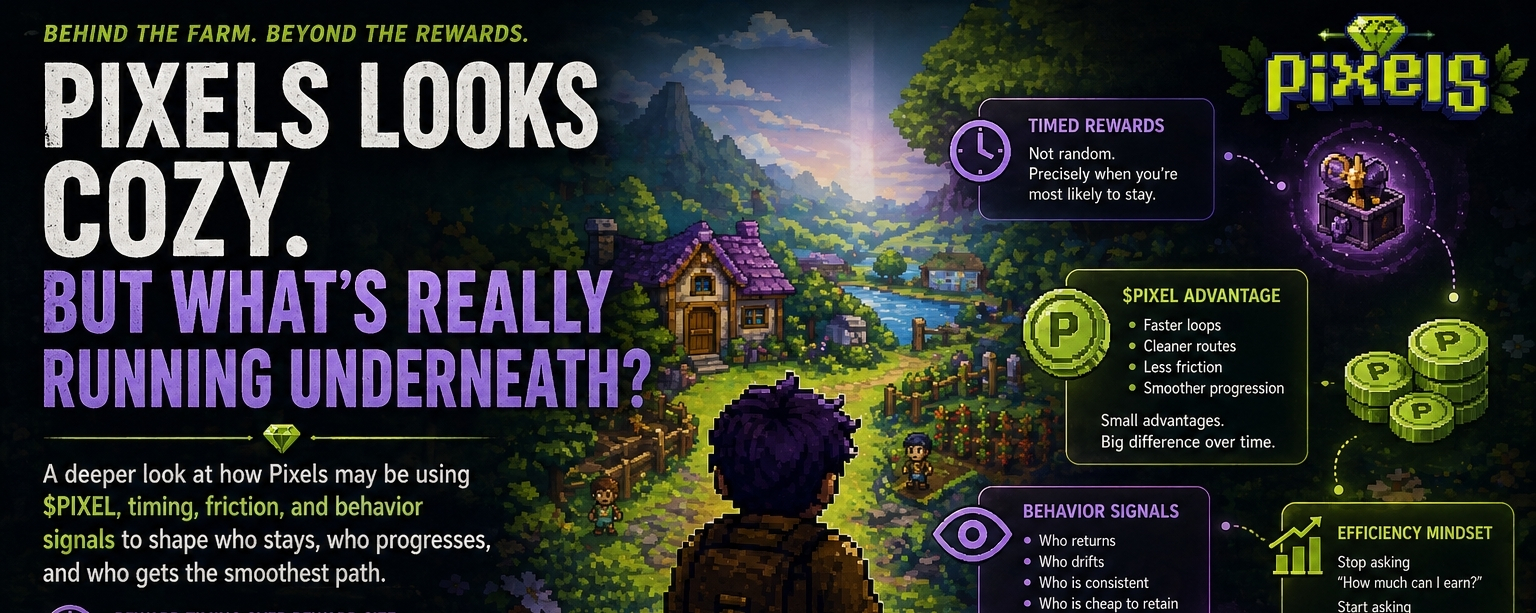
I logged in expecting a calm farming loop plant, wait, harvest, repeat. Nothing intense. Nothing demanding. Just something soft to pass time.
But after a while, something felt… off.
Not in a bad way. Just precise.
The kind of precise that makes you pause and think: was that really random… or was it meant for me?
On the surface, Pixels is one of the most relaxed Web3 games I’ve touched. No loud pressure, no aggressive mechanics, no obvious grind walls screaming at you. Everything feels slow, almost peaceful. But the longer I stayed, the more I realized the pressure isn’t gone.
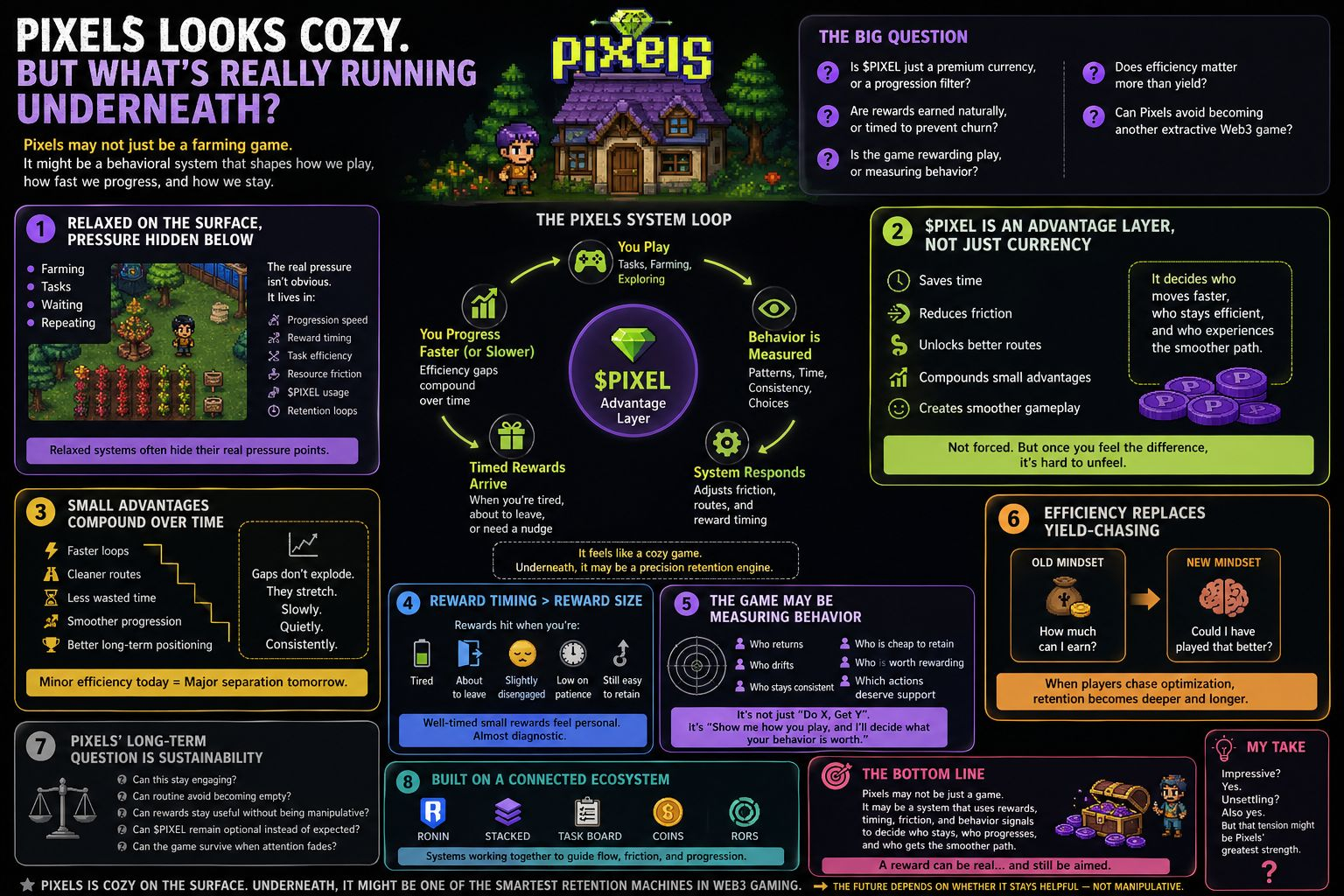
It’s just hidden.
It lives in progression speed.
In how long tasks take.
In when rewards show up.
In how smoothly or inefficiently you move through the game.
And most of all, it lives in how you use PIXEL.
At first, I saw PIXEL like any other token a utility layer, something optional. But the more I played, the more it felt like something else entirely.
Not currency. Not reward.
An advantage layer.
It quietly decides who moves faster.
Who avoids friction.
Who wastes less time.
Who builds momentum without even noticing it.
And that’s where it gets interesting.
Because Pixels doesn’t create massive gaps overnight. It doesn’t punish you loudly. Instead, it lets small advantages compound. A slightly faster loop here. A cleaner route there. Less friction on a task you’ve done ten times before.
Individually, these things feel minor.
Over time, they separate players.
Not by luck. Not by brute effort. But by efficiency.
At some point, I stopped asking myself, “what did I earn today?”
I started asking, “could I have done that better?”
That shift is subtle but powerful. Because now I’m not just playing for rewards. I’m playing to optimize. And that kind of thinking doesn’t burn out easily. It sticks.
Then there’s the part that made me uncomfortable.
Reward timing.
I noticed rewards didn’t always come when I expected them. They came when I was about to log off. When I felt slightly bored. When I hesitated between staying and leaving.
And every time, it worked.
Not because the reward was hug but because it arrived at the exact moment it needed to.
That’s when it hit me:
Maybe Pixels isn’t just rewarding play.
Maybe it’s reading behavior.
Who comes back consistently.
Who starts drifting.
Who needs a nudge.
Who is easy to retain and who is worth investing in.
It started to feel less like “do X, get Y” and more like:
“Show me how you play, and I’ll decide what your time is worth.”
That doesn’t mean the rewards aren’t real. They are.
But something can be real… and still be aimed.
And that tension sits at the core of Pixels.
It’s cozy, but calculated.
Generous, but selective.
Relaxed, but deeply structured.
Even PIXEL fits into this idea perfectly.
It’s not just speeding things up it’s smoothing friction. It’s not forcing you to use it, but once you do, you start to feel the difference. And once you feel that difference, it’s hard to go back.
Which raises a bigger question:
Is PIXEL optional… or does it quietly become expected over time?
That’s where sustainability comes in.
Because Pixels isn’t just a game it feels like a behavioral system. One that balances rewards, timing, friction, and efficiency to keep players engaged without overwhelming them.
But that balance is fragile.
If rewards feel too controlled, it becomes manipulative.
If routines become empty, it loses meaning.
If PIXEL becomes necessary instead of helpful, it breaks trust.
If attention fades, the system gets tested.
Right now, Pixels sits in a very interesting place.
It doesn’t scream for attention. It doesn’t rely on hype. Instead, it builds something quieter a loop that slowly pulls you in, not through force, but through design.
And honestly, that might be its strongest feature.
Because the real value of Pixels may not be the token at all.
It might be how the system uses time, friction, and behavior to shape who stays, who progresses… and who ends up experiencing the game the smoothest way.
I’m still not sure if that’s impressive or unsettling.
Maybe it’s both.
And maybe that’s exactly the point.
