
In many early GameFi projects, tokens were mainly used as rewards. Players would earn them through gameplay and often sell them quickly, which created short-term excitement but weak long-term stability. @Pixels is approaching this challenge differently by building Pixel around utility within its Stacked ecosystem.
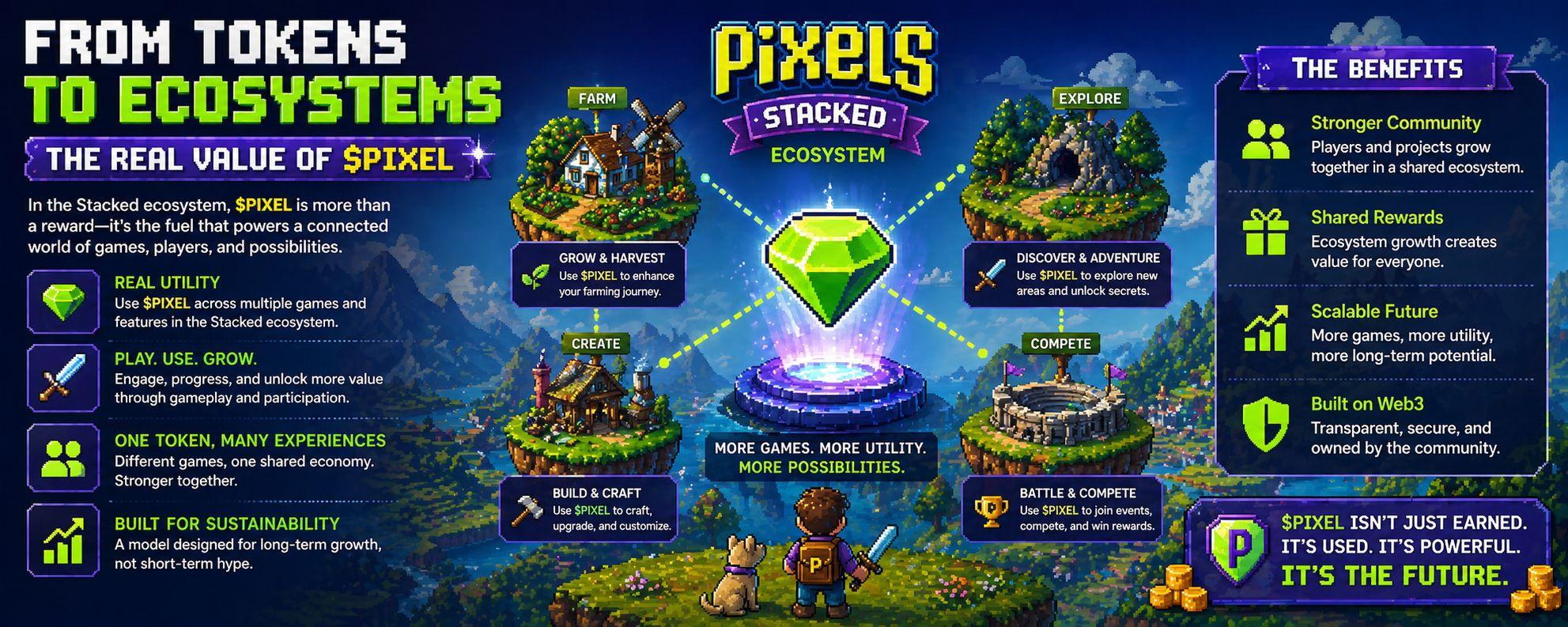
The idea behind the Stacked ecosystem is simple but powerful: instead of limiting a token to one game, it connects multiple experiences under a shared economic layer. This means $PIXEL is not just something you earn—it becomes something you actively use across different parts of the ecosystem. Whether through gameplay participation, progression, or interaction with future projects, the token plays a more meaningful role.
This approach helps shift the focus from “earn and sell” to “play, use, and grow.” When players have reasons to keep and use a token, the ecosystem becomes more stable and engaging. It also encourages long-term participation rather than short-term speculation.
Another key advantage is scalability. As more games and features join the ecosystem, the potential use cases for $PIXEL can expand. This creates a network effect where each new addition strengthens the overall system, benefiting both players and developers.
In a space where sustainability has been a major challenge, @Pixels is working toward a model where value comes from utility and participation. By integrating $PIXEL into a broader ecosystem rather than a single game loop, it represents a step forward for Web3 gaming.
For anyone exploring the future of GameFi, understanding how #pixel evolves through Pixel and the Stacked ecosystem offers valuable insight into where the industry might be heading.