

Pixels is one of those Web3 games that feels easier to understand when you stop looking at it like a crypto chart and start looking at it like a living world.
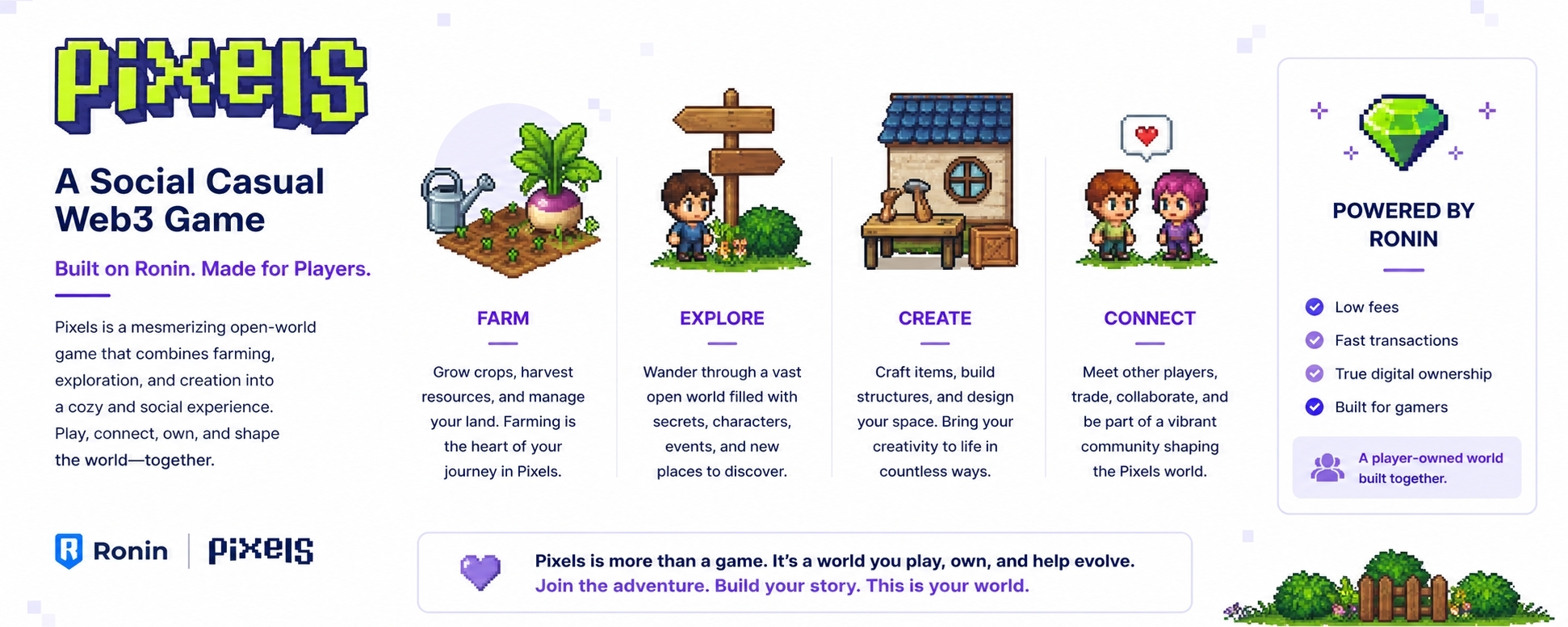
At its core, Pixels is a social casual game powered by the Ronin Network. The main experience is built around farming, exploration, and creation, which sounds simple, but that simplicity is actually the point. Players enter an open-world environment where the daily rhythm matters: planting, gathering, moving through spaces, interacting, improving, and slowly shaping their place inside the game.
What interests me about Pixels is that it does not need to explain itself through complicated language. The product is visible in the loop. Farming gives players something familiar. Exploration gives the world some movement. Creation gives people a reason to stay and make the space feel personal. In a sector where many projects talk before they show, that kind of product-first approach is worth noticing.
Still, I think games like Pixels have to prove themselves over time. A social game cannot survive only because it has Web3 mechanics or a token attached to it. It needs activity, habits, small goals, and a reason for players to return even when the market is quiet. That is where the real building happens. Not in the announcement, but in the daily experience.
PIXEL also sits inside this broader idea of digital ownership and player participation, but the more important question is whether the game itself keeps improving. Are the systems smooth? Does the world feel alive? Do players have enough to do? These are the details that matter more than the label.
Pixels feels like a project still being shaped through use, feedback, and repetition. That is usually where real products become clearer. Not perfect, not finished, but active.
And maybe that is the better way to watch it: less as a promise, more as a process. Pay attention to what is being built, what players actually do inside the world, and what the builders keep learning as the game grows.