
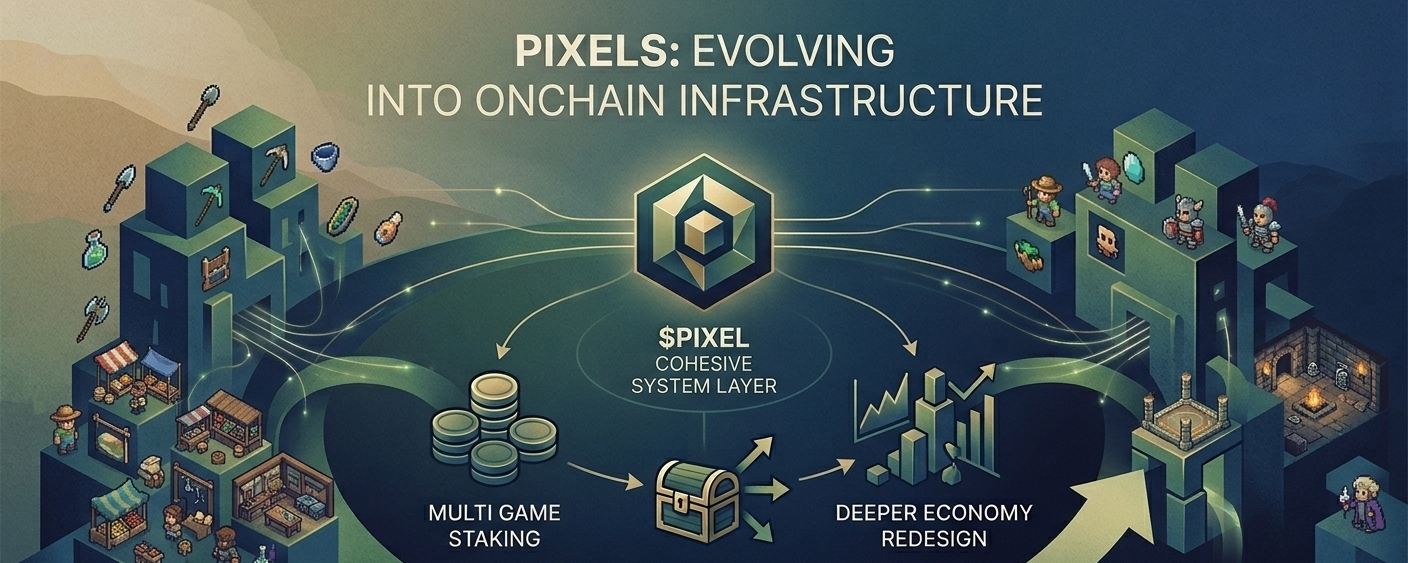

Pixels is no longer just a game you log into for farming loops and daily rewards. It’s starting to look more like an onchain economic layer where multiple games, assets, and player behaviors are being stitched into a single system. And that shift matters more than any short term update.
What’s changed recently is not just feature depth, it’s direction. Multi game integrations, staking mechanics tied to participation, and cross utility for assets are all signals that Pixels is moving away from isolated gameplay toward something closer to a shared digital economy. Instead of each game resetting value, the idea now is to let value persist, move, and compound.
That’s a difficult transition to execute. Most Web3 games collapse because their economies are circular and extractive. Tokens get farmed, sold, and drained. Assets inflate, utility fades, and new users end up subsidizing early ones. Pixels seems aware of that pattern and is actively trying to redesign around it.
The introduction of deeper sinks, progression systems, and utility expansion for $PIXEL is part of that. The token is slowly being repositioned from a simple reward into an access and coordination layer. That’s a subtle but important distinction. Reward tokens create short term engagement. Coordination layers create long term systems.
Another piece that stands out is how they are approaching player behavior. Instead of forcing speculative loops, Pixels is leaning into time investment, skill progression, and ownership continuity. If a player spends time building something, that effort should not reset when a new game or feature launches. That continuity is what traditional games have always done well, and Web3 has mostly failed to replicate.
Now, with Pixels experimenting across multiple experiences and tying them together economically, there is a real attempt to solve that. Not perfectly, not cleanly, but directionally it’s one of the few projects actually iterating toward a cohesive model.
There’s also a bigger structural angle here. If Pixels succeeds in making assets and tokens usable across multiple game environments, it starts to behave less like a game and more like infrastructure. A lightweight layer where developers can plug in experiences and inherit an existing economy instead of bootstrapping from zero every time.
That reduces one of the biggest frictions in Web3 gaming which is cold start. New games struggle because they have no users, no liquidity, and no reason for players to stay. Plugging into an existing system changes that dynamic completely.
From my perspective, this is still early and far from stable. The economy will need constant balancing. Token pressure will always be a factor. And user retention will depend on whether the gameplay itself evolves beyond repetitive loops.
But what makes Pixels interesting right now is not perfection. It’s intent backed by iteration. They are not just shipping features, they are actively trying to redesign how value flows inside a Web3 game environment.
Most projects talk about ecosystems. Pixels is one of the few actually attempting to build one in a way that players can feel over time.
If they can align gameplay depth with economic design, $PIXEL stops being just another in game token and starts becoming the backbone of a persistent onchain world.
That’s not guaranteed. But it’s one of the more credible paths being explored in the space right now.
