

I was just sitting one evening and scrolling through a few Web3 games. Nothing serious. Just passing time. I clicked through a few of them and closed them quickly. Then I opened Pixels again. I had seen it before but never really stayed. This time I did.
Something felt slower.
Not boring. Just not rushed. I kept playing a bit longer than I expected. And while playing I started thinking about something I have seen many times before.
Play to earn sounds good at first.
You play a game and you earn value. Simple idea. Easy to understand. That is why it became popular so quickly. I remember when many games started using this model. People joined fast. Activity went up. Everything looked strong.
Then things started to change.
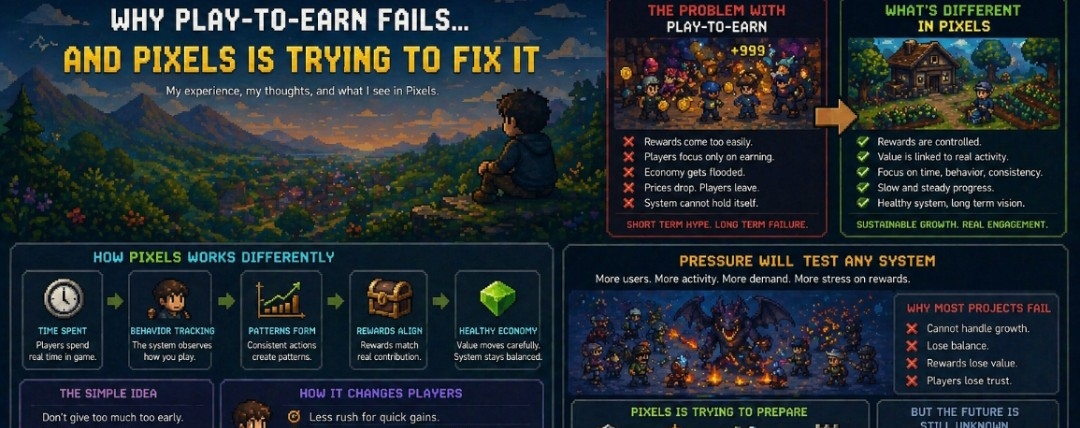
Rewards came too easily. People focused only on earning. Not on the game. Not on the experience. Just on extracting value. Over time the rewards lost meaning. More supply entered the system. Prices dropped. Players left.
The system could not hold itself.
I have seen this pattern repeat again and again. It is not really about the game. It is about how value is designed. When rewards come too fast the system builds pressure. And most systems are not ready for that pressure.
That is where I started looking at Pixels more carefully.
It does not feel like it is trying to fix everything at once. But it feels like it is aware of the problem. It feels like it is slowing things down on purpose. Not rushing rewards. Not pushing users to farm quickly.
The focus feels different.
Instead of pushing earning it tries to connect value to real activity. It looks at how players spend time. How often they return. How they behave over time. That changes how rewards feel inside the system.
They feel more controlled.
The idea is simple when I think about it.
Do not give too much too early. Let the system grow first. Let players form patterns. Then connect rewards to that behavior. This makes value move more carefully inside the game.
It also changes how players act.
Instead of rushing for quick gains there is more reason to stay consistent. More reason to understand the system. That creates a different kind of engagement.
It is not perfect.
Systems like this can feel unclear at times. Players may not always understand how rewards are decided. If the balance is not right it can feel unfair. There is always a risk when control is not obvious.
And pressure will test it.
Because growth changes everything. More users bring more activity. More demand. More stress on rewards. This is where many projects fail. Not because the idea is wrong. But because the system cannot handle real conditions.
Pixels feels like it is trying to prepare for that.
It is trying to build structure before things get too big. It is trying to avoid the same cycle that many play to earn games went through. That does not mean it will succeed. But it shows a more careful direction.
Right now the market is still moving in cycles.
Some Web3 games grow fast. Then they slow down just as quickly. Activity comes in waves. Tokens see short bursts of attention. Then quiet periods. Nothing feels stable for long.
$PIXEL has also moved through these phases.
There have been moments where activity picked up. Then times where things slowed down. It is not constant. But that is normal in this space. What matters more is how it behaves over time.
Does it keep balance. Does it handle pressure. Does it hold user interest without forcing rewards.
That is what I am watching.
I do not think play to earn is completely broken. But I do think the simple version of it does not work anymore. Systems need more control. More structure. More connection between effort and value.
Pixels feels like it is trying to move in that direction.
I am not fully convinced yet.
But I also do not ignore it.
Because sometimes the difference is not loud. It is not obvious. It shows up in small decisions. In how rewards are managed. In how the system reacts over time.
For now I am just observing.
Still learning.
Still cautious.
