

I’ve spent enough time around crypto projects to recognize a pattern almost immediately. A new idea emerges, it gets wrapped in a narrative about decentralization or ownership, and then it’s presented as if it will fix something fundamental about the internet. Sometimes that’s true, but more often it’s just a reshuffling of old ideas with new incentives. So when I first came across Pixels, I didn’t approach it with excitement. I approached it with a kind of quiet curiosity, the same way you’d walk into a place that looks familiar but claims to offer something different.
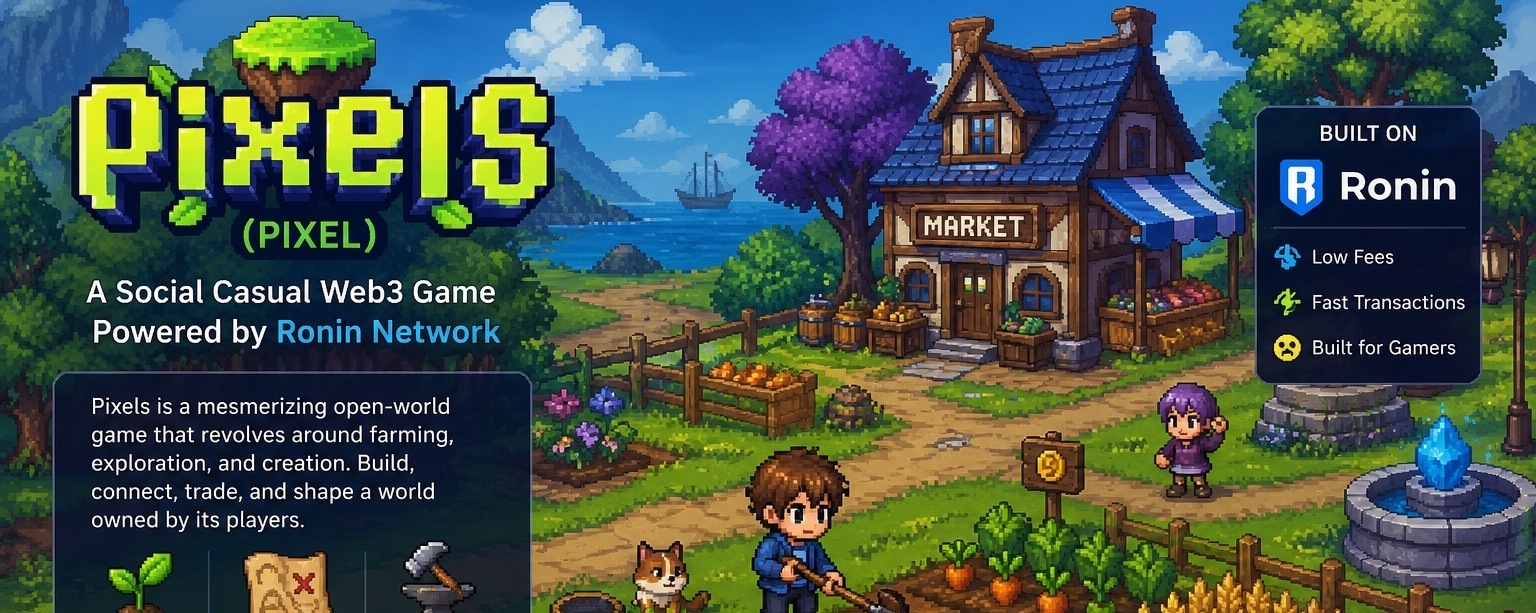
At its surface, Pixels feels almost disarmingly simple. It’s a social, casual game built around farming, exploration, and creation. That alone isn’t new. Farming mechanics have been recycled across games for decades because they tap into something deeply satisfying—routine, progression, ownership of space. What makes Pixels different, at least in theory, is that it’s built on blockchain infrastructure, specifically the Ronin Network, and integrates a token economy meant to give players some form of ownership over their time and effort.
But I’ve learned to pause whenever I hear phrases like “ownership” and “play-to-earn.” The industry has leaned heavily on these ideas, often without fully resolving the tension between fun and financialization. So I started looking at Pixels less as a game and more as a system. What is it actually trying to do beneath the surface?
The core idea seems to revolve around turning a casual game into a persistent digital economy where player actions have tangible value. Farming isn’t just a mechanic for progression; it becomes a form of resource production that feeds into a broader marketplace. Exploration isn’t just about discovery; it’s about finding opportunities, assets, or advantages that can be traded or leveraged. Creation, meanwhile, hints at user-generated content, which has always been one of the more compelling but underdeveloped aspects of Web3 gaming.
In theory, this aligns with one of the long-standing promises of crypto: giving users a stake in the systems they participate in. Traditional games are closed economies. You put time in, maybe money too, but the value you generate stays inside the system, controlled entirely by the developer. Pixels, like many Web3 games, tries to invert that relationship. It suggests that the time you spend farming or building could translate into something that exists beyond the game itself.
But this is where I start to feel that familiar tension again. The idea of open economies in games sounds appealing, but it often runs into practical problems. If everything has value, then the system risks becoming extractive rather than enjoyable. Players stop playing because it’s fun and start playing because it’s profitable. And once that shift happens, the entire dynamic changes. You’re no longer designing a game; you’re managing an economy, and economies are fragile.
So I spent some time thinking about whether Pixels actually addresses that issue or just inherits it.
One thing that stands out is its emphasis on being “social” and “casual.” That might sound like marketing language at first, but it could be more important than it appears. Most Web3 games in the past leaned heavily into complexity or speculation. They assumed that players would tolerate clunky gameplay as long as there was a financial upside. That assumption didn’t hold up very well. When token prices dropped, so did user engagement.
Pixels seems to be taking a slightly different route by focusing on accessibility. The mechanics are simple, the world is easy to understand, and the barrier to entry is relatively low. It doesn’t try to overwhelm you with systems. Instead, it leans into familiarity. And there’s something quietly strategic about that. If you want to build a sustainable on-chain game, you probably need players who would still show up even if the token wasn’t doing anything interesting.
That leads me to the Ronin Network, which plays a significant role in the project’s architecture. Ronin has its own history, particularly with gaming-focused applications, and it’s optimized for lower transaction costs and faster interactions compared to many other chains. That matters more than people sometimes realize. If every in-game action required expensive or slow transactions, the experience would collapse under its own weight.
By building on a network designed specifically for gaming, Pixels avoids some of the friction that has plagued earlier Web3 projects. You don’t feel like you’re constantly interacting with a blockchain. And ironically, that might be one of the most important design choices: making the blockchain less visible. The more seamless the experience, the more likely players are to engage with the system without thinking about the underlying technology.
Still, I can’t ignore the broader question: what problem is Pixels actually solving?
If I strip away the surface-level narrative, it seems to be addressing the disconnect between time spent in digital environments and value creation. In traditional systems, your contributions are ephemeral. You build something, achieve something, and it exists only within the confines of that platform. Pixels suggests that this doesn’t have to be the case. It tries to create a world where your actions accumulate into something more persistent and potentially transferable.
That’s a meaningful idea, but it’s also one that the industry has struggled to execute. The challenge isn’t just technical; it’s behavioral. Players don’t always want their leisure activities to feel like labor. And when you introduce real-world value into a game, you inevitably attract participants who are there for extraction rather than engagement. Balancing those two groups is incredibly difficult.
What feels different about Pixels, at least from my perspective, is that it doesn’t lean too heavily into grand promises. It’s not trying to position itself as a complete reinvention of gaming. Instead, it feels more like an experiment in blending familiar gameplay with on-chain elements in a way that doesn’t disrupt the core experience. That restraint is interesting. It suggests a level of awareness about where previous projects have gone wrong.
And there have been plenty of missteps in this space. The industry often overestimates how much players care about ownership in the abstract. Yes, it’s nice to own assets, but only if those assets have meaning within a compelling environment. Without that context, ownership becomes hollow. It’s like owning pieces of a game that no one wants to play.
Pixels seems to understand that, at least partially. The focus on an open world and social interaction hints at an attempt to create a space where assets derive value from their use, not just their scarcity. That’s a subtle but important distinction. It shifts the emphasis from speculation to participation, even if the line between the two is never entirely clear.
Still, I find myself wondering about the long-term sustainability of the system. Token economies are notoriously difficult to manage. They require constant calibration, and even small imbalances can lead to cascading effects. Inflation, resource oversupply, and shifting player incentives can all destabilize the experience. And unlike traditional games, where developers can quietly adjust systems behind the scenes, on-chain economies are often more transparent and harder to control.
There’s also the question of audience. Who is Pixels really for? Is it targeting traditional gamers who might be curious about Web3, or is it primarily appealing to crypto-native users looking for the next opportunity? The answer probably lies somewhere in between, but that middle ground can be tricky to navigate. Each group has different expectations, and satisfying both simultaneously is not easy.
As I think about it more, I realize that Pixels isn’t just a game; it’s part of a broader conversation about what digital spaces can become. It sits at the intersection of gaming, economics, and social interaction, trying to find a balance that hasn’t quite been achieved yet. And in that sense, its value might not come solely from its success or failure, but from what it reveals about the direction of the industry.
There’s a tendency in crypto to chase novelty for its own sake. Every new project wants to be radically different, to introduce something entirely unprecedented. But sometimes progress comes from refinement rather than reinvention. Pixels feels like an attempt to refine existing ideas, to smooth out the rough edges that have made Web3 gaming difficult to adopt.
Whether that’s enough is still an open question.
I don’t walk away from Pixels convinced that it has solved the fundamental challenges of on-chain gaming. But I also don’t dismiss it as just another iteration of the same old formula. It occupies an interesting middle ground. It’s aware of the pitfalls, it makes some thoughtful design choices, and it seems to prioritize experience over abstraction, at least to some extent.
And maybe that’s where its real significance lies. Not in bold claims or revolutionary mechanics, but in the quieter attempt to make something that people might actually want to spend time in.
I find myself cautiously intrigued. Not because I think Pixels will redefine the space overnight, but because it reflects a shift in how these projects are being approached. Less emphasis on hype, more attention to usability. Less focus on extracting value, more consideration of how value is created in the first place.
It’s still early, and uncertainty is part of the equation. The economy could falter, the player base could shift, or the novelty could wear off. All of those outcomes are possible. But for now, Pixels feels like a small step toward something more grounded, even if it doesn’t fully escape the gravity of the patterns that came before it.
And maybe that’s enough to keep me watching, if not fully convinced, then at least engaged in the question it’s trying to answer.
