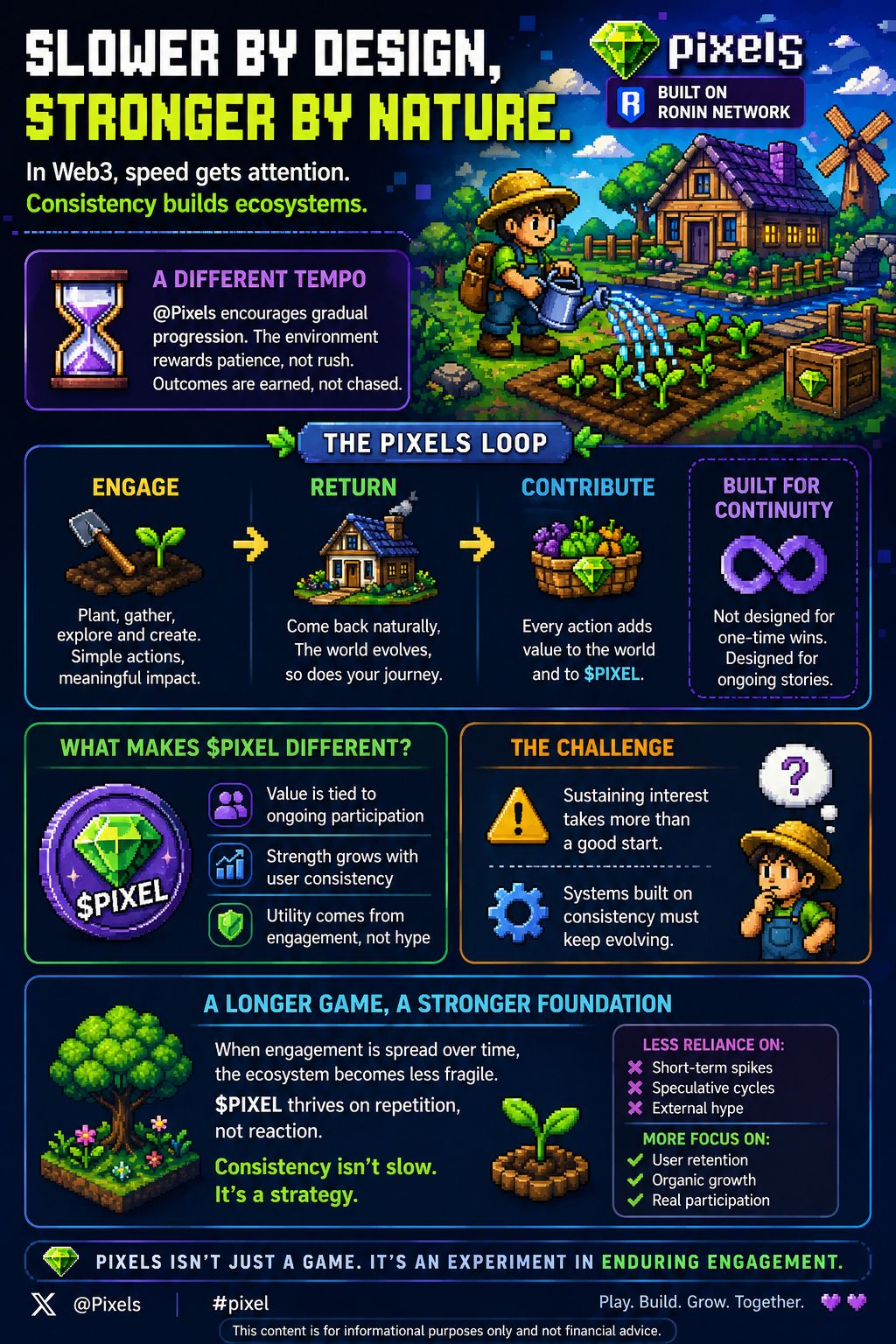


At the beginning, it felt straightforward. Log in, plant, harvest, move around, repeat. The kind of loop you don’t overthink. It looked like a relaxed system, almost intentionally simple. No urgency, no pressure to optimize, just a steady rhythm you could fall into.
But after spending more time inside it, that simplicity started to feel… layered.
Not in an obvious way. Nothing breaks. Nothing stops you. You can keep playing exactly the same way every day. Yet somehow, the outcomes don’t always feel consistent. The same actions don’t always carry the same weight. And that’s where it started to get interesting for me.
It stopped feeling like a fixed system and started feeling responsive.
At first, I assumed it was randomness or minor variation. But the pattern kept repeating. Some actions seemed to hold value longer, while others slowly faded in impact even when I didn’t change how I approached them. That’s when I started thinking less in terms of “actions” and more in terms of “behavior.”
Because Pixels doesn’t just track what you do it seems to react to how you do it over time.
That subtle shift changes everything.
Instead of a clean loop where effort leads directly to reward, it begins to feel like the system is quietly evaluating which patterns deserve to keep producing value. Not instantly, but gradually. Almost like it’s filtering behavior rather than simply rewarding activity.
And once you notice that, it’s hard to go back to seeing it as just another GameFi structure.
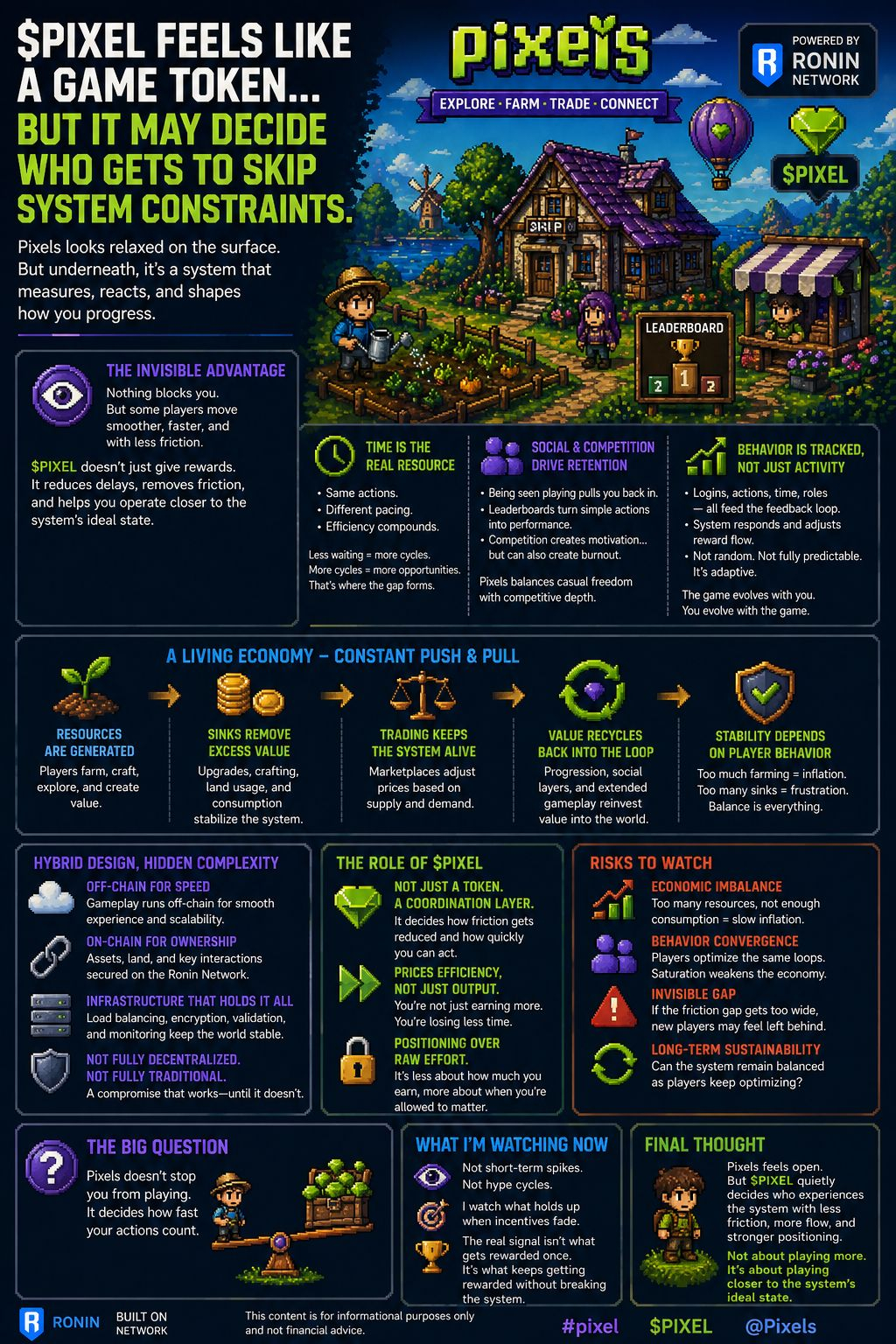
This is where $PIXEL started to make more sense to me not just as a token, but as part of a broader mechanism shaping how participation translates into progress.
On the surface, it still behaves like a typical in-game asset. It’s used for upgrades, interactions, and deeper economic actions. But in practice, it feels more connected to how smoothly you move through the system rather than just what you receive from it.
Two players can follow similar paths, put in similar effort, and still experience different pacing.
One moves through loops with fewer interruptions, fewer delays, fewer points of friction. The other moves, but with small pauses nothing major, just enough to slow momentum. Individually, those differences don’t look significant. Over time, they compound.
That’s where the system starts to resemble something closer to infrastructure than gameplay.
Because now it’s not just about what you do it’s about how efficiently your actions convert into progress. Time becomes the hidden variable. And $PIXEL sits right next to it, quietly influencing how that time is experienced.
What makes this more complex is that none of it is explicitly forced.
You’re not blocked from playing. You’re not required to engage with the token at every step. The base experience remains accessible. But optional layers have a way of becoming relevant over time not because the system demands it, but because competing without them starts to feel inefficient.

I’ve seen this dynamic before, especially in markets.
Access is technically equal, but execution isn’t. Some participants operate closer to optimal conditions, while others remain in the default environment. Both are active, but they’re not operating at the same level of efficiency.
Pixels seems to be introducing a similar structure, just in a more subtle form.
And that raises an important tension.
The system still feels open. Anyone can join, participate, and progress. But not all participation carries the same long-term impact. Some behaviors are reinforced, others slowly lose relevance not because they’re removed, but because they’re no longer prioritized.
That’s where things start to shift from “playing a game” to “adapting to a system.”
You begin to adjust without fully realizing it. You pay attention to what feels effective, what continues to produce results, what maintains momentum. Over time, your decisions aren’t just about enjoyment they’re about alignment with how the system distributes value.
And that alignment isn’t always visible.
It shows up indirectly, through outcomes.
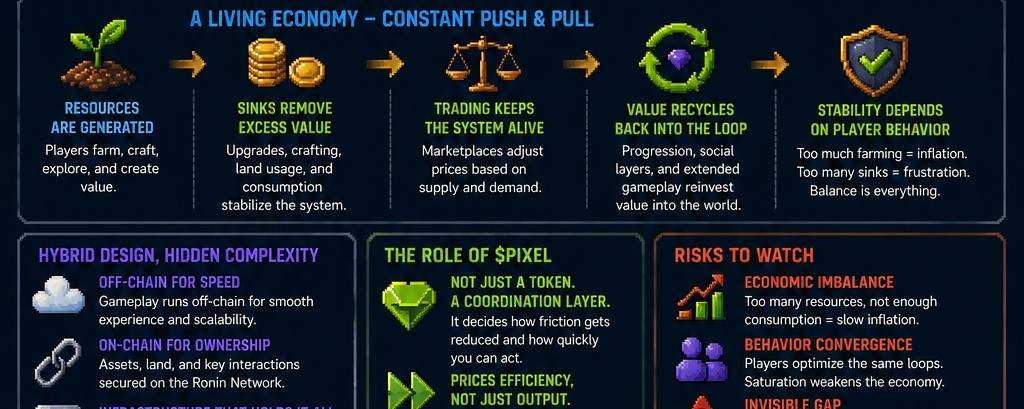
This is also where the economy becomes more than just supply and demand. It turns into a feedback loop between player behavior and system response. Resources are generated, consumed, and recycled, but their relevance depends on how they fit into that loop.
If too many players converge on the same strategy, value shifts. If certain behaviors dominate, the system adjusts around them. It’s not static it’s reactive.
That reactivity is powerful, but it also introduces fragility.
Because the more a system adapts to behavior, the more it starts shaping behavior in return. Some play styles naturally scale, while others become less effective over time. Freedom still exists, but outcomes become uneven in ways that aren’t immediately obvious.
And that’s where the deeper question sits.
Not whether the system works it clearly does but how it evolves as players continue to optimize within it.
Because players always optimize.
If the system rewards efficiency, players will chase efficiency. If it rewards consistency, they’ll adapt toward consistency. And if certain behaviors are consistently reinforced, those behaviors eventually dominate.
At that point, the system is no longer just supporting gameplay it’s guiding it.
From my perspective, Pixels doesn’t feel like a finished structure. It feels like something still adjusting, still calibrating how value flows between activity, time, and participation.
And honestly, that’s what makes it worth paying attention to.
Not the short-term outputs, not the immediate rewards but the patterns that remain stable once incentives start fading and only behavior is left driving the system.
Because in the end, the real signal isn’t what gets rewarded once.
It’s what continues to get rewarded without breaking everything around it.
This content is for informational purposes only and not financial advice.