
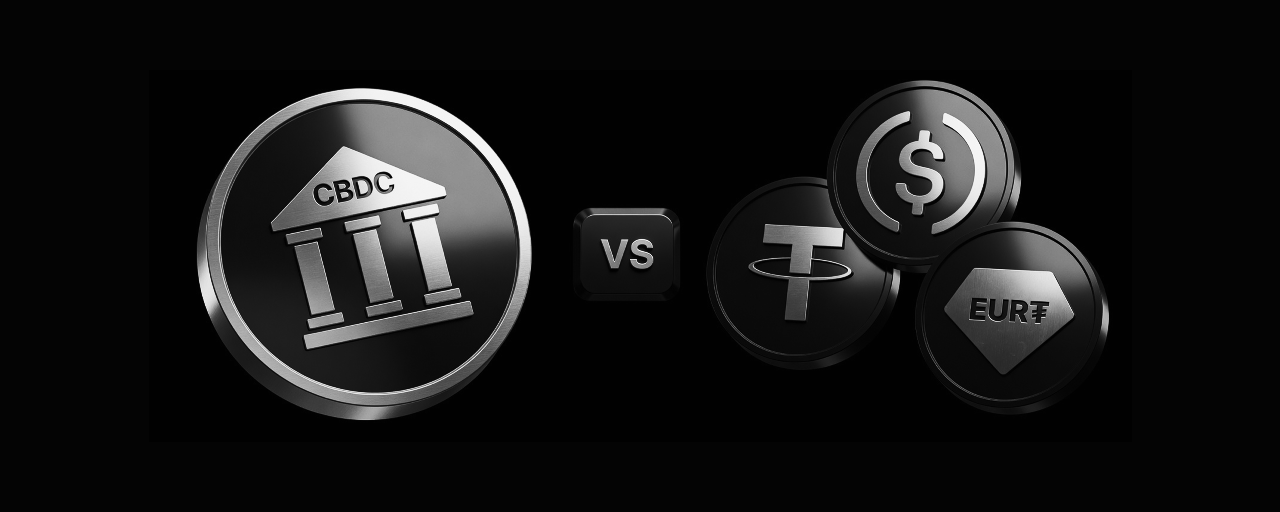


Digital payments are evolving fast, and two models are emerging as frontrunners: government-issued digital currencies and privately issued crypto tokens. Central Bank Digital Currency (CBDCs) and stablecoins both aim to solve the same problem—fast, cheap, digital transactions—but they approach it very differently.
What Are CBDCs?
CBDCs are:
Digital versions of national currencies
Issued and controlled by central banks
Examples include:
eNaira
Digital Yuan
Key traits:
Centralized control
Government-backed stability
Integrated with national financial systems
What Are Stablecoins?
Stablecoins are:
Crypto tokens pegged to fiat currencies (usually USD)
Issued by private companies
Examples include:
USDT
USDC
Key traits:
Blockchain-based
Globally accessible
Operate across DeFi ecosystems
Head-to-Head Comparison
Speed and Efficiency
Stablecoins offer near-instant global transfers and operate 24/7.
CBDCs are fast domestically but often limited by national systems.
Winner: Stablecoins for global use
Accessibility
Stablecoins can be used by anyone with a wallet.
CBDCs often require identity verification and are jurisdiction-bound.
Winner: Stablecoins
Trust and Stability
CBDCs are backed by governments and have legal tender status.
Stablecoins depend on issuer reserves and transparency.
Winner: CBDCs
Privacy
Stablecoins are typically pseudonymous depending on the blockchain.
CBDCs provide higher visibility for governments.
Winner: Stablecoins for privacy
Regulation and Control
CBDCs are fully regulated and allow policy enforcement.
Stablecoins are increasingly regulated but still more flexible.
Winner: CBDCs from a policy perspective
Ecosystem Integration
Stablecoins are deeply integrated into DeFi, trading, and lending.
CBDCs have limited integration with open crypto systems.
Winner: Stablecoins
Use Case Breakdown
CBDCs are stronger in:
Government payments such as taxes and welfare
Domestic financial systems
Monetary policy implementation
Stablecoins are stronger in:
Cross-border payments
Trading and DeFi
Use in regions with unstable local currencies
Key Insight
This is not a winner-takes-all scenario.
CBDCs focus on control, compliance, and stability.
Stablecoins focus on speed, accessibility, and flexibility.
Challenges Ahead
CBDCs face:
Privacy concerns
Adoption resistance
Competition with existing systems
Stablecoins face:
Regulatory pressure
Questions around reserve transparency
The Bigger Picture
The future of payments will likely be hybrid:
CBDCs dominating domestic and government use
Stablecoins leading global, crypto-native transactions
Both systems may coexist rather than compete directly.
Conclusion
CBDCs and stablecoins are reshaping digital payments from different angles. Stablecoins currently lead in global usability and integration, while CBDCs provide trust and regulatory alignment. The outcome is not about one replacing the other, but how both evolve to serve different parts of the financial system.
Disclaimer: The information provided herein is offered "as is" for illustrative and informational purposes only, with no representation or warranty whatsoever. This information is not intended to vouch for financial, legal, or other professional advice, nor does it endorse the purchase of any particular product or service.