
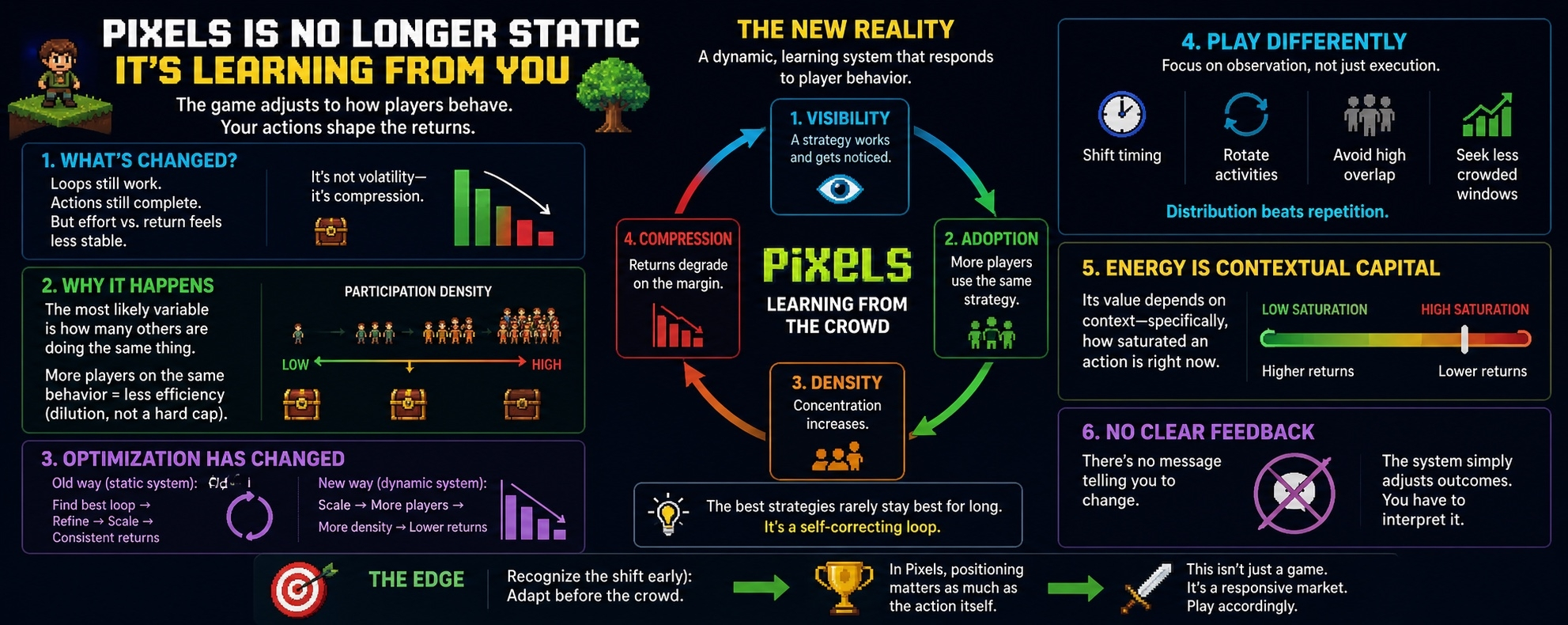

There’s a subtle shift in how Pixels behaves that’s easy to miss if you’re focused on execution instead of outcomes. Nothing in the interface signals it directly. The loops still work. The actions still complete. But the relationship between effort and return feels less stable than it used to.
What stands out isn’t volatility it’s compression.
A loop that previously felt “clean” now carries a bit more friction in its output. Not enough to break the strategy, just enough to reduce its edge. And when that happens consistently across sessions, it stops looking like randomness and starts looking like a system reacting to something.
The most likely variable isn’t the action itself, but how many others are doing it at the same time.
Pixels increasingly behaves like a shared incentive surface rather than a fixed reward schedule. When participation concentrates around a specific behavior whether it’s a crop cycle, a route, or a timing window the efficiency of that behavior appears to degrade on the margin. It’s not a hard cap or a visible nerf. It’s closer to dilution.
That changes the role of optimization.
Traditional optimization assumes stability. You identify the best loop, refine it, and scale it. But in a system that adjusts to aggregate behavior, scaling a known loop is exactly what erodes it. The more visible and repeatable a strategy becomes, the faster it loses efficiency.
From a player perspective, this creates a lag between perception and reality. A strategy can still feel optimal because it worked recently, even as its underlying efficiency is already declining. By the time the shift is obvious, the edge is gone.
The more useful approach seems to be observational rather than mechanical.
Small adjustments shifting timing, rotating activities, avoiding periods of high overlap tend to produce more consistent returns than simply executing faster or more precisely. Not because the actions are better, but because they’re less crowded. The system appears to reward distribution as much as it rewards effort.
In that sense, energy behaves less like a fixed input and more like capital deployed into a dynamic environment. Its value isn’t static. It depends on context specifically, how saturated a given action is at the moment you take it.
This also explains why the “best” strategies rarely stay best for long. Visibility attracts adoption, adoption increases density, and density compresses returns. It’s a self-correcting loop.
What’s interesting is that none of this is explicitly communicated. There’s no clear feedback telling you to change behavior. The system simply adjusts outcomes, and it’s up to the player to interpret why.
That creates a different kind of gameplay layer. Less about solving a fixed system, more about reading a moving one.
Right now, most players still approach Pixels as if it’s static optimize a loop, repeat it, expect consistency. But the system itself is behaving more like a responsive market, where positioning relative to others matters as much as the action itself.
The edge, if there is one, comes from recognizing that difference early and adjusting before the crowd does.
