

I’ve spent a lot of time inside Pixels, and the more I play, the more I notice something that doesn’t show up in trailers, patch notes, or surface-level metrics. The game feels alive busy farms, active markets, constant updates—but beneath that activity, there’s a quieter dynamic shaping everything.
It’s not just about earning.
It’s not just about grinding.
It’s about how expensive it becomes to stay relevant over time.
And in my experience, two mechanics sit right at the center of that pressure: Slot Deeds and Preservation Runes.
When I first started, progression felt clean and rewarding. I upgraded tools, expanded land, optimized production loops—it all felt like forward momentum. Like most players, I assumed that if I kept improving my setup, I’d naturally stay competitive.
But that assumption didn’t hold for long.
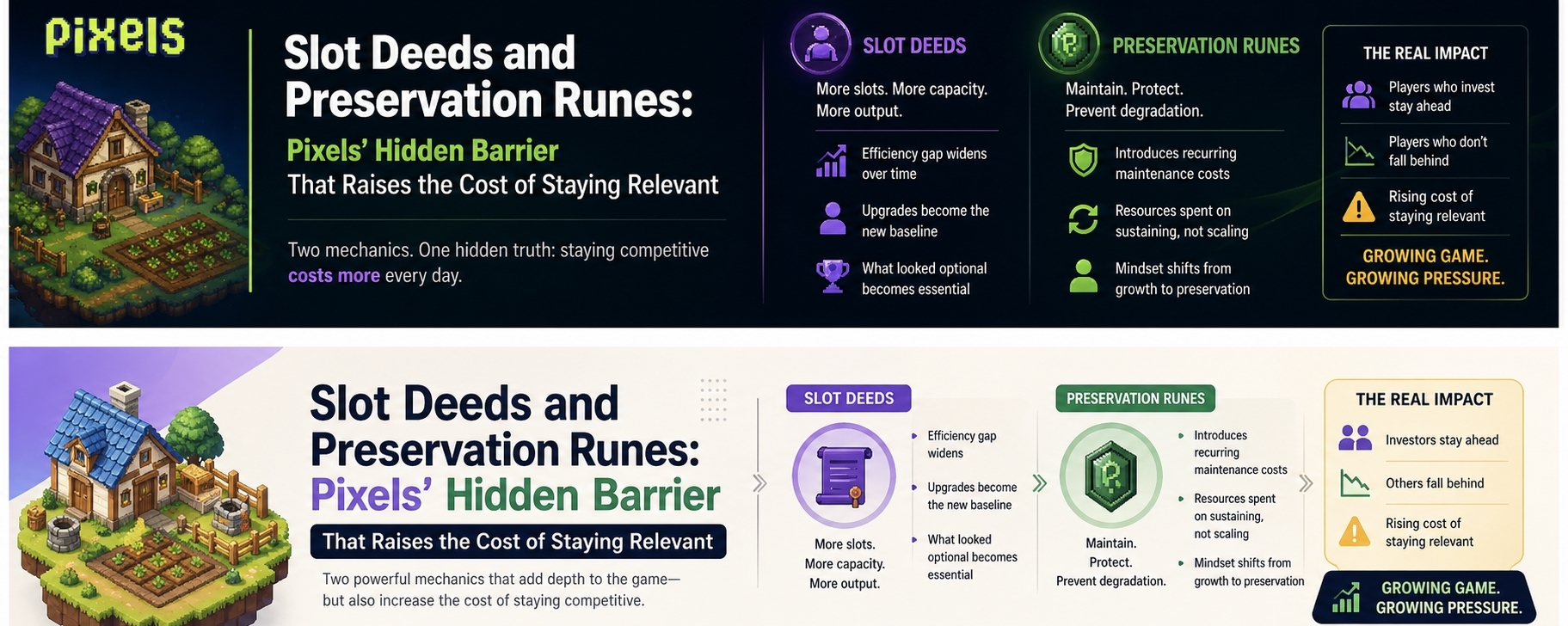
Slot Deeds are introduced as upgrades—more slots, more capacity, more output. On paper, they’re optional. In practice, they quietly redefine what “normal” looks like. The moment a segment of players adopts them, the baseline shifts. Suddenly, higher output becomes the new standard, not the exception.
I began to notice that without these upgrades, my efficiency wasn’t just lower—it was falling behind at a noticeable rate. The gap wasn’t dramatic overnight, but it compounded. Players with more slots could cycle resources faster, generate more value per session, and reinvest at a pace that was difficult to match.
What looked like a choice slowly started behaving like a requirement.
Then came Preservation Runes, which at first seemed like a reasonable balancing tool. Maintaining assets, preventing degradation—it makes sense in a living economy. But the more I engaged with the system, the clearer it became that this wasn’t just about balance. It was about introducing a recurring cost layer into the core loop.
Instead of simply building and earning, I found myself allocating resources just to maintain what I already had. The gameplay loop subtly changed:
Build → Maintain → Protect → Then earn
That extra step—maintenance—does more than just add complexity. It changes how you think.
I noticed that my decisions became more defensive. Instead of asking, “What’s the best way to grow?” I started asking, “What do I need to sustain?” That’s a very different mindset. It shifts the experience from expansion to preservation.
Zooming out, this matters because of the scale Pixels has reached. Running on the Ronin Network, the game has seen hundreds of thousands of daily active users at its peak, making it one of the most played Web3 games to date. Its economy is active, its player base is engaged, and its systems are constantly evolving.
But scale amplifies structure.
When a system introduces ongoing costs—like runes for preservation and upgrades for competitiveness—it doesn’t just affect individuals. It shapes the entire economy. Players who can afford to continuously upgrade and maintain stay efficient. Those who can’t gradually lose ground.
Over time, this creates layers within the player base.
New players enter with low pressure and high curiosity. Everything feels accessible. Mid-level players begin to feel the tension—they see the efficiency gap and start investing more to close it. Advanced players, however, operate under a different reality altogether. They’re managing larger setups, higher maintenance costs, and a constant need to optimize just to maintain their position.
What’s interesting is that Pixels doesn’t enforce this through hard restrictions. There’s no obvious paywall blocking access. Instead, it builds a soft barrier—a system where you can participate freely, but staying competitive requires increasing investment.
And soft barriers are powerful because they don’t feel like barriers at first.
They feel like progression.
Until they don’t.
This is where I think the real question lies. Not whether Pixels is successful—it clearly is—but whether this structure is sustainable. Economies that rely on increasing efficiency gaps and recurring maintenance tend to face a specific kind of friction over time: not burnout from effort, but fatigue from upkeep.
There’s a difference between logging in because you want to grow and logging in because you need to maintain.
I’ve felt that shift personally, and I’ve seen others mention it too. It doesn’t happen suddenly. It builds gradually, almost invisibly, until the experience starts to feel different.
To be clear, Pixels gets a lot right. It has one of the strongest retention loops in Web3 gaming, consistent updates, and a real functioning economy. Few projects reach this level of activity, let alone sustain it. That’s exactly why these underlying mechanics deserve closer attention.
Because when a system is already working, its hidden pressures matter more—not less.
Slot Deeds and Preservation Runes aren’t flaws. They’re well-designed tools that add depth and structure. But they also introduce a rising cost of staying relevant, and that changes how the entire ecosystem behaves over time.
For me, that’s the most important insight.
Not that the system is broken—but that it’s quietly evolving the player experience from growth-driven to maintenance-driven. And in any game economy, that’s a line worth watching closely.