
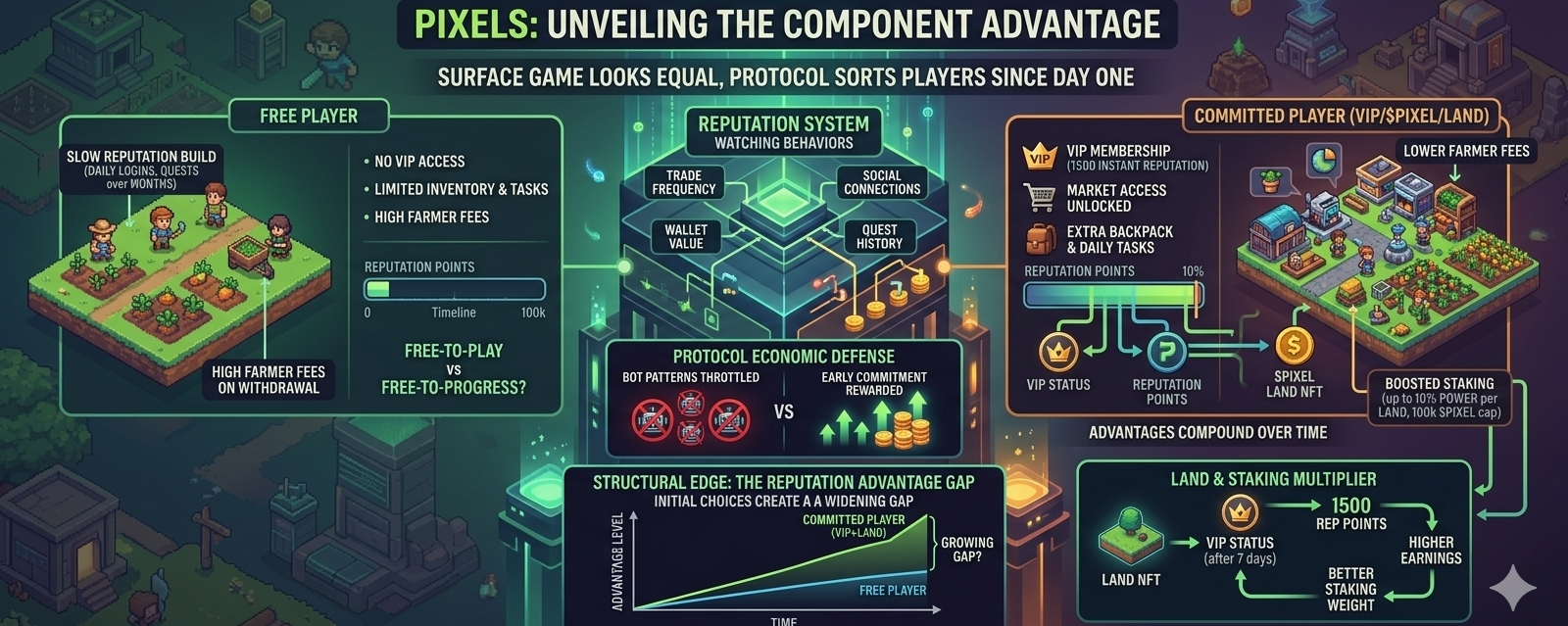
I almost scrolled past #pixel the first time I saw it. Farming game, cute pixel art, Web3 wrapper. I figured I'd seen this before. Planted a few crops, checked the task board, moved on with my day. Nothing about the surface suggested there was anything worth paying close attention to.
Then I started noticing something that didn't sit right with me. Two players logging in at the same time, doing the same things, ending up in completely different places by the end of the week. Same game. Same world. Different outcomes. And it wasn't about skill or luck. It was about decisions made before either of them got serious about playing.
Pixels is genuinely free to play. I want to say that clearly because it matters. You can log in today without spending anything and have a real experience. But there's a difference between free to play and free to progress, and Pixels is very deliberate about which one it actually offers. The core earning opportunities and the ability to withdraw tokens sit behind a VIP Membership purchased with $PIXEL. That one line explains most of the gap I kept noticing between players.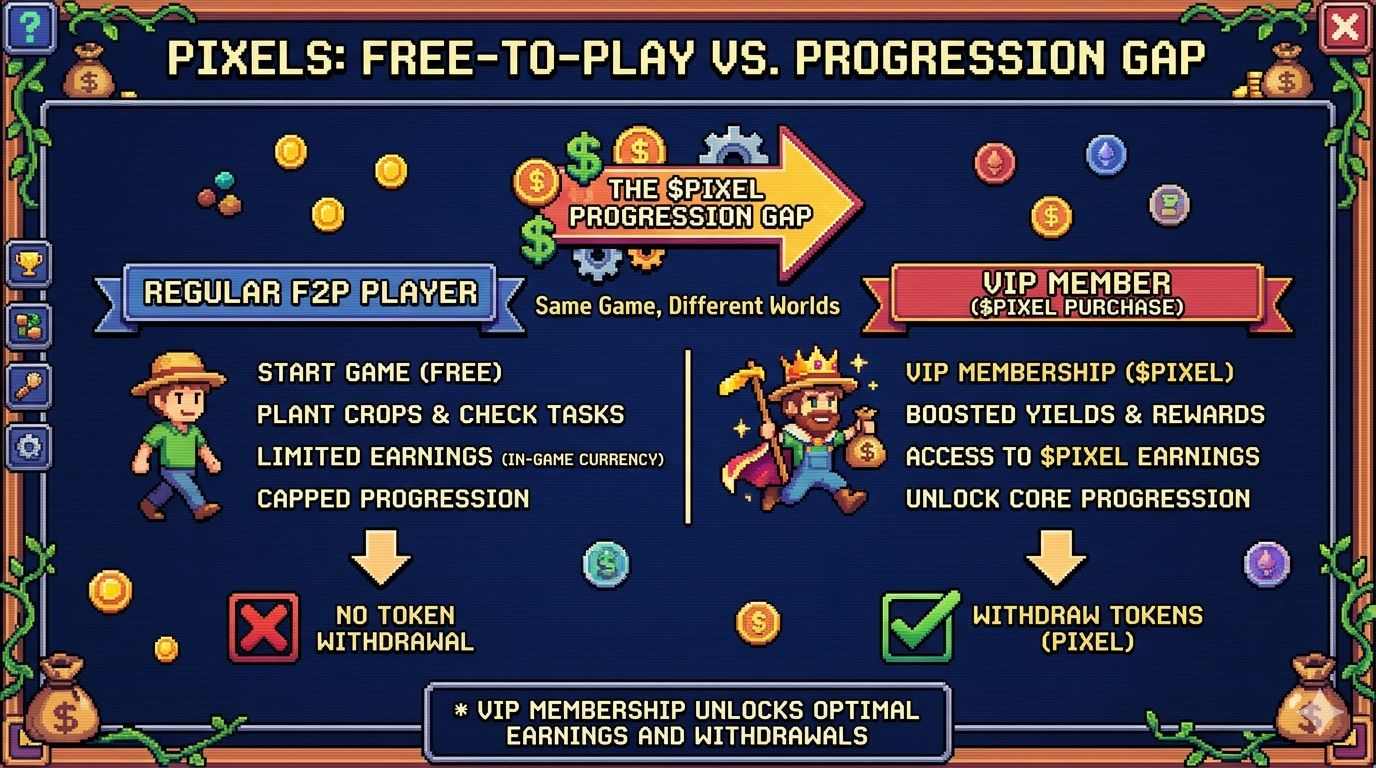
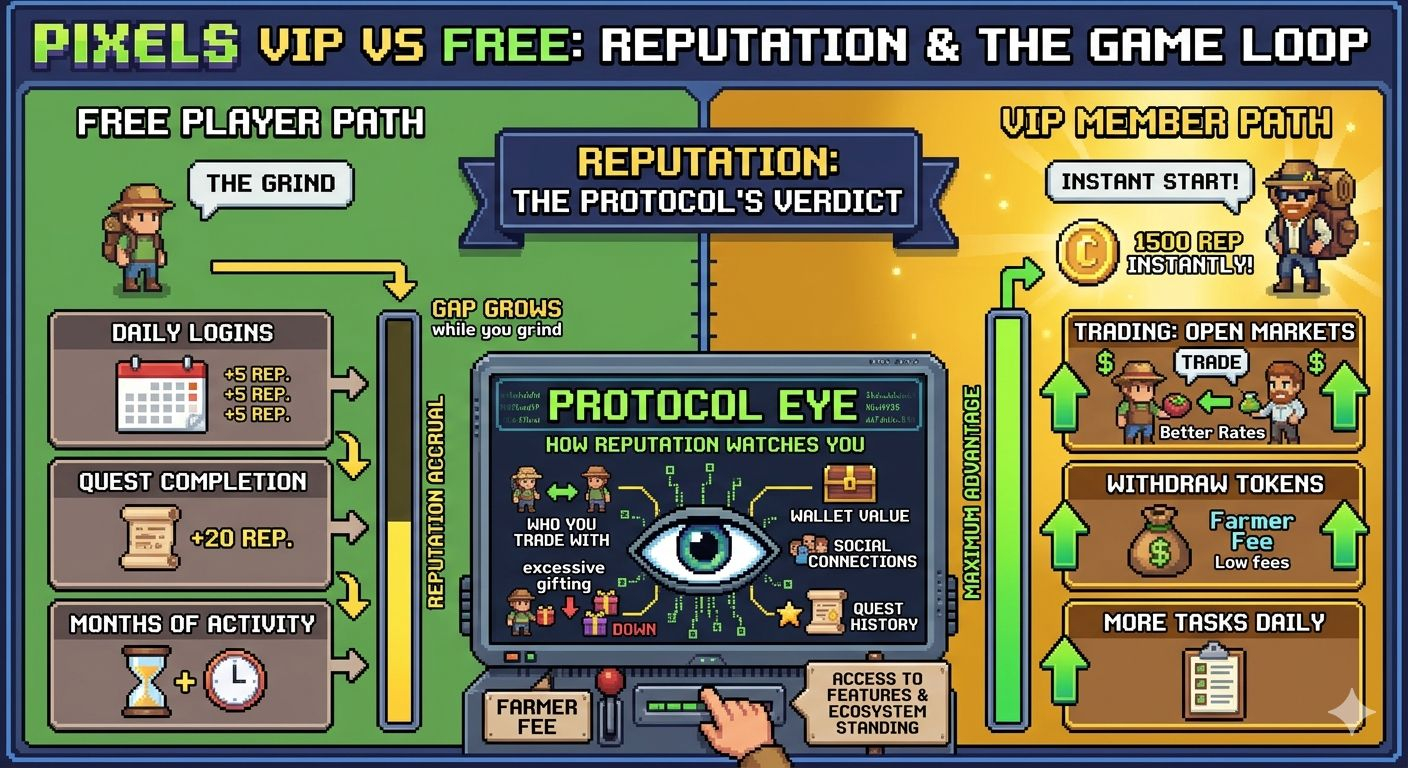
VIP members get extra backpack slots, access to exclusive areas, more tasks available each day, and are automatically handed 1500 reputation points, which opens up the player markets. The extra tasks and backpack space affect daily earnings directly. But the 1500 reputation points landing in your account instantly is the part that actually changes your trajectory. Because reputation in Pixels is not a cosmetic number sitting next to your username. It is the mechanism the protocol uses to decide what you're allowed to do and on what terms.
For a free player those same 1500 points come slowly. Without VIP you build reputation through daily logins, quest completions, and consistent activity over months. That path is real and it works. But while a free player is grinding their way up the reputation ladder, a VIP player is already trading on the market, withdrawing tokens at better rates, and completing more tasks every single day. The free player is not just behind. They are behind and the gap is actively growing while they work to close it.
What I didn't fully appreciate until I dug properly into the mechanics is how much the reputation system is actually watching. It tracks who you trade with, how often you trade, your wallet value, your social connections, and your quest history. Trading with low reputation users pulls your own score down. Excessive gifting hurts it too. This is not a simple points counter. It is a continuous behavioural profile being built on every account. The system is forming an ongoing opinion about what kind of participant you are, and that opinion affects your Farmer Fee when you withdraw, your access to features, and your standing in the broader ecosystem.
I think this design is genuinely clever for one specific reason. Bots and mercenary farmers behave in recognisable patterns. They trade too frequently, hold little wallet value, skip social connections entirely, ignore quests. The reputation system catches those patterns and throttles them before they do real damage to the economy. That is something most GameFi projects never figured out how to do. But the same system that protects the economy from bad actors also creates compounding advantages for anyone who committed capital early. VIP players and landowners start with significantly higher scores and those higher scores translate directly into lower Farmer Fees when withdrawing $PIXEL. Every withdrawal a VIP player made at a reduced fee rate over the past six months is an advantage that is now baked permanently into their position.
Land ownership is where this goes from interesting to structural. Each Farm Land NFT gives a 10% staking power boost per land, capped at 100,000 $PIXEL per land. So two people staking identical amounts of $PIXEL end up with different positions in the reward pool purely because one of them holds a land NFT. The token and the NFT are designed to multiply each other. Neither one alone gives you the full picture. Land owners also receive automatic VIP status after holding their plot for seven days. So one asset handles the work of two. Better staking weight, instant VIP status, 1500 reputation points, lower withdrawal fees, more daily tasks. All from a single holding decision.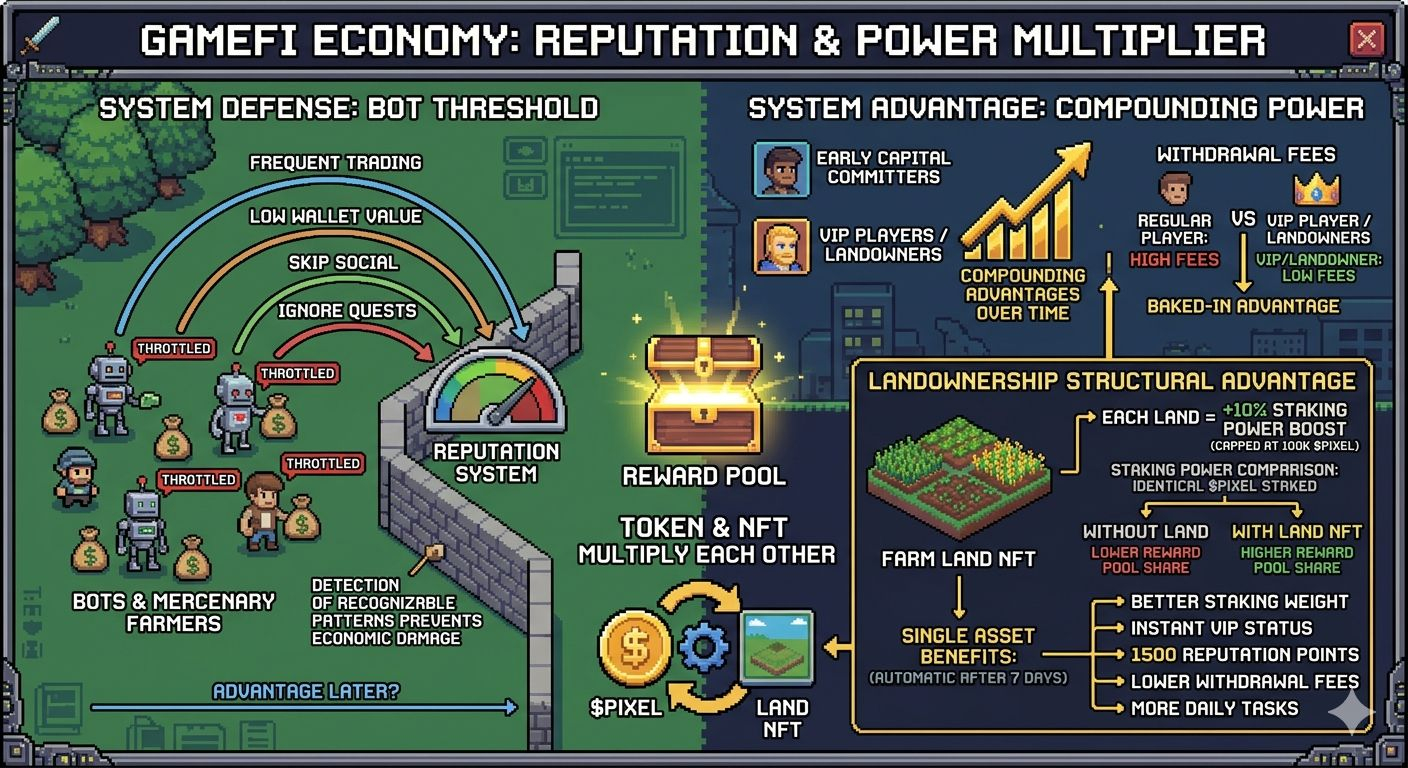
Most Web3 games I've watched fail because their paid advantages felt like tollbooths. Pay here to access this. Pay again to access that. Players put up with it during good markets and walked away the moment sentiment turned. Pixels wires the advantages differently. Spending $PIXEL on VIP or land doesn't feel like paying a toll. It feels like investing in your own position inside a system where that position compounds over time. The reputation you build lowers your fees. Lower fees mean more $PIXEL stays in your wallet. More $PIXEL means stronger staking weight. Stronger staking means better monthly rewards. Each layer feeds the next one quietly in the background while the game on the surface still looks like a relaxed farming sim.
Higher tier task board orders require advanced skill levels and VIP members have more potential tasks available each day. So even the raw earning rate scales with how long someone has been committed. A player who bought VIP eight months ago isn't just ahead by the value of that membership. They are ahead by every task they completed that a free player couldn't reach, every market trade they made while someone else was still unlocking basic features, every reputation point that accumulated while others were still at the starting line.
The game looks relaxed and it genuinely is relaxed to play. But the protocol underneath it has been sorting players by commitment level from the moment they arrived and that sorting gets more pronounced with every passing week.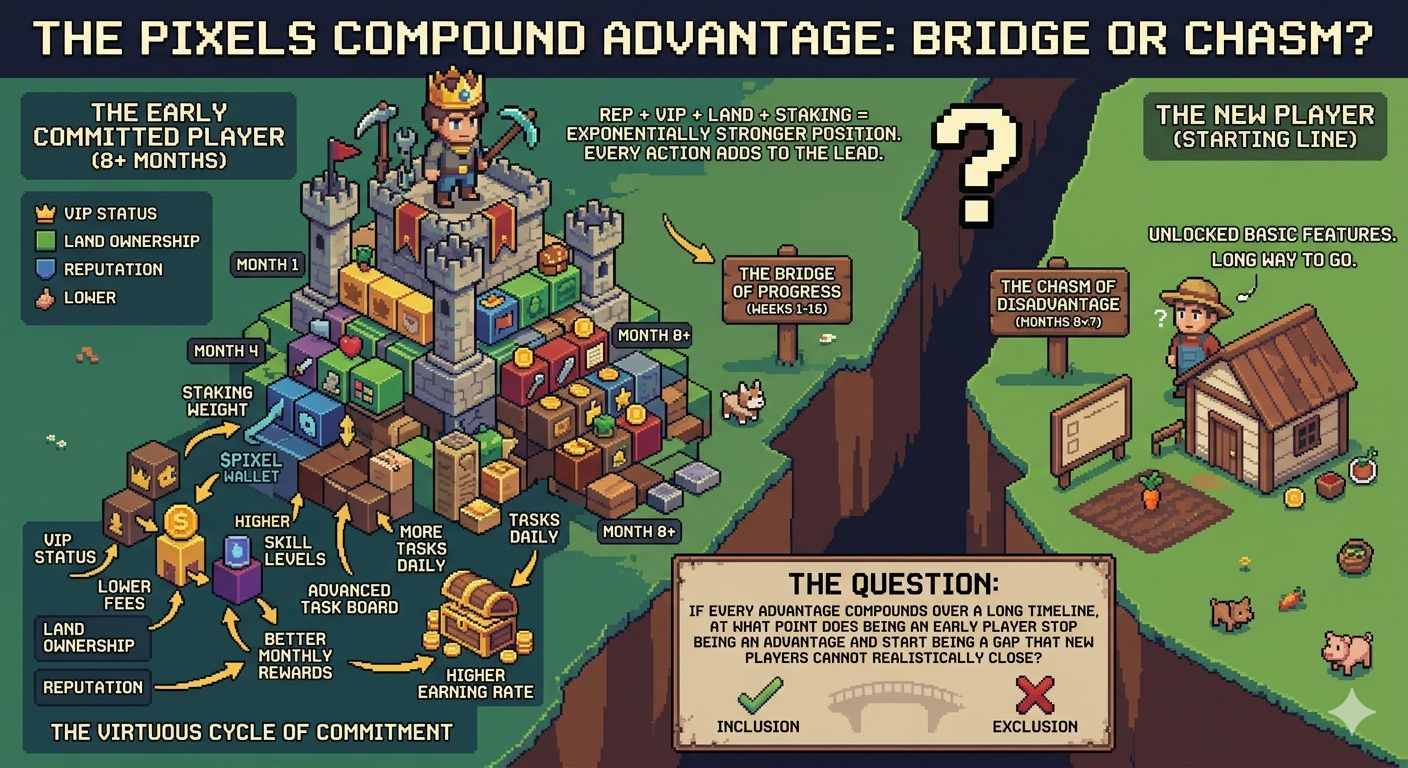
So here is the question I keep coming back to. If reputation, VIP tier, land ownership, and staking weight all compound on each other over a long enough timeline, at what point does being an early committed player in Pixels stop being an advantage and start being a gap that new players realistically cannot close?
