
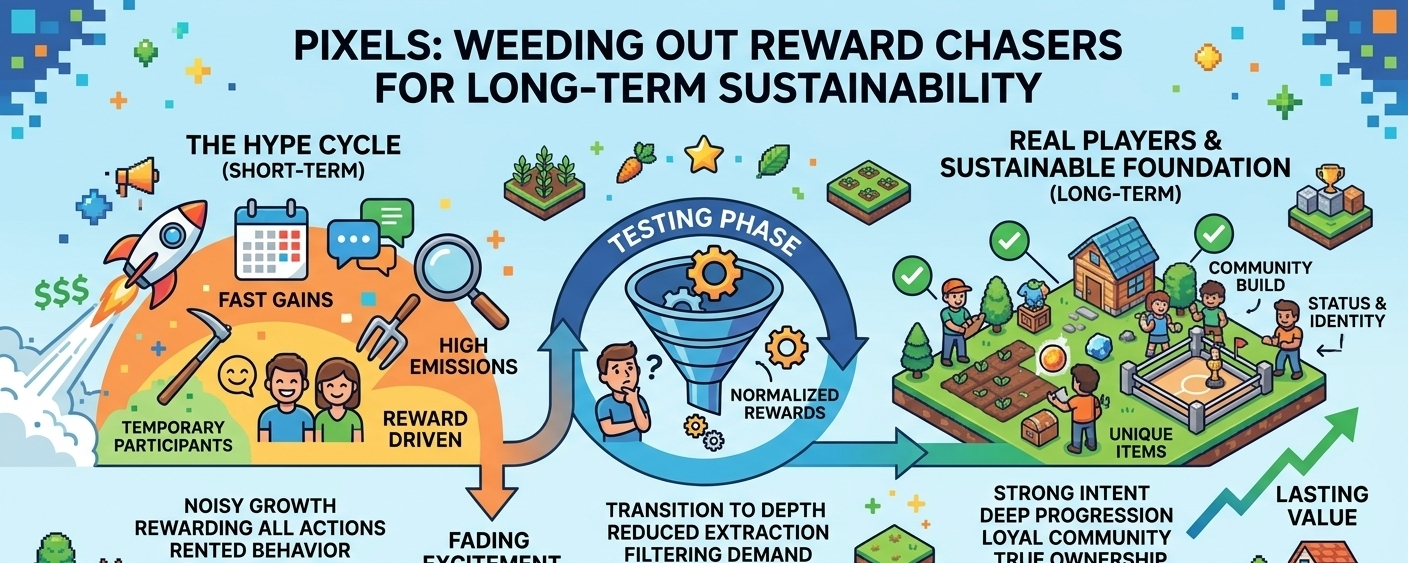
I did not take Pixels seriously at first. That is not meant as disrespect. It is just honesty. I have watched too many crypto gaming projects arrive with bright visuals, friendly branding, simple mechanics, and the same old promise hidden underneath everything: show up, stay active, earn rewards, repeat the loop. After seeing enough of those cycles, you stop reacting to surface aesthetics. You stop caring whether the world looks colorful, whether the characters are cute, or whether the roadmap sounds exciting. You start asking harder questions. Who is actually here for the game? Who is only here for the token? Who leaves the second the rewards tighten? That is where Pixels became more interesting to me.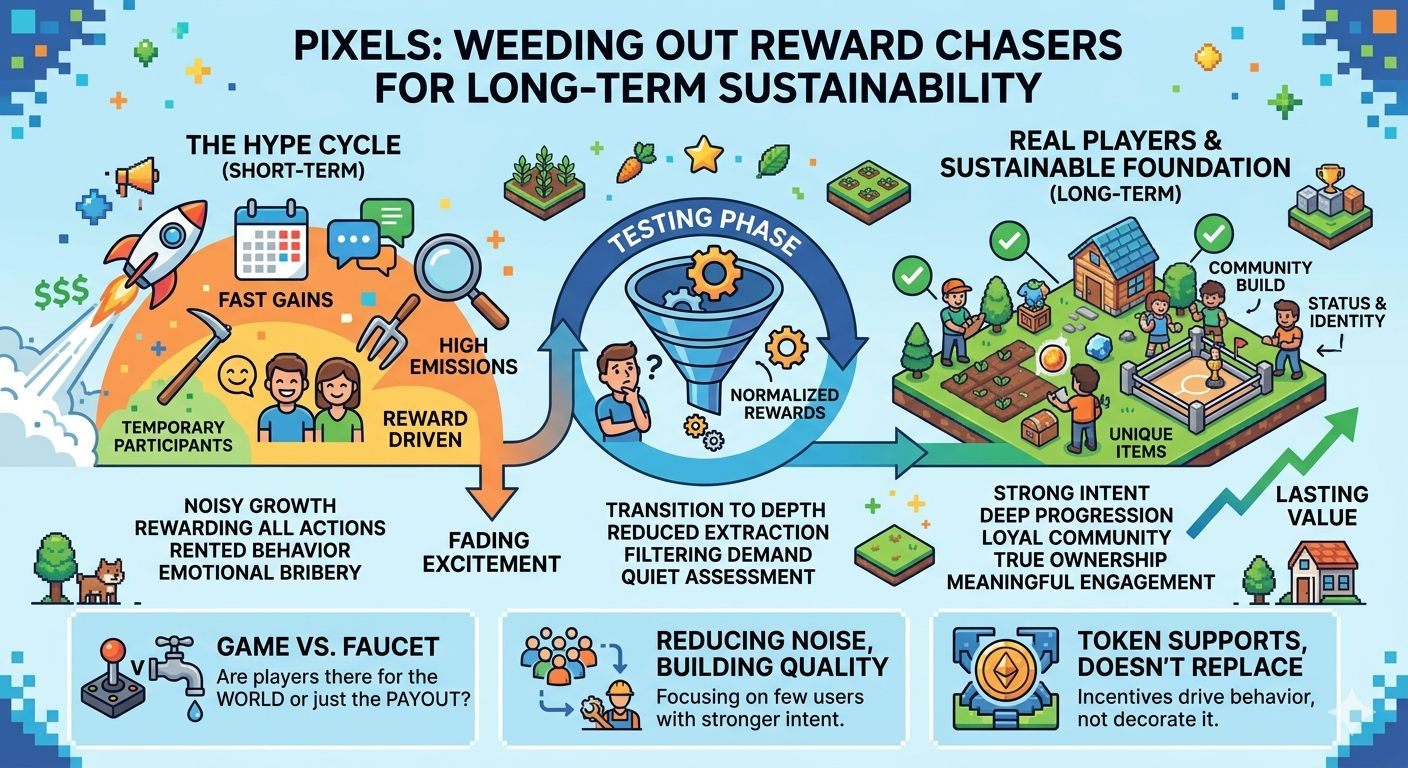
From the outside, it still looks harmless. Farming, land, crafting, pets, progression systems, routines, upgrades. It feels soft, casual, and accessible. But crypto has taught me something important: the softer a system looks, the more dangerous it can become once token incentives are attached to behavior. Because once rewards enter the picture, people change. They stop behaving like players and start behaving like economists. They stop asking what is fun and start asking what is efficient. They stop exploring the world and start optimizing extraction. That is not because users are bad. It is because incentives shape behavior faster than branding ever can. Pixels now seems to be facing that reality head-on.
I have seen this pattern too many times. First, a project launches rewards. Activity rises. Wallet numbers look strong. Social media gets loud. Everyone posts screenshots of earnings. Communities look alive. The charts show growth. Influencers call it the future of gaming. Then the rewards slow down. Suddenly the energy changes. People still log in, but less often. Communities become quieter. Conversations shift from excitement to complaints. The focus turns to emissions, token price, reduced earnings, and whether the team is still committed. Then the truth arrives. Many users were never players. They were temporary participants responding to incentives. That distinction matters more than most teams admit.
A user who came for entertainment can tolerate weaker rewards if the experience remains strong. A user who came only for extraction leaves the second the math gets worse. Most crypto games never survive learning the difference. Pixels appears to be learning it now. What caught my attention is that Pixels does not seem obsessed with paying every action forever. That sounds simple, but it is one of the hardest decisions any blockchain game can make. Because rewarding everything creates fake health. Every click looks like engagement. Every repetitive task looks like retention. Every daily login looks like loyalty. But if those actions only happen because a payout exists, then the system is renting behavior rather than building community.
That kind of growth feels good early and feels terrible later. A game cannot endlessly subsidize every loop without eventually draining value from itself. At some point, rewards must become selective. Some behavior should matter more than others. Some actions should create progression rather than payouts. Some users should gain identity, status, ownership, or meaningful advancement instead of constant token extraction. That transition is painful, but necessary. Pixels seems to be somewhere inside that transition.
Most people think the challenge is attracting users. I disagree. Attracting users with rewards is easy. Keeping users after rewards normalize is the real test. That is where projects discover whether they built a game or just built a faucet. Pixels has to answer a difficult question now: do players care about the world itself, or do they only care about what the world pays? Those are two completely different audiences. A real player values progress. They care about building land, collecting items, improving efficiency, competing socially, owning something recognizable, and feeling connected to a persistent world. A pure farmer values throughput. Time in, tokens out. If returns fall, loyalty disappears because loyalty never existed.
Whenever a project tightens rewards or changes incentives, complaints increase immediately. That reaction is predictable. If someone joined because the loop was profitable, then a weaker loop feels like a worse product. From their perspective, they are right. But from the project’s perspective, something else may be happening. The system may be filtering unsustainable demand. Not every user benefits long term. Some users generate noise, sell pressure, shallow metrics, and inflated expectations. They make dashboards look impressive but contribute little lasting value. When they leave, the numbers shrink, but sometimes the quality of the remaining base improves.
Crypto often misunderstands this because it worships visible growth. More wallets. More transactions. More volume. More mentions. But quantity without durability becomes expensive theater. Pixels may be choosing something harder: fewer users with stronger intent. That does not look exciting in the short term. Sometimes it is exactly what survival requires.
This is where many teams fail. They let the token become the main emotional reason people care. Once that happens, everything else becomes decoration. Land becomes a workplace. Tasks become shifts. Daily play becomes labor. Community becomes coworkers. The token becomes wages. That model collapses because wages are judged by market value, not by enjoyment. If earnings fall, morale falls with them. A healthy game economy needs the token to support the world, not replace it. Pixels needs users to spend because progression feels worth it. It needs scarcity to feel meaningful. It needs upgrades to feel desirable. It needs status, ownership, personalization, and competition to matter beyond pure payout. That is much harder than distributing rewards, but it is also more real.
I have followed enough gaming tokens to know when something feels familiar. The usual cycle goes like this: first comes the dream, then the farming, then the screenshots, then the calculators, then complaints about sustainability, then the team starts using words like long-term vision. By then, half the audience is already mentally gone. They may still be logged in, but they are waiting for one more exit opportunity. Pixels still has a chance to avoid becoming that story. But it has to deepen the world faster than it weakens the easy extraction loop. That balance is brutal. Too much reward and value leaks. Too little reward and people leave before the deeper systems matter. Too much grind and users feel exploited. Too little progression and the game feels empty. There is no elegant formula for solving this, only trade-offs.
Crypto loves noise. Loud communities. Sudden pumps. Constant announcements. Big participation spikes. But noise is often rented. Quiet phases tell you more. When rewards become less generous and attention cools, who remains? Who still builds? Who still upgrades? Who still returns daily without needing emotional bribery? That smaller, quieter base can be more valuable than a huge crowd chasing short-term yield. Markets usually realize this late. They celebrate hype and ignore retention quality until months later when one project still has a functioning core and others have empty metrics. Pixels may be entering that quiet test now, and that is why I think it deserves attention.
Pixels is not only fighting competitors. It is fighting habits crypto trained into users. Move fast. Farm rewards. Rotate early. Trust nothing. Take profit quickly. Leave before everyone else leaves. Those habits were rational in previous cycles. Users learned them because many projects deserved them. Now any serious game has to reverse that conditioning through design. That means rewarding contribution over repetition, meaning over motion, retention over traffic, and participation over extraction. Some people will reject that model. They want immediate returns. Others may adapt, and those users are usually the foundation worth building around.
I am not watching every small token move. I am not watching emotional social media posts trying to force bullish sentiment. I am watching behavior. Do players return when farming is less attractive? Do they spend inside the world for reasons beyond speculation? Do they care about land, identity, efficiency, prestige, progression? Does the ecosystem create value flows in both directions, from game to player and player back into the world? If yes, Pixels has something real. If not, it becomes another attractive machine designed to distribute temporary attention.
Pixels has not proven victory. It may still fail. The economy could weaken. Interest could fade. Progression systems could disappoint. Rewards could become too tight or too loose. Those risks are real. But I think many people are missing the bigger picture. The project does not need to prove that rewards attract users. Everyone already knows they do. It needs to prove that a world can survive after rewards stop doing all the emotional work. That is the real challenge. If Pixels manages to build a smaller, quieter, more committed player base while others chase loud temporary numbers, the market may notice much later than it should. Because crypto often mistakes noise for strength. Until one day the noise is gone, and only the real base remains.
