
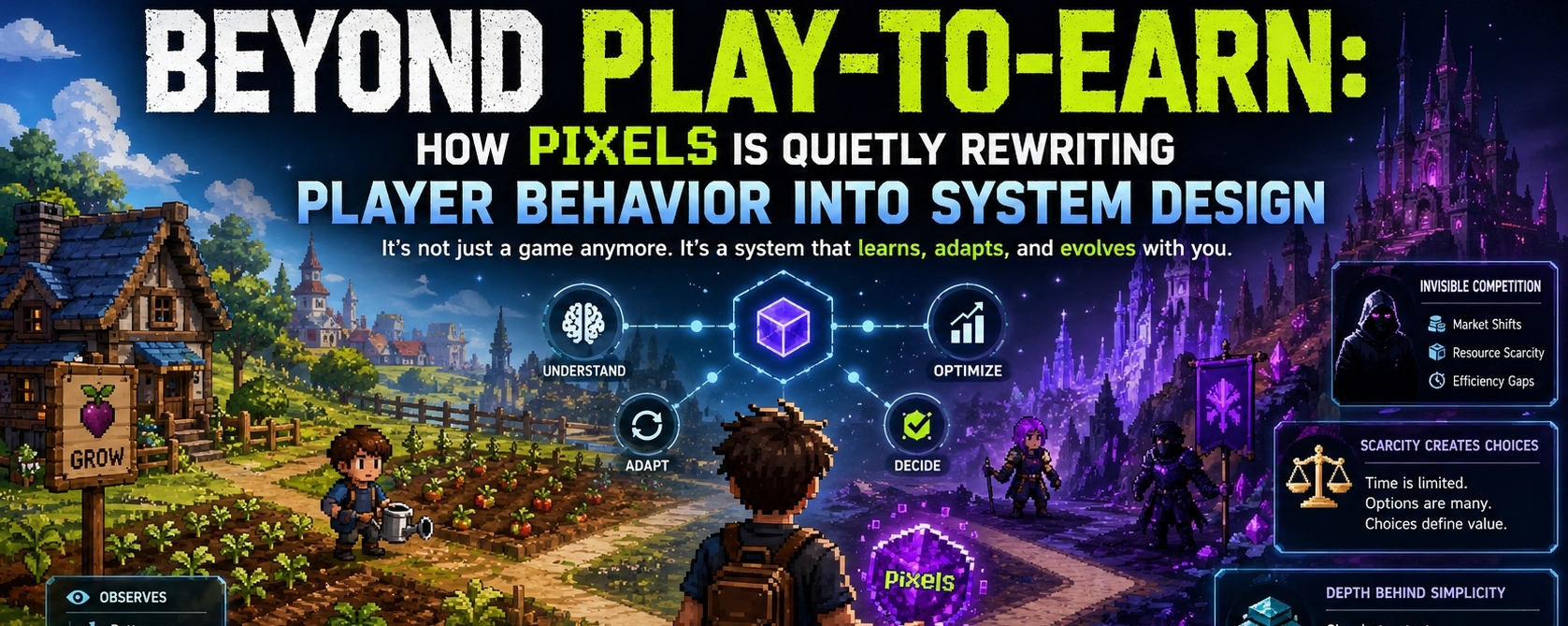
Sometimes it doesn’t feel like you’re playing a game anymore it feels like you’re participating in something that’s learning from you.
That’s the strange shift I’ve been noticing with Pixels lately.
Earlier, most systems in games were built for interaction you click, you earn, you move on. But now, it feels like Pixels is starting to observe patterns instead of just rewarding actions. It’s subtle, but once you notice it, you can’t unsee it.
Take progression for example.
It’s no longer just about upgrading tools or unlocking new areas. It’s about how consistently you show up, how you distribute your effort, and even how you adapt when the system changes. The game doesn’t just respond to what you do it slowly reshapes what you want to do.
And that’s where things start to feel different.
Because now, value isn’t only tied to grinding. It’s tied to understanding. Players who pay attention to timing, to market behavior, to small shifts in mechanics they start moving differently. Not faster… just smarter.
There’s also this quiet emergence of “invisible competition.”
Not the loud kind like PvP or leaderboards… but the kind where you know others are optimizing, adjusting, refining. You don’t see them directly, but you feel their presence through prices, resource availability, and efficiency gaps. It creates a pressure that isn’t forced it’s implied.
And that kind of pressure changes behavior more deeply than any rule ever could.
Another thing that stands out is how Pixels is handling scarcity.
It’s not just limiting resources it’s creating situations where choices matter more than availability. You can’t do everything at once anymore. You have to decide where your time goes, what you prioritize, and what you’re willing to ignore. That trade-off? That’s where real engagement begins.
But here’s the interesting part
Despite all this complexity, the surface still looks simple.
You can still log in, do a few tasks, and log out. But underneath that simplicity, there’s a layered system constantly evolving almost like it’s testing how far it can go without breaking the player experience.
And maybe that’s the real experiment.
Not “play-to-earn” or “free-to-play”
But “learn-to-adapt.”
Because the players who succeed here aren’t just active they’re aware.
They notice shifts early. They adjust before others. They treat the game less like a routine and more like a living system.
So the real question isn’t whether Pixels is a game or an economy anymore.
It’s this:
When a system starts shaping how you think… are you still playing it, or are you slowly becoming part of it?
I don’t think we fully know yet.
But one thing is clear this isn’t about simple loops anymore.
This is about depth that reveals itself only if you’re willing to look for it. 🚀