
I’ve been around long enough to recognize the early mood of a new system. It always feels lighter than it should. Cleaner. As if the rough edges that usually take years to show up have somehow been designed away.
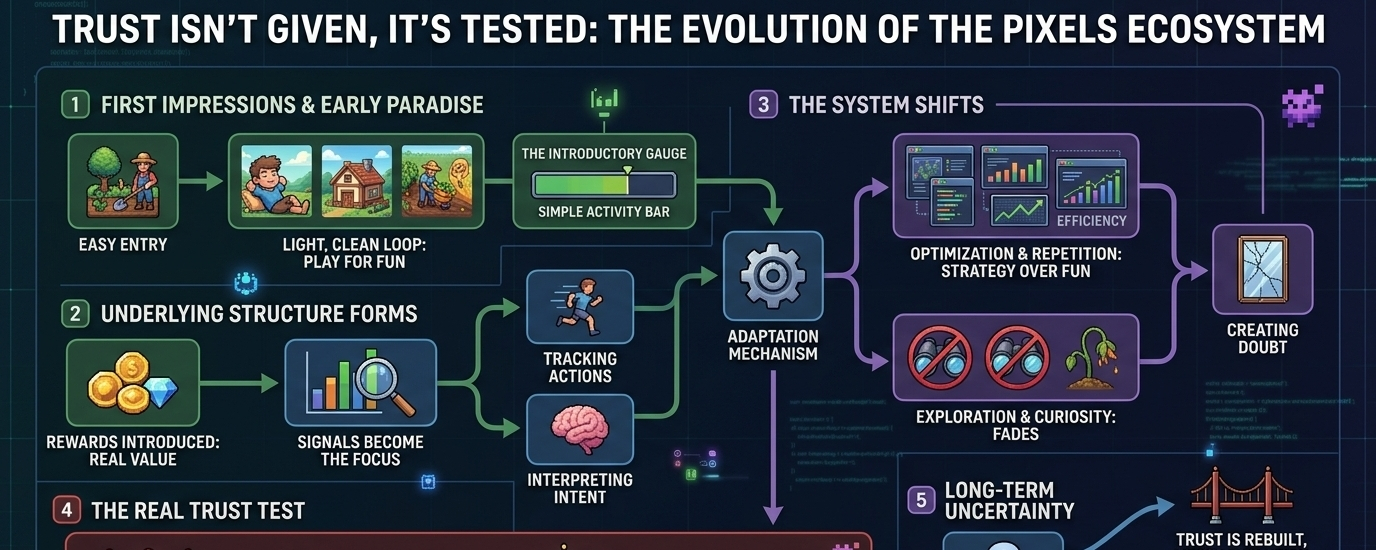
Pixels, at first glance, gives off a bit of that feeling. It’s easy to approach. Farming, collecting, building—nothing complicated. You move through it without friction, and for a while, it feels like the kind of environment where things just… work.
But I’ve learned not to stop at first impressions.
Underneath the gameplay, there’s a quieter structure forming—one that ties what you do to what you eventually get. Your time, your actions, your consistency—they start to look less like play and more like signals. Signals that the system records, interprets, and eventually rewards.
That’s where things begin to shift.
Because the moment rewards enter the picture—especially ones with real value—people stop behaving the way they did before. Not dramatically, not all at once. It’s more subtle than that. Curiosity slowly gives way to strategy. Exploration turns into repetition. And before long, someone figures out the most efficient way to extract value… and shares it.
From there, it spreads.
What Pixels seems to be building, whether intentionally or not, is a kind of evolving trust layer. Not just tracking activity, but trying to assign meaning to it. And that’s a much harder problem than it looks. It’s one thing to count actions. It’s another to understand intent behind them.
Is someone farming because they enjoy the loop? Or because they’ve optimized it to the point where enjoyment doesn’t matter anymore?
From the system’s perspective, both can look identical.
That’s where most of these designs start to strain. Early on, everything feels fair. Rewards align with effort, and effort feels genuine. But systems like this don’t stay in that state for long. People adapt. They always do. And they usually adapt faster than the system can respond.
I’ve seen credential-based systems try to solve this before. Track behavior, assign weight, distribute rewards accordingly. It sounds reasonable. But over time, something always creeps in—doubt.
Not loud, obvious doubt. Just small inconsistencies. A reward distribution that feels slightly off. A pattern that benefits a certain type of user more than expected. A quiet sense that maybe the system isn’t seeing things as clearly as it should.
That’s all it takes.
Because once people start questioning the process, they don’t stop at the surface. They start questioning the issuer too—the logic behind the system, the adjustments being made, the invisible hands shaping outcomes. And trust, once it starts to crack, doesn’t break cleanly. It splinters.
Some users lean deeper into the system, trying to stay ahead of it. Others pull back, assuming it’s already tilted. And then there are those who just watch—paying attention to how the system behaves under pressure.
Pixels is heading toward that same moment, sooner or later.
The real challenge isn’t building the system. It’s maintaining credibility once people begin testing it—intentionally or not. When players start pushing boundaries, creating multiple accounts, automating behavior, or coordinating actions to amplify rewards, the system has to respond.
And every response comes with trade-offs.
Tighten controls too much, and you risk shutting out genuine users who just happen to play differently. Stay too open, and the system becomes easy to exploit. There’s no perfect balance here—just constant adjustment.
What I find more interesting is how the system chooses to handle that tension.
Does it acknowledge its imperfections openly? Or does it try to smooth things over quietly?
Because over time, users notice patterns. They notice when rules shift. They notice when outcomes feel managed rather than earned. And once that awareness sets in, participation changes again—not out of curiosity this time, but out of calculation.
That’s the part people don’t like to talk about. Incentives don’t just reward behavior—they reshape it.
And in a system like Pixels, where behavior feeds directly into value, that reshaping happens continuously.
Still, I don’t think the goal here is to create some kind of instant, unquestionable trust. At least, it doesn’t feel that way. If anything, it feels like an environment where trust is meant to evolve—to be questioned, adjusted, and maybe even rebuilt over time.
That’s a more grounded approach. But it’s also messier.
There’s no guarantee that credentials will keep their meaning. No guarantee that rewards will always feel fair. And definitely no guarantee that users won’t eventually treat the system as something to optimize rather than experience.
But maybe that’s the point.
Systems like this don’t prove themselves at launch. They reveal themselves slowly—through pressure, through edge cases, through the way people interact with them when no one is watching closely anymore.
So I’m watching.
Not expecting it to fail, not expecting it to succeed. Just paying attention to how it changes when it’s no longer new. Because that’s when the real version of any system starts to show.
And Pixels isn’t there yet.